The Marriage “Periodic Inspection” (APK)
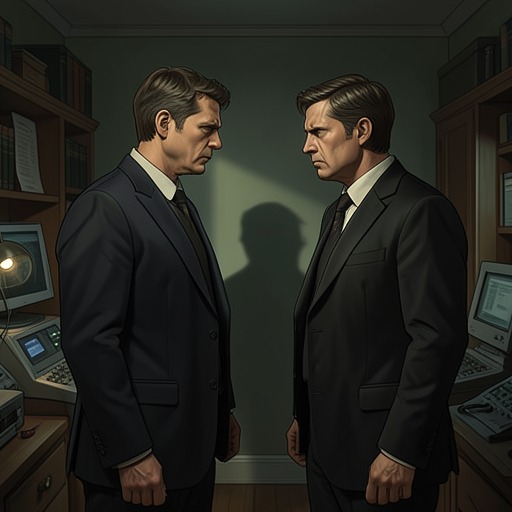
Mr. & Mrs. SmithThe Marriage “Periodic Inspection” (APK) is Jane Smith’s playful name for marital therapy, a metaphor that initially makes the Smiths’ visit sound like routine maintenance but gradually gives way to the seriousness of the crisis beneath it. The image of checking an engine and changing its oil becomes a frame for the novel’s movement between domestic complaints and lethal action, while Dr. Wexler’s invitation to write helps turn the couple’s private disorder into a story they can recognize and revisit.
A theory offered in the consulting room
Dr. Wexler presents the material as recordings of sessions with Mr. and Mrs. Smith, made from the first session of the previous month and summarized and transcribed by his assistant, Katrina Östlicher. His opening account emphasizes how composed the couple look: young, attractive, well dressed, polite, and intelligent. That professional surface makes the strain harder to read at first. When the conversation stalls, he deliberately lets the silence continue, reasoning that an uncomfortable silence can prompt nervous people to speak. The pause becomes part of the frame through which the couple’s guardedness is recorded.
Jane introduces the APK with a smile, but Dr. Wexler’s annotation suggests that John is hearing of the theory for the first time. He nevertheless plays along. He says they have been married for about five or six years; Jane corrects him to six. John then compares the appointment to an interim inspection of a car: a chance to look at the engine, change the oil, and replace a few valves. The mechanical analogy suits him, Dr. Wexler observes, while the disagreement over the number of years hints that even the history they share is not being described in quite the same way.
From light metaphor to private trouble
The name makes therapy sound manageable: marriage can be examined, serviced, and put back in working order. Yet Dr. Wexler later challenges Jane’s initial account of the visit. She has returned alone, and he asks whether this is really still an APK—or simply a charitable-auction prize she once impulsively decided to redeem. Jane looks at her hands and shakes her head. His question reframes the appointment: whatever the original explanation, she has come because she needs to talk.
Jane acknowledges that she and John are reasonably honest with each other, while also saying that both keep secrets. Dr. Wexler suspects she is withholding things from her husband, perhaps something important. Rather than demand a confession, he gives her written homework. She is to put her feelings on paper, but the exercise is explicitly private: it need not be polished, consist of complete sentences, or be shown to anyone, even the therapist. The purpose is self-understanding—finding out what is troubling her by beginning to tell herself her own story.
Writing as a way into the shared past
When Jane asks how to begin, Dr. Wexler directs her toward the beginning of the relationship: how the couple met and why she first fell in love with John. The prompt changes the emotional register. Jane gazes into the distance and finally smiles as she recalls something pleasurable, then identifies Bogotá, six years earlier, as the place and time of their meeting. The APK thus opens not only onto a diagnosis of present unhappiness but onto a remembered origin, allowing the marriage to be retold from its first encounter onward.
The book’s larger account repeatedly places everyday friction beside danger. John’s irritation over bringing home salted butter when Jane asked for unsalted butter is narrated through a mock-heroic image of a tortured knight set an impossible task by an ice princess; almost immediately, Jane changes the subject to new living-room curtains. Elsewhere, a small grenade falls through a ventilation opening, and the domestic scale of the object is made grotesquely comic by its resemblance to a toy from a Happy Meal. In the house, gunfire destroys Jane’s treasured teapot and kettle along with the kitchen. At a home-goods store, the couple confront a gun-wielding mascot among stuffed teddy bears. Such collisions make the APK’s maintenance language darkly ironic: the relationship’s troubles are discussed as if they were manageable household or mechanical defects, even as the narrative shows a marriage entangled with extreme violence.
A new beginning, not a completed repair
After the couple’s violent crisis, Jane comes into John’s arms. They hold each other, and John experiences the moment as waking from a nightmare to find that nothing is wrong. He calls it a new day and the privilege of beginning again. The language offers a renewal rather than proof that every difficulty has been permanently fixed; the idea of inspection remains an open-ended practice of returning to what has gone wrong and trying to speak about it.
Dr. Wexler’s closing account gives that practice a modest, concrete aftermath. He calls the case successful and points to the value of putting feelings on paper. After some time without seeing the Smiths, he receives their change-of-address notice, recognizes Jane’s handwriting, and reads a note thanking him from both Jane and John. He sends a fruit basket to congratulate them on their new home and reminds them that they still have one session remaining. The unfinished appointment quietly preserves the APK’s central implication: reconciliation is a beginning and an ongoing check-in, not a final certificate that the marriage needs no further attention.