The Smiths' Dinner Confrontation and Escape
Mr. & Mrs. SmithThe Smiths' Dinner Confrontation and Escape transforms a carefully prepared dinner into the point at which Jane and John recognize one another as armed opponents. A suspicious meal becomes a mutual test: their guarded gestures and coded remarks give way to the realization that each knows the other's secret, and then to an accidental shot, a pursuit, and a spectacular break from domestic routine. The scene makes the couple's home both a stage for their marriage and the first battleground of its collapse.
The Dinner as a Test
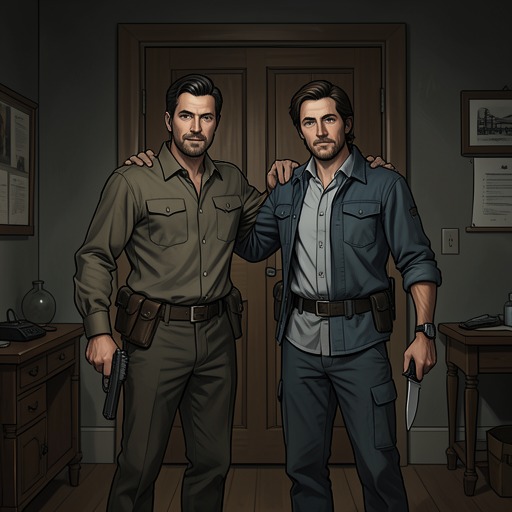
John arrives home braced for danger, one hand on his briefcase and the other in his pocket, where he is carrying a weapon. Jane's greeting, “Precisely on time,” catches him so sharply that he nearly shoots his own foot. She presses a fragile glass into his shooting hand, then bends toward him for a kiss. Neither closes their eyes. What should be an ordinary reunion is already a contest in which each watches the other for signs of a concealed attack.
Jane leads him to a dining room arranged with flowers, the best table linen, and several forks, as if they were entertaining royalty. The display echoes John's effort on the way home to plan the menu, choose the tableware and tablecloth, and consider buying flowers. He had wanted everything perfect for one last time, before everything fell apart. Their parallel preparation gives the scene its domestic tenderness, but its timing makes that care feel like a last performance staged under threat.
The threat is not merely imagined. From the dining room, John sees a bottle of drain cleaner on the kitchen counter and freezes with his martini close to his lips. At the table, they sit beyond one another's reach. Jane moves a potato onto his plate with a knife, bringing its blade uncomfortably close to his body, and says that things are not yet all right, though they will be. John wonders whether his food has been poisoned. The ordinary acts of serving dinner have become a language of menace, and neither spouse can safely take the other at face value.
Recognition and Rupture
The decisive shift comes when John sees Jane move with speed that does not belong to the domestic role he has assumed for her. A smile slowly spreads across his face. Their eyes meet again, and the knowledge passes between them: he knows, she knows that he knows, and she knows that he understands her awareness. The revelation is mutual rather than a one-sided unmasking. Their marriage's hidden structure—two people living together while concealing what they are—has suddenly become visible to both.
The moment does not produce a calm confession. They begin speaking at once, and the wine falls onto the immaculate cloth, leaving a blood-red stain. Jane offers to fetch a cloth, but the domestic problem has already changed meaning: the spill looks like a wound across the carefully prepared table. The scene lets a small household mishap carry the force of their broken cover and the violence now pressing into the marriage.
From the House to the Chase
Jane reaches the garage and opens its door. John hears it, runs through the house and out across the lawn, and blocks her car as she reverses from the drive. His attempt to stop her becomes physically awkward and dangerous: the gate gives way beneath him, he falls into mud, and the impact makes his gun fire accidentally. The sudden shot turns suspicion into open danger. As John observes, a bullet cannot be taken back once it has been fired; the domestic confrontation has crossed into an irreversible exchange of violence.
Jane drives off. John pursues her by cutting through neighboring gardens and ends up stranded atop a fence. Jane's car comes around the corner, her headlights catching him there; as the fence tilts and drops him into the mud, a bullet punches through her windshield. She believes John is trying to kill her and brakes hard. The sequence makes their failure to understand one another immediate and material: John's shot was accidental, but from Jane's position the bullet is an attack, and each new attempt to react compounds the danger.
John then realizes Jane's car has stopped beneath him. He kicks in a rear window and drops through the broken glass onto the back seat. He tries to make her listen, but she throws open the door and rolls out into an overgrown garden. The pursuit has become a collision of gestures: John's attempt to get close enough to speak looks like an assault, while Jane's escape prevents the explanation he is trying to make. Their tactical instincts overpower the conversation their marriage urgently needs.
Aftermath and Recurring Domestic Warfare
The immediate aftermath separates them rather than reconciling them. John, shaken and uncertain where else to turn, goes late at night to Eddie's home. When Eddie asks what happened, John answers that it was his wife. The brevity of that answer holds the contradiction exposed by the dinner: the person who should be closest to him is now the person from whom he has fled. Jane, meanwhile, goes to the projection room at Triple Click, where Jasmine is still present late at night. Each seeks refuge in the professional world that had been hidden from the other.
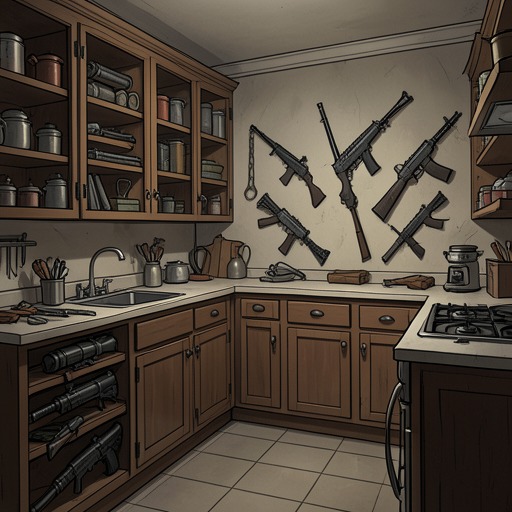
The dinner's collision of household routine and lethal stakes recurs elsewhere in the couple's conflict. During their later office confrontation, a small grenade drops from a ventilation opening; John calls it a “Barbie grenade,” making a toy-like domestic image the measure of an immediate threat to life. In the later gunfight at home, John fires through the kitchen, shattering glasses, throwing open cabinets, and destroying Jane's treasured teapot and its matching kettle. Jane pauses to look at the wreckage of her favorite room before turning back toward him. The home that first served as the polished setting for a suspicious dinner becomes an actual field of destruction.
The pattern reaches a public setting in the home-goods store: what begins as a clash with an undercover agent becomes a larger, exposed shootout amid the store's merchandise. Jane and John each fire into Homey's oversized stuffed head, and the mascot's concealed shotgun blasts the ceiling. These later scenes extend the dinner's central reversal: domestic things—food, glassware, kitchen objects, toys, and household displays—do not shield the couple from violence but make its intrusion newly visible. At dinner, the most intimate danger lies in recognizing that a spouse may be an enemy; in the scenes that follow, the private war spills into rooms and places that were never meant to contain it.