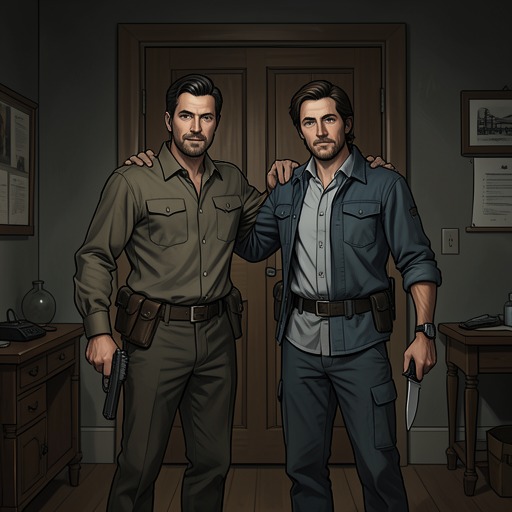
The Spouses' Identities Revealed and Mutual Assassination Assignments
Mr. & Mrs. SmithThe Spouses' Identities Revealed and Mutual Assassination Assignments marks the rupture between the Smiths’ domestic life and their secret work: Jane discovers that her designated target is John, and John decides that his assignment is to kill his wife. The contrast between ordinary marital irritations and professional violence gives the turn its bitter comedy, while making the marriage itself the ground on which both missions collide.
Causes and Revelation
The change begins when Jane tells Jasmine that the spy they have been ordered to kill—the man who had tried to kill Jane—is someone she knows, in relative terms: her husband. Jasmine is astonished by the coincidence, but quickly frames the disclosure in the blunt terms of the job: Jane does not love him, she should kill him, and nobody can do it better. Jane gives no answer. Her fiddling with her wedding ring makes the conflict visible in a small gesture: the assignment has reached directly into the symbol of the relationship it demands she destroy.
The danger sits uneasily beside the couple’s familiar household life. John’s private frustration over salted butter becomes a miniature portrait of their domestic mismatch: he has brought the wrong kind, Jane waves away his apology, and he imagines himself as a knight set an impossible task by an ice princess. Her attempt to change the subject to new living-room curtains does not resolve the irritation; it shows how quickly their shared home can return to routine without addressing the distance beneath it.
John’s Decision
After hearing the painful details, John’s friend Eddie first gives him a few told-you-so remarks, then advises him to get Jane out of the way. John immediately agrees that this is the only solution. The decision is staged with deliberately absurd domestic detail: beside a cookie jar, nearly rancid cheddar, and an open mustard pot, John takes a machine gun from Eddie’s kitchen counter and asks to borrow it. Eddie assents casually, and John rushes out, recast by the narration as a half-baked macho commando on his way to kill his wife.
That bravado is already unstable. As John leaves into the cool evening air, a voice tells him to stop, though he cannot tell whether it is the stars or a schizophrenic voice in his head. The moment interrupts his simple, self-assured performance of the assignment: even as he arms himself and commits to action, the narration exposes a hesitation that the mission’s blunt logic cannot contain.
Domestic Life Under Threat
The assassination plot is set against the couple’s competing efforts to manage their marriage. On the way home, Jane plans dinner in exacting detail—menu, dishes, tablecloth, perhaps flowers—and wants everything perfect one last time before it all falls apart. The title of the household instruction, “The food will be ready at seven,” makes the dinner plan sound like a promise of ordinary order even as its accompanying intention points toward an ending.
The marriage’s erotic and comic registers also persist amid the violence. In a scene involving a client, Jane adopts a teasing, commanding tone, asking whether Marco has been a bad boy; the bed shakes when he nods meekly. The episode’s sexual playfulness and the subsequent assignment against John occupy the same narrative world, where performance, control, and danger are never cleanly separated.
Violence Turns Domestic
The threat becomes physical in scenes that make violence look grotesquely out of place among household objects. A small grenade drops through a vent and rolls across the floor. It resembles a cheap toy from a Happy Meal, a Barbie grenade, but John recognizes that it is real; with only milliseconds between him and death, there is no time for his brain to send his legs running. The childish appearance of the weapon sharpens rather than softens the danger: lethal work arrives disguised as something ridiculous.
At home, John’s attempt to preserve the domestic ritual of cake gives way to gunfire. He moves toward the dining room while shooting, shattering glasses, flinging cabinets open, and hitting Jane’s cherished teapot and its companion kettle. Jane pauses to take in the destruction of her favorite room—appliances, cabinets, decorations—before turning toward him with a furious look. The kitchen, once a site of small failures and household expectations, becomes the material record of their conflict.
Consequences and Significance
The collision between the couple’s assignments and their marriage does not remain private. At a home-goods store, a confrontation that should have been a skirmish with an undercover agent escalates into a major public incident. Jane and John move through the store as agents close in; passing a bin full of teddy bears, they see Homey, the life-sized store mascot, rise with a house-shaped hat, a mustache, and a sawed-off shotgun. Without hesitation, both shoot the oversized stuffed head, and the mascot’s weapon discharges into the ceiling as he falls backward into the bin.
Across these moments, domestic props repeatedly cross the boundary into danger: the wedding ring accompanies Jane’s discovery, dinner becomes a last bid for perfection, Eddie’s kitchen supplies sit beside John’s borrowed machine gun, and the store’s mascot conceals a firearm. The event’s defining reversal is not simply that two spies become enemies; it is that the routines and objects of married life remain present as the spouses are assigned, and begin, to attack one another. Their professional roles make killing seem like a solution, while the recurring details of the home expose what that solution would destroy.