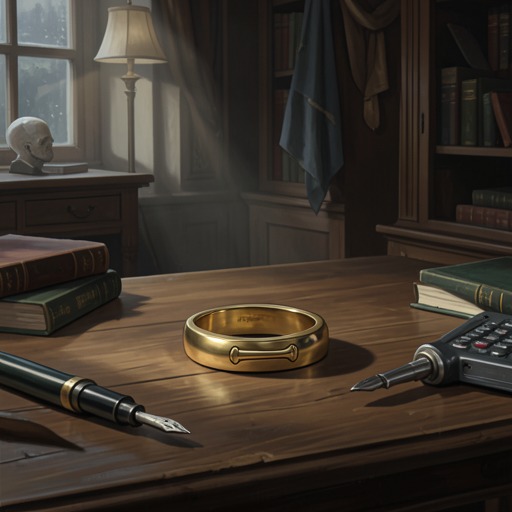
Till Death Do Us Part
Mr. & Mrs. SmithTill Death Do Us Part is the wedding vow that Jane Smith and John Smith’s story turns into dark irony. Spoken as a promise of enduring union, it acquires a harsher meaning when their marriage becomes a war involving real weapons and explosives: neither can simply leave the other behind, and surviving the conflict is not the same as escaping its emotional consequences.
The vow against the marriage
John reflects that marriages can end over disputes far smaller than the conflict he and Jane have endured. The contrast sharpens the vow’s double edge: their relationship has not merely weathered arguments but become a battlefield, with the language of marital permanence shadowed by the possibility of death. He describes their estrangement through the logic of combat, in which neither side takes prisoners or leaves witnesses.
The familiar formula sounds different in that context. John notes that people rarely think about the words Till Death Do Us Part when they say yes in the heat of passion. The vow’s ordinary, ceremonial promise collides with the extraordinary violence of the Smiths’ married life; its endpoint, death, is no longer remote from the relationship but part of its practical stakes.
Literal violence and domestic life
The book repeatedly brings the language of marriage into contact with the couple’s dangerous double life. In one domestic exchange, John inwardly casts himself as a suffering knight sent on an impossible quest by an ice princess: Jane is dissatisfied with the salted butter he has brought, although he believes he has followed her instructions. She brushes aside his attempted apology and says she will manage, then changes the subject to new living-room curtains. Mundane household preferences and strained communication coexist with the larger danger surrounding their marriage.
That collision becomes far less metaphorical when a small grenade drops from a ventilation opening and rolls across the floor. John recognizes that the object is real rather than a toy and calls out that Jane is dead. The abrupt shift from teasing to imminent death gives the vow a physical, immediate resonance: the couple’s playful talk takes place within a world where a joke can give way to an explosive threat in seconds.
Domestic objects as casualties
During their armed confrontation, John fires as he moves toward the dining room. The shots shatter glasses, burst open cabinets, and strike Jane’s cherished teapot and its companion kettle. The destruction is not confined to abstract symbols of marriage: familiar possessions and a favorite room become casualties of the couple’s conflict. Jane pauses in disbelief to take in the wreckage of her kitchen before turning back toward John.
The scene makes domestic life both the setting and the material cost of their war. A teapot carefully treasured in ordinary life cannot remain outside the violence that has entered the home. The vow’s promise of a shared life survives as a bitter contrast to the household being dismantled around the spouses.
Survival without simple resolution
After the fighting, John reflects that he and Jane have fought their peculiar game of love and war to its end. He believes he has won, but immediately qualifies that victory with the fact that he is lucky to be alive. His account makes survival the most literal possible fulfillment of a vow organized around death, while refusing to present survival as uncomplicated triumph.
The closing image of an untouched place setting and an empty chair beside a luxurious white tablecloth keeps that qualification in view. Against the pristine table, the absence of the other person becomes a taunt. The words Till Death Do Us Part therefore hold together two truths that the relationship cannot neatly reconcile: the spouses have driven their conflict to the edge of death, yet the language of their bond still measures what their violence has put at risk.