Barbie en Ken
Mr. & Mrs. Smith“Barbie en Ken” names the glossy ideal-couple image that John and Jane Smith project and exposes the distance between that image and their private life. The comparison begins as a joke about perfection; it becomes a compact emblem of a marriage whose picture-perfect surface hides concealment, resentment, and danger.
The Ideal Couple on Display
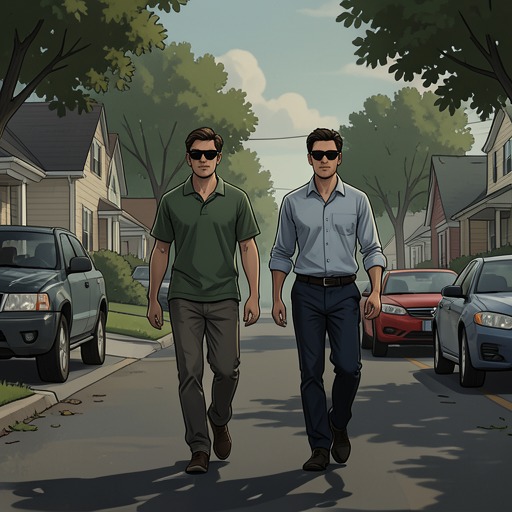
In a conversation about marriage, the Smiths smile at each other before turning back to their questioner. The narrator sees them as “the perfect happy couple,” then compares them to Barbie and Ken. The sequence turns the couple’s apparent harmony into a recognizable manufactured image: attractive, coordinated, and complete at a glance. The comparison is not simply praise. The narrator is beginning to understand where the conversation is leading, and the perfect-couple pose is about to be examined rather than accepted at face value.
A Suburban Dream and Its Façade
The image returns in Jane’s account of neighborhood life. At barbecues and holiday parties, people treat John as a lucky husband and regard Jane with envy; some men even try to corner her in the kitchen. Jane reflects that these acquaintances would be surprised to learn that she and John live like Barbie and Ken, and that their dream home is only a façade. The contrast is pointed: the neighbors’ admiration confirms that the performance works, while the couple’s concealed reality makes the ideal look hollow.
Jane’s disillusionment is not simple rejection of suburban life. She acknowledges that the neighbors are mostly kind, if dull, and that this ideal world was one she had dreamed of when she was young. The façade therefore covers more than a marriage in crisis: it is also the outward form of a life Jane once wanted. Her fatigue with the performance coexists with attachment to the dream it represents.
Domestic Comedy and Covert Conflict
The Barbie-and-Ken image also sharpens the book’s collision of household routine and espionage. A disagreement over salted rather than unsalted butter becomes a miniature marital failure: Jane waves away John’s apology and says she will improvise, while he inwardly casts himself as a tormented knight sent on an impossible errand by an ice princess. The domestic exchange is comic, but its mismatch of expectation and response gives the polished couple’s daily life a prickly, adversarial edge.
That edge can turn abruptly lethal. During a confrontation, a small grenade drops through a ventilation opening; its toy-like appearance prompts the narrator to think of a Barbie grenade, but it is real, and John calls out that the other person is dead. The name of the doll-world thus enters a scene in which make-believe offers no protection. Elsewhere, John’s attempt to get through the house destroys the kitchen: glasses burst, cupboards fly open, and Jane’s treasured teapot and its companion kettle are hit. The room that held the couple’s everyday domestic objects becomes a casualty of their armed conflict.
The Image Reversed
In the final store escape represented in the evidence, the couple’s violence breaks into public view. As they pass a bin full of teddy bears, the store mascot Homey springs up, wearing a house-shaped hat and carrying a sawed-off shotgun. John and Jane each shoot him in the head; his weapon fires into the ceiling as he falls. What should have been a skirmish with an undercover agent becomes a major public event. The domestic symbols—the home-shaped mascot and stuffed toys—no longer decorate a safe, idealized setting. Like the Barbie grenade, they are caught up in real danger.
Across these moments, “Barbie en Ken” shifts from an image of apparent perfection to a measure of the gap between appearance and lived reality. Its force comes from the repeated collision of toys, household objects, and suburban ideals with resentment and gunfire: the couple may resemble a flawless display, but the life behind it is neither simple nor safe.