Dr. Wexler
Mr. & Mrs. SmithDr. Wexler is the couples therapist whose recorded sessions frame the Smiths’ marriage as both a clinical case and a story being assembled from testimony. His questions and writing assignments give Jane and John room to describe what their courteous public manner conceals; his notes, meanwhile, let the reader see how a professional observer tries to interpret them. By the end he judges the case successful, but the couple’s farewell and his rueful expectation that they will not return leave the meaning of that success deliberately light-footed.
Identity and First Impressions
Dr. Wexler introduces himself as the therapist whose recordings cover sessions with Jane Smith and John Smith beginning the previous month. His assistant, Katrina Östlicher, has summarized and transcribed the tapes, adding annotations about the patients’ expressions and body language to his own notes. The story therefore reaches the reader through more than one layer of mediation: spoken sessions, a prepared transcript, and the therapist’s observations of what the speakers do as well as what they say.
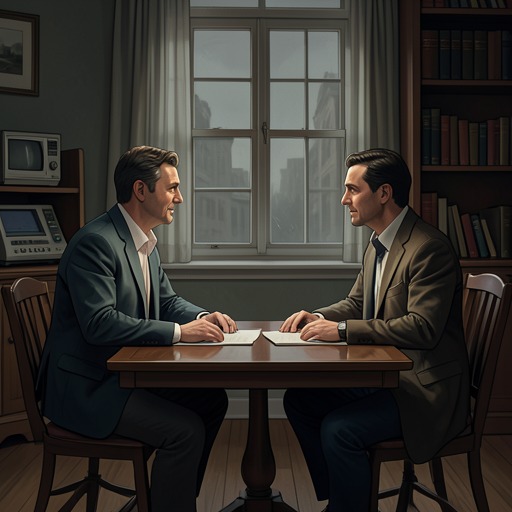
When the Smiths first enter his office together, Dr. Wexler is surprised. They are younger than the couples he usually sees, attractive enough to resemble film stars, well-groomed, neatly dressed, polite, and apparently intelligent. They laugh, and he thinks they could be taken for an ideal couple. Their visible courtesy contrasts with the more openly angry or volatile pairs he is accustomed to treating. He notices John pulling out Jane’s chair and Jane thanking him, but these gestures offer no obvious explanation for why two people who seem so composed need a marriage therapist.
Separate Sessions and Questions
The apparent harmony does not resolve Dr. Wexler’s uncertainty; it directs his attention toward what is not being disclosed. In Jane’s second session, she arrives hesitantly and apologetically, shifts her posture repeatedly, and fidgets with her wedding ring. Dr. Wexler asks how honest she is with her husband. Her answer distinguishes outright lies from the private secrets each spouse may keep, while his notes record his impression that she is concealing something important. He presents that impression as a suspicion, not as knowledge.
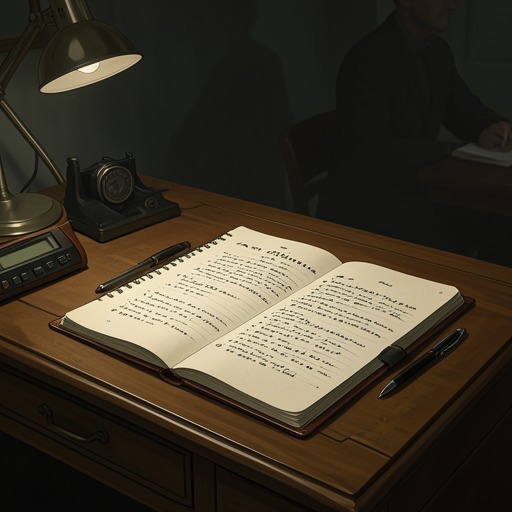
Dr. Wexler assigns Jane the task of putting her feelings on paper. When she worries that she is not a writer and is too busy with work, he lowers the stakes: it need not look good, use complete sentences, or be shown to him or anyone else. The point, he explains, is self-understanding—sometimes a person does not know what their own story is until they tell it to themselves. When Jane asks how to begin, he suggests writing about how she and her husband met and why she first fell in love with him. Her attention turns to Bogotá six years earlier, and a troubled present opens into a remembered beginning.
The private appointments reveal that Jane has not told John she is attending alone; she wants to avoid worrying him or making him think that something is wrong. Dr. Wexler recognizes this as one of the secrets between them. But the arrangement is reciprocal in an unexpected way: John has also called to make an appointment without Jane knowing. Dr. Wexler records the separate session, and his clinical frame becomes a device for disclosing that neither spouse is the only one privately seeking help.
Writing the Marriage into View
The writing assignment extends beyond the couple’s past. John reports that writing about Bogotá was difficult and that Dr. Wexler now wants him to write about the present and their marriage. John recounts the therapist’s view that he has put away things he does not want to think about or has never processed, and that writing may be a way to work through them. The therapeutic method is modest rather than dramatic: return to an experience, give it words, and see what becomes legible when it is no longer left unspoken.
The transcripts set that method against the small domestic scenes in which estrangement has accumulated. Jane’s account of the curtains describes her frustration that John seems not to care about the house or about her; his muted response leaves her feeling invisible. John’s account of the salted butter she did not want turns an everyday shopping mistake into another instance of his feeling that he cannot satisfy her. Dr. Wexler is not present in those household moments, but his invitation to write makes their differing accounts available side by side: routine that one spouse experiences as neglect can register to the other as an impossible test.
The therapeutic frame also creates a pointed contrast between ordinary marital friction and the extraordinary violence concealed beneath the Smiths’ domestic life. The narrative can move from a complaint about butter or curtains to a grenade rolling out of a ventilation opening, and from Jane’s painstaking plan for a perfect dinner to the destruction of her cherished kitchen. Dr. Wexler’s transcripts do not make those worlds identical; they put them into the same case history, where the gulf between a polite couple’s surface and their actual lives becomes part of the dark comedy.
Case, Reconciliation, and Farewell
After the couple’s crisis, John describes a new day and the chance to begin again; the two hold each other, and he asks Jane how things are going in IT while offering her fruit. Dr. Wexler later takes the Smiths’ case as evidence for his belief in the usefulness of putting feelings on paper. His concluding judgment is that it was a very successful case, linking the couple’s renewed beginning back to the writing and self-examination he encouraged.
The ending gives that professional conclusion a domestic, lightly comic coda. Dr. Wexler has not seen the Smiths for some time when a change-of-address notice arrives. He recognizes Jane’s handwriting and reads her thanks, signed with affection by Jane and John. He sends a fruit basket to congratulate them on their new home and a card reminding them that they still have one session left. Yet he doubts they will come back. His final joke—that if every married couple were like the Smiths, he could close his practice—recasts the apparent success of the treatment: the couple may have found a way forward together, but their extraordinary case is hardly a model of ordinary marital trouble.
Narrative Role
Dr. Wexler’s importance lies as much in the way the story is told as in what he does within the therapy sessions. His recordings and annotations establish an observing, sometimes bemused voice, while Jane’s and John’s accounts supply the intimate and conflicting perspectives his first impressions cannot provide. The gap between the polished couple he sees and the secrets they disclose makes his uncertainty a structural feature of the narrative: he must ask, listen, and revise rather than infer the marriage from appearances.
The writing exercise gives that structure a clear principle. Memories and domestic grievances become narratable through prompts and private acts of writing, while the transcript allows the reader to encounter those accounts as pieces of a case that Dr. Wexler is still trying to understand. His closing approval is sincere, but the unused appointment and his expectation of no further visits keep the ending from becoming a clinical triumphalism. The couple leave his files with a new address; he is left with a successful case and a story he suspects will not continue in his office.