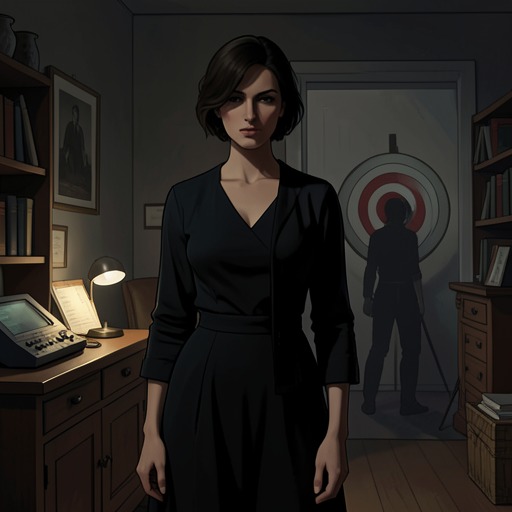
Jane Assassinating Marco Rasin and Escaping the Hotel
Mr. & Mrs. SmithJane Smith’s assassination of Marco Rasin is a compact demonstration of how her domestic façade and professional violence occupy the same life. In a hotel suite high above New York, she uses a staged flirtation to get close to an arms dealer, kills him when she confronts him with his trafficking, and escapes down the side of the building on a line hidden inside her bag. The scene’s defining reversal is not simply that the apparent date is an assassination: Jane’s calm, ordinary exit depends on the same performance of conventional femininity that helped her approach her target.
The Domestic Mask and the Assignment
The episode’s tonal counterpoint is established through household frustration. Jane has asked for unsalted butter, but John brings home salted; her attempt to explain the distinction ends with her saying she will make do. She changes the subject to new living-room curtains, while John responds with little enthusiasm. The exchange is minor, but it places Jane’s covert work beside the domestic life she is expected to maintain: even a small shopping failure becomes part of the performance of a marriage that is not as effortless as it looks.
At the hotel, the performance changes register. Jane slips into the bedroom and shuts the door while her host is occupied in the adjoining bathroom. She takes the opportunity to survey the room, noticing the large bed’s zebra-patterned bedding. The detail makes the setting faintly ridiculous even as she treats it as a worksite. Her attention is practical; the apparent seduction that follows is not a surrender to the scene but a way of controlling it.
Marco Rasin enters as her client, a European arms dealer in his fifties whom Jane privately regards with disgust. She gives him a deliberately alluring smile and lets him approach, presenting herself as eager to please while watching for the chance to put him at a disadvantage. Once she has drawn him in, she locks the door. The lock turns the suite from a place of apparent intimacy into a sealed space in which Jane can carry out her assignment.
Turning the Encounter into an Interrogation
Jane sustains the role of a playful partner, asking Marco whether he has been naughty and whether he has played dirty games by himself. He responds eagerly, and she uses his expectations to keep him compliant. The scene’s comic sexual teasing is also operational: he believes he understands the encounter, while she is preparing to change its terms.
Before escalating, Jane checks the exits. She then shifts from flirtation to accusation, asking whether Marco has violated international law and sold heavy weapons to bad people. His reaction exposes the vulnerability beneath his bluster: his eyes widen, and a bead of sweat runs down his nose. The questions are not an invitation to confess so much as the moment when the act becomes unmistakably an assassination.
Jane strikes with her whip and confronts him with the arms dealing. Marco tries to summon his bodyguards, but the rubber ball in his mouth prevents him from calling out. She pulls his flushed face back, braces his jaw with both hands, and efficiently twists his head without warning. His eyes bulge and the ball shoots from his mouth. The narration marks the consequence in plain terms: his participation in other people’s deaths is over. The sudden lethal action cuts through the comic performance without dissolving it; the absurdity of the setup and the finality of the killing remain tightly joined.
The Hotel Escape
The assassination is immediately complicated by time. Jane checks her phone and realizes it is already half past eight; she is expected at the Colemans, and John will be angry if she fails to show. The domestic appointment intrudes on the aftermath of a killing, giving the escape an urgency that is both professional and marital. She has no time to explain what happened to Marco’s men.
A bodyguard knocks and calls through the door, reminding Marco that their plane leaves in an hour. As the knocking grows more insistent, Jane decides to leave before the men discover their host’s death. She runs onto the terrace, checks the roof for guards, and looks over the railing. Fifty floors below, taxis move through the city like bright fish in a dark river. The height makes the next choice plainly dangerous, but Jane has prepared for precisely this kind of bad day.
Her black leather bag contains an escape line. She hooks one end to a metal fixture inside the suite, turns toward the open evening air, and jumps over the railing just as Marco’s men force their way into the room firing. Her parting remark thanks them for the push. As she falls, the bag unravels into an almost invisible, ultrathin Kevlar cord, and she descends along it like a spider. Near the ground she lets go and lands on the sidewalk.
A passerby stares at her, but Jane assumes a New Yorker would not even blink and hopes the witness will mistake what he saw for a film shoot. She closes her coat and walks toward the hotel entrance as if she were an ordinary housewife returning from the market. When a taxi stops at the curb, she gets into the back without breaking stride, smiles warmly at the doorman, and thanks him. He replies as though the exchange were entirely ordinary. Her disguise is completed not by hiding from public view but by making an extraordinary escape look like routine city life.
Consequences and Narrative Significance
Once in the taxi, Jane calls headquarters to report that the assignment has been completed. Only then does she sink back and relax for the first time since receiving the call. The brief pause underscores the cost of the performance: the practiced smile and unhurried walk conceal a mission that has required deception, a killing, and a descent from a fifty-storey hotel.
The scene’s action-comedy depends on repeated collisions between incompatible registers. Jane’s domestic role appears in her worry about the Colemans and John’s reaction; her professional competence appears in the locked door, checked exits, improvised timing, and concealed Kevlar line. Meanwhile, the encounter’s exaggerated seduction and the conspicuously bizarre escape gear keep the violence from settling into a straightforward thriller register. The tonal shifts do not make the danger unreal: they show how completely Jane can move between the roles that her life requires.
The exit also gives the episode a visual answer to the scene’s central misdirection. Marco mistakes Jane for a woman whose purpose is to please him, and the bodyguards arrive too late to prevent her departure. Jane then passes the doorman and the watching stranger as a housewife and a normal passenger. At each stage, other people see the part she has arranged for them to see; the bag that first appears to be an accessory becomes the mechanism that carries her beyond their reach.