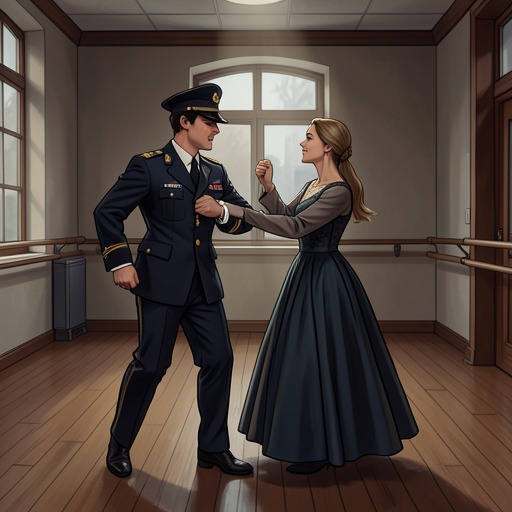
John and Jane Smith’s Marital Reconciliation
Mr. & Mrs. SmithJohn and Jane Smith’s marital reconciliation is the decisive change from treating their six-year marriage as a polished cover—and a private battlefield—to choosing one another as partners in an uncertain future. It does not restore the house or erase the danger of their work; instead, it makes their shared life, and their ability to speak about it, more important than the appearance of domestic perfection.
From domestic performance to crisis
The reconciliation answers a marriage in which even ordinary household exchanges could expose the gap between intention and understanding. When John brought home salted butter after Jane had asked for unsalted, he saw the recurring trap in which he could not fulfill her requests to her satisfaction. Jane waved away his apology and said she would improvise, but the small failure sat beside their larger inability to say plainly what was wrong. The comic scale of the errand made the strain legible without making it trivial: their domestic routine offered a stage for the same distance that had accumulated between them.
That strain coexisted with identities neither could comfortably disclose. In a session recorded and transcribed by Dr. Wexler, Jane admitted that although she did not lie to John, each of them must have private secrets. Dr. Wexler suspected that she was concealing something important and asked her to put her feelings on paper, insisting that the writing need not be polished or shown to anyone. He encouraged her to begin with the start of the relationship and recall why she had fallen in love with her husband. Her smile at the memory of their meeting in Bogotá, six years earlier, briefly made the past available not as a cover story but as a story she could tell herself.
The couple’s reconciliation is set against the escalation of their concealed lives into open violence. John’s domestic effort to plan dinner shows the old impulse to make one last evening perfect before everything fell apart: he planned the menu, dishes, tablecloth, and even whether to buy flowers. Later, during their armed conflict at home, the kitchen’s familiar objects became collateral damage. John fired toward the dining-room door, shattering glass and striking Jane’s cherished teapot and its companion kettle; Jane paused to take in the destruction of her favorite room before turning back toward him. The wrecked kitchen gives physical form to the failure of the perfect household they had tried to maintain.
Choosing each other in the aftermath
The change becomes explicit after the violence, when the possibility of escape is no longer just a question of where to go. Jane considers a boat in La Paz, but answers John’s joke about it by noting that it is the rainy season. Then she squeezes his hand and says she is exactly where she wants to be. Her choice is not a declaration that their circumstances are safe: she has a bruised jaw, and the danger remains. The gesture and her answer instead make clear that, at this moment, being with John matters more than an easier destination.
John meets that choice with a changed understanding of their future. Jane tells him she wants a child. The news initially lands like a blow, but as he looks at her he knows that he wants one too. The work he has treated as a normal condition of life and death is suddenly seen through the prospect of a shared life beyond it. The possibility of a child does not settle what that life will look like; it makes the stakes of their survival newly intimate and gives their reconciliation a future-oriented consequence.
Their renewed beginning is deliberately ordinary in its details. John thinks of it as a new day and the privilege of beginning again, then offers Jane fruit and asks how things are going in IT. The calm exchange follows the nightmare of their armed confrontation without pretending it never happened. Its domestic ease is now different: rather than relying on a flawless home to prove that everything is all right, the couple can find a point of contact in the simplest act of conversation.
A home beyond the house
Jane’s understanding of their marriage changes alongside her understanding of home. With the inscription “Escape the Dance” on the flask before her, she recognizes that she and John have escaped not only the immediate danger but also the pattern of their six-year marriage because they have been able to talk about it. The realization distinguishes a home from a house. Having grown up without a home, she had tried to make the house look perfect, surrounding herself with things she believed she loved and persuading herself that perfection meant safety, stability, and love. Now the house has been reduced to possessions, none of which carries what matters most.
The recognition does not promise a settled or gentle life. Jane knows that they will have to escape the dance again, both at home and at work; their future will be messy, dangerous, and unpredictable. What has changed is not the world around them but their sense of what they can face together. They can go anywhere and call it home as long as they are together. The loss of their house therefore becomes a test of the old equation between property and security—and the marriage survives by rejecting that equation.
Telling the story and its coda
The book’s therapy frame gives this change a narrative counterpart. Dr. Wexler records the Smiths’ sessions, with his assistant Katrina Östlicher transcribing them and adding observations about the patients’ expressions and body language. His writing assignment asks Jane to turn feeling into a story for herself, not merely to produce a document for the therapist. Later, after the couple have talked through events in their marriage, Dr. Wexler calls the case successful and credits the practice of putting feelings on paper. The frame makes narration part of the couple’s work of understanding: a life that had depended on concealment can be revisited and spoken about.
Dr. Wexler’s final evidence of their continued connection is a change-of-address announcement in Jane’s handwriting, signed with love from Jane and John Smith. He sends a fruit basket to congratulate them on their new house and a card reminding them that they still have a session remaining. The closing gesture is modest, but it extends the reconciliation beyond the immediate survival scene: the couple has moved, remains in contact with the therapist, and has not been declared finished with the work of marriage. The new address signals a new house; the deeper resolution is that they can make a home wherever they face the next uncertain chapter together.