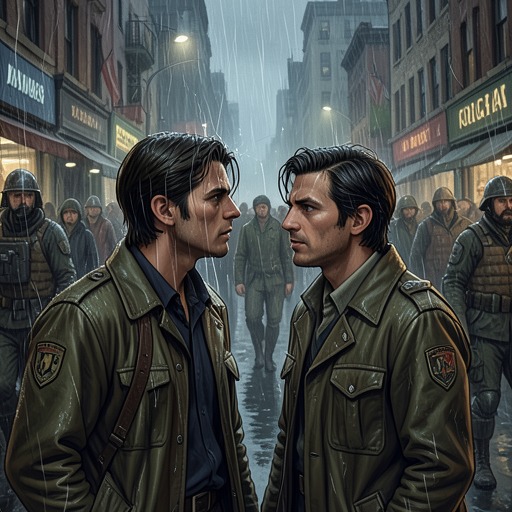
Saint Joe Vallone's Assassination and the Bogotá Riots
Mr. & Mrs. SmithSaint Joe Vallone’s assassination and the ensuing Bogotá unrest create the dangerous public crisis in which Jane and John first meet. The news that Vallone has been shot sends police into the city to seize tourists traveling alone; when a police captain enters the hotel bar and asks whether Jane and John are together, their exchanged glance becomes the hinge between two isolated lives and an improvised partnership. The episode is both a violent political disturbance and the opening scene of their shared story, where survival begins with acting as a couple.
The assassination and the city’s response
Jane recalls being in Bogotá on an assignment when a bellboy rushed through the Americana Hotel lobby bar with news that someone had shot the Barracuda. John, also at the bar, already knew that Saint Joe Vallone had been killed, though he did not tell the bellboy. The assassination is thus not merely distant news: it is the spark that turns the surrounding city into a threatening, fast-moving scene.
The bellboy warned that police were arresting tourists traveling alone. He asked John directly whether he was alone, and the warning made the danger immediate for both travelers. The novel does not establish why the police targeted solo tourists; John’s recollection offers only speculation that the practice may have been borrowed from American films. The uncertainty matters: the threat is experienced as real even though its rationale remains opaque.
The bar confrontation
Jane remembers that her work for the day was finished and that she had started toward John, drawn to the stranger at the bar. Before she could reach him, the police captain stormed in. He began arresting suspects and asserting his authority, creating the possibility that Jane and John could be taken to prison and disappear from public view.
The captain looked Jane over, appeared to suspect something, and then turned his attention to John. He asked whether the two travelers were together. Their eyes met. That brief exchange does not yet establish trust or a relationship; under pressure, however, it gives them a chance to present themselves as companions rather than isolated strangers. The scene’s first connection is therefore also a tactical answer to the police’s question.
Two solitary travelers become a pair
The encounter is narrated retrospectively by both participants. Jane remembers seeing John for the first time and being unable, in that instant, to look elsewhere. John’s account emphasizes a different starting point: he says he was alone, and had always been alone, describing solitude as the life he led. Set beside Jane’s immediate fascination, his recollection makes the meeting a sharp contrast between attraction and habitual isolation.
The crisis gives that contrast practical consequence. The captain’s question forces the strangers to respond together, before they have built a relationship or explained themselves to one another. In the larger history of their marriage, the moment foreshadows an enduring pattern: Jane and John can become a convincing team under immediate danger even when each conceals a separate life. Bogotá makes their first act of togetherness a performance, but it also gives that performance the force of a beginning.
Recollection and narrative significance
The episode is later recalled through Jane and John’s accounts rather than presented as an impersonal report of the unrest. Their separate memories preserve different details—the bellboy’s warning and the captain’s intervention, Jane’s movement toward John, and John’s sense of longstanding solitude—while converging on the same decisive image: their eyes meeting as the captain asks whether they belong together.
That convergence makes the assassination and the police response important beyond their immediate danger. Public violence compresses the distance between two strangers and gives them a reason to align themselves. The scene also establishes the novel’s tonal pattern: an assassination and the possibility of disappearance sit beside an abrupt, intimate encounter, while a potentially life-saving claim of companionship begins as an answer to an official’s question. The riot is not simply backdrop to a romance; it is the pressure that makes the romance’s first appearance an act of improvisation.