The Couple’s Gunfight and Reconciliation at Home
Mr. & Mrs. SmithThe Couple’s Gunfight and Reconciliation at Home turns the Smiths’ marital crisis into a literal battle inside their house, then overturns the violence when John lowers his weapon and catches Jane in his arms. Domestic resentment first finds expression in damaged lawns and cherished household things; as the fight escalates, those familiar objects become casualties of a conflict that Jane recognizes as more intimate and more furious than an ordinary clash between rival agencies.
From Household Resentment to Armed Confrontation
On the way home, John had once planned a dinner in detail, considering the dishes, tablecloth, and even whether to buy flowers. That image of careful domestic attention stands in sharp contrast to the later return home: racing through the front garden to get there first, he tears up the lawn and splashes Jane’s Mercedes with mud. He knows the damage will infuriate her, and jokes to himself that she is not the one who has to mow the lawn three times a week. A household grievance becomes a deliberate act of provocation before either spouse has reached the door.
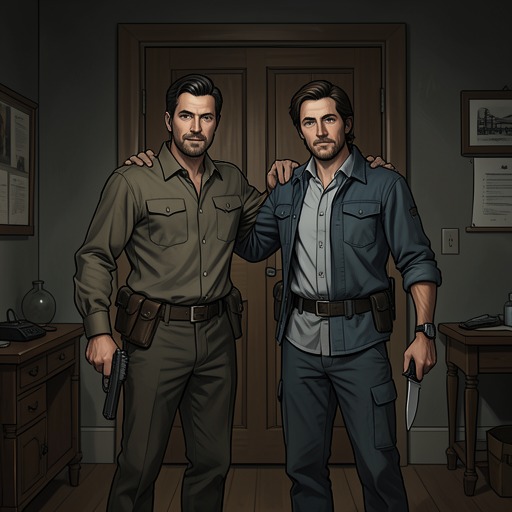
Jane gets out of her car with her hair blowing in the wind and her eyes flashing in the moonlight, feet planted in a defiant, Rambo-like stance. John sees the challenge and answers it with his own readiness to fight. Inside his private sanctuary, he opens a concealed wall panel and takes out a silenced pistol, pristine and ready for use. The hidden weapon makes explicit what the domestic setting had concealed: the house has long held a second life, and its private rooms can become a combat space in an instant.
The House Becomes a Battlefield
With Jane close behind him, John runs to the kitchen for cover, turns to shoot, and dives over the island. He fires again while moving toward the dining room. Glasses shatter one after another, cupboards fly open, and the gunfire hits Jane’s treasured teapot and its companion, the kettle. The damage is pointedly domestic: the objects are not anonymous furnishings but belongings the couple had once cared for, now caught in the same crossfire as their owners.
The scale of the fight is at once frightening and grotesquely comic. Later, Jane sees that John has decapitated her teddy bear and immediately thinks of how expensive it was. That reaction preserves the domestic register even amid lethal danger: the bear is both a casualty of the battle and a reminder of the ordinary attachments the violence is wrecking. As the two struggle over a weapon, bullets fly through the room and the furniture and walls are battered; Jane finally drives John to the floor with an elbow strike to his face.
From Gunfire to Grappling
The fight does not end with John knocked down. Jane and John keep attacking each other with elbows and knees, using martial-arts techniques as furniture gives way and they crash into the walls. Their brawl leaves rooms they once took care of in ruins. Jane understands that the contest has changed: it is no longer merely a clash between rival agencies whose agents have crossed into one another’s territory, or a struggle over trophies and curtains. The violence has become personal, old, and intimate—the murderous fury of a wife who wants to kill her husband and a husband who is plainly trying to kill his wife.
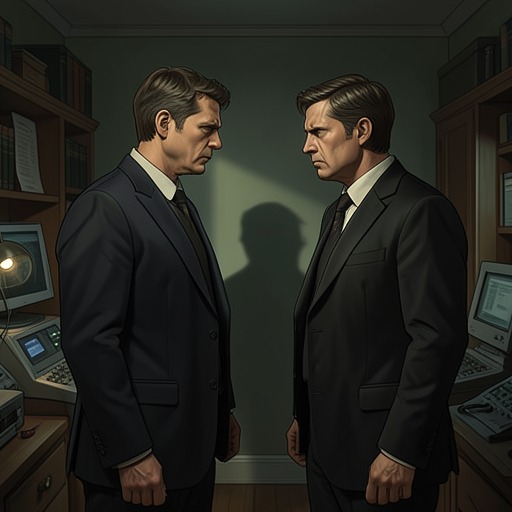
Jane staggers back toward a corner, sees her weapon on the floor, and reaches for it. Wiping sweat from her eyes, she raises the gun and turns to find John facing her with another barrel trained on her. For a moment, the house’s destruction and the spouses’ training have brought them to a direct standoff: each can shoot, and each knows that the other is no longer simply an opponent in an agency operation.
The Reversal and Its Intimate Aftermath
At the standoff’s breaking point, John’s shoulders suddenly relax and his weapon drops. He does not answer the gun Jane has aimed at his heart with another shot. Instead, he wraps his fingers around hers, as if guiding a lover, and cocks the gun she is holding. The gesture preserves the danger—the weapon is still pointed at him—but changes who is controlling the moment: John turns the threat into a choice Jane must confront at close range.
Jane’s finger slips from the trigger and her weapon falls from her hand. John catches her in his arms, holding her in a hungry, crushing embrace. After the blows, gunfire, and wrecked rooms, the shift is abrupt but embodied: surrender comes not through an explanation or a negotiated truce, but through the lowering of a weapon, the loss of Jane’s grip, and John’s arms around her.
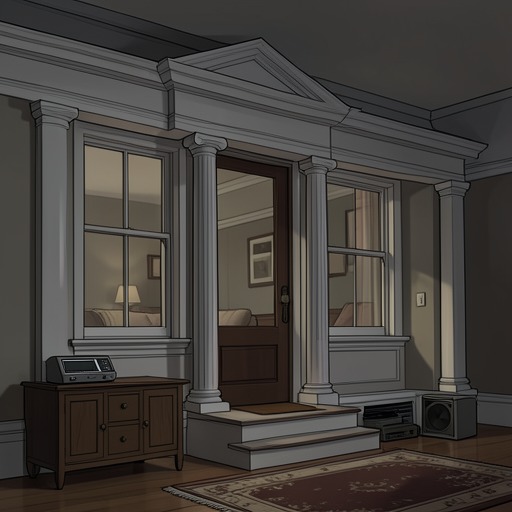
As they tear at each other’s clothes, they slide across a floor strewn with reminders of their former life. The setting makes reconciliation inseparable from the damage: the couple’s intimacy returns amid the remains of the home they had once cherished. The scene’s resolution does not erase the violence or restore the house; it makes the lovers’ renewed physical closeness the counterforce that stops their mutual attempt to kill one another.
Violence, Comedy, and the Domestic Setting
The scene’s tonal shifts depend on the same household details that make its violence intimate. A secret arsenal belongs to John’s home, but the things destroyed in the shooting are teaware, glassware, furniture, and a teddy bear; military skill and household attachment occupy the same rooms. The bear’s price registers even as it lies decapitated, and the kettle’s destruction receives a dry joke about its no longer making a sound. Such details do not make the danger unreal: the couple are armed, trained, and trying to kill each other. Instead, the absurdly specific domestic losses expose how completely their professional violence has invaded the life they built together.
The reversal also depends on physical action rather than explanation. John lowers his gun; he takes Jane’s hand and cocks the weapon she has aimed at his heart; her finger leaves the trigger. Their reunion emerges from the same close bodily struggle that had carried them across the wrecked rooms, converting a contest for control into an embrace without undoing what preceded it. They end the fight amid the scattered reminders of their former life, so intimacy returns not to an untouched home but to a damaged space that holds both their shared past and the immediate evidence of their attempt to destroy one another.