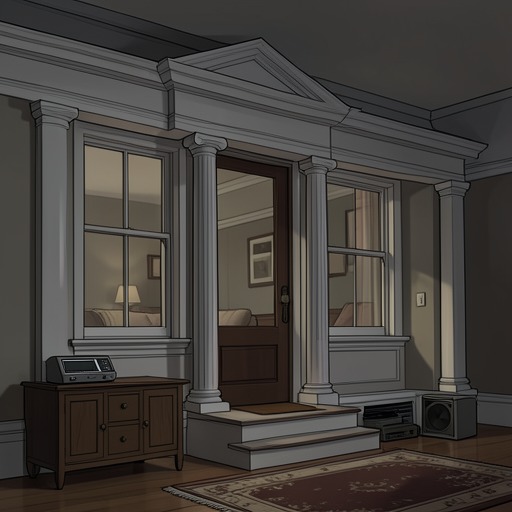
The Facade of Perfect Suburban Life
Mr. & Mrs. SmithThe Facade of Perfect Suburban Life is the domestic ideal Jane Smith and John Smith build around their marriage: a handsome house, orderly routines, good-neighbor appearances, and the promise that dinner will be ready at seven. Its decisive significance is that this picture of normality is both a refuge from their dangerous work and a fiction that cannot contain it. As the couple’s secret lives collide, the house that once seemed to embody their shared dream becomes an object of forensic scrutiny, a battlefield, and finally a heap of wreckage.
The imagined home
For Jane, the home begins as a dream of an ordinary life made visible. She remembers the good neighborhood, pleasant street, and beautiful garden, then the spacious interior: thick carpet, matching cups and saucers arranged on a shelf, a refrigerator stocked with their favorite food, and a splendid bedroom shared with the handsome husband she had dreamed of. The composition is almost magazine-ready. Its appeal lies in the completeness of the image: each object and domestic comfort seems to confirm that life has settled into its proper place.
That ideal has practical rituals as well as a polished appearance. Separate towels and toothbrushes mark out a place for each spouse; the neatly mown lawn and neighborhood parties extend the performance beyond the front door. Dinner at seven becomes a recurring emblem of predictability. Jane can turn even a return home into a plan for perfection, deciding the menu, dishes, tablecloth, and whether to buy flowers. She wants everything right one last time, just before she expects it all to fall apart. The effort is not merely housekeeping: it is an attempt to make a life feel ordered by arranging its visible details.
Two lives inside one picture
The suburban routine coexists with danger rather than replacing it. For six years, Jane’s life has seemed to have two orderly sides: work, risk, and challenge on one hand, and the beautiful house, neighborly parties, trimmed lawn, and evening meal on the other. She tries to divide herself just as neatly, aspiring to be the best spy, wife, and lover. Yet the carefully separated categories conceal a deeper uncertainty: having grown up without knowing what a happy family was, she has imitated the ideal she glimpsed through other people’s windows.
The image therefore offers Jane a template, not a secure understanding of happiness. From outside, it can be copied through the right house and habits; from within, it remains difficult to know what is missing. She recognizes that her life looked perfect only on its surface, while something in it had always seemed absent. The domestic tableau is sincere as a desire, but its completeness is an imitation—an assembled picture that cannot by itself supply the feeling it promises.
Small household exchanges expose how fragile that picture is. John returns with salted butter when Jane had requested unsalted; the mistake becomes a miniature of the larger mismatch between an orderly domestic expectation and the less-than-perfect reality of living together. Jane waves away his attempted apology and says she will think of something, then cheerfully changes the subject to new living-room curtains. The exchange is comic and slight, but it places the strain in the house’s ordinary language: even a grocery errand can become a test that John cannot quite pass, while the conversation moves quickly back toward furnishing and improvement.
The house under inspection
Once Jane’s colleagues search the home, the ideal interior is exposed to the same methods she herself has used against other people. She watches agents overturn the rooms and search for the evidence hidden in ordinary belongings. Julie directs them to examine coat and trouser pockets, receipts, and matches. Jane knows both the procedure and its purpose: she trained these women, understands their forensic thoroughness, and expects them to move on to John’s emails, their accounts, drawers, keepsakes, and clutter.
The intrusion makes the house’s double function unmistakable. It is still the cherished home Jane had imagined, but it is also a case to be dismantled—its records and intimate possessions treated as traces in an investigation. She tells herself to keep calm and let the team finish, even as the prospect of everything being pulled apart frightens her. The search turns domestic order inside out: objects once arranged to support the image of a perfect life become evidence to be examined, while the house’s private history is opened up room by room.
A honeymoon video sharpens the rupture between appearance and knowledge. Janet remarks that she has never seen Jane look so happy; Jane does not want to watch herself in John’s arms or be reminded of how good that happiness felt. She had thought her former life had receded into a vague memory, but the footage makes it more painful, not less. The realization is stark: it had all been one great lie, even their honeymoon. The images of happiness remain real as images, but the revelation changes what they mean. The polished life can no longer be trusted simply because it once looked and felt convincing.
From domestic order to wreckage
As the marriage breaks open into armed conflict, the house’s familiar objects lose their ordinary use. John fires through the kitchen on his way to the dining room: beautiful glasses burst, cupboards fly open, and the cherished teapot and its companion kettle are hit. Jane pauses to stare at the destruction of her favorite room. The scene makes the violence intimate by measuring it against the specific things that had made the home hers. The kitchen is not a generic battleground; it is a beloved domestic space being destroyed in front of her.
Afterward, the living room is a mess, and the new curtains are in tatters. John considers throwing everything out and starting again, as they had on the day they moved in. That thought echoes Jane’s original investment in the house as a made thing, an arrangement that could be composed and renewed. But the damage is no longer limited to furnishings. Grenades blow up the boiler and the basement; the force throws the couple out through the door, and the blast races through the other rooms, destroying their secrets and lies. The structure shakes, collapses, and breaks into a smoldering heap.
Jane and John cling to each other as they look at the ruin. The wrecked house becomes the visible form of the old lives they had built and concealed: their previous world is gone for good. Its destruction does not simply undo the magazine-like picture of suburban happiness. It reveals how much that picture had been asked to carry—romantic hope, domestic routine, and the concealment of two dangerous identities. The facade was never enough to reconcile those worlds, but once it is destroyed, the couple can see its failure together rather than inhabit it separately.
The facade’s comic and dangerous afterlife
The ideal’s imagery persists even when events make it absurd. A small grenade rolling out of a ventilation opening looks to Jane like a cheap toy bundled with a Happy Meal, a Barbie grenade, although she knows it is no toy. The familiar plaything becomes a lethal object in an instant. The juxtaposition captures the story’s unstable boundary between domestic or commercial comfort and sudden violence: objects associated with harmless everyday life can be recast by the secret world running beneath the surface.
That same collision turns domestic destruction into comedy without making it harmless. During the gunfire, the teapot and kettle are treated almost as casualties in the kitchen; later, the couple flee a home-goods store as a life-sized mascot called Homey rises from a box of teddy bears, wearing a house-shaped hat and carrying a sawed-off shotgun. Jane and John shoot into its oversized padded head, and the mascot’s weapon blasts the ceiling. An encounter meant to be a skirmish with an undercover agent becomes a major public event. The home-shaped mascot is an exaggerated echo of the domestic ideal: here the reassuring symbol of a house conceals a weapon, just as the Smiths’ beautiful home had concealed the lives and secrets that ultimately destroyed it.