“She thinks they walk among us”
Mr. Mercedes“She thinks they walk among us” is a satirical remark that becomes an indictment of the people who made it. Spoken by Bowfinger about Mrs. Melbourne, it originally frames her as a harmless crank; after Hodges identifies Brady Hartsfield as the Mr. Tastey ice-cream man, the phrase turns back on its speakers. Mrs. Melbourne had been right that a suspicious figure was among them, concealed not by an extraordinary disguise but by the ordinary familiarity of work, routine, and neighborhood life.
The joke and its original context
The phrase comes from Bowfinger’s comment about Mrs. Melbourne: “She thinks they walk among us.” In the scene recalled by the narrative, Hodges had canvassed the neighborhood and heard her concerns about black SUVs, chiropractors, and people on Hanover Street playing loud music late at night. Her suspicions were presented as eccentric, and the line about people walking among them made that eccentricity the punchline.
The irony depends on the gap between Mrs. Melbourne’s broad, apparently fanciful suspicions and her specific observation. Alongside the other things that troubled her, she had singled out the Mr. Tastey man. The passage preserves the plainness of her warning—“That one looks suspicious”—and her sense that he appeared unusually often that spring. The joke had turned attention away from the one detail that would matter most.
Recognition in the neighborhood
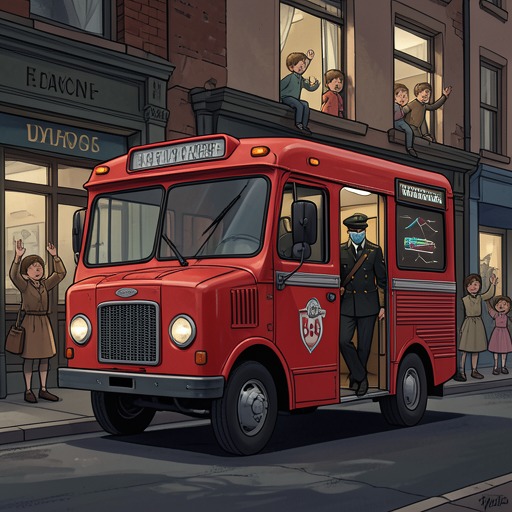
The phrase returns when Hodges learns that Brady Hartsfield drives the Mr. Tastey truck. Children and adults across that side of town know the vendor: Mrs. Melbourne’s warning is recalled alongside the fact that Hodges, Janey, and local children had bought from him. He was not a stranger who had forced his way into view. He was a familiar presence whose truck announced itself with bells.
Hodges realizes that he has heard those cheerful, tinkling bells repeatedly. During the spring of his depression, he spent afternoons crashed out in his La-Z-Boy watching television, at times playing with the gun he carried against his ribs. The bells seemed to sound every day, but he ignored them because, in his view, only children paid attention to the ice-cream man. The passage distinguishes that conscious dismissal from a deeper part of his mind that had retained Bowfinger’s remark about Mrs. Melbourne. The sound was ordinary enough to disappear into the background, yet persistent enough to become, in retrospect, a missed signal.
The reversal of the remark
At the Mingo Auditorium, while the threat to the crowd remains unresolved, Hodges revisits the joke and admits that the joke had been on him and Bowfinger. Mrs. Melbourne was right in the consequential sense: Brady Hartsfield was among them all along, fixing computers and selling ice cream. Hodges calls him an alien, not as a literal explanation, but as the stark image of an enemy hidden inside the everyday world the people around him thought they understood.
The phrase’s meaning therefore changes without changing its words. At first, “they” implies an imagined, extraordinary presence and marks Mrs. Melbourne as credulous. In Hodges’s later understanding, the frightening presence is real, but the disguise is not fantastical: Brady’s ordinary jobs and the familiar truck have helped make him visible without making him seem worth noticing. The revelation is not merely that a killer was nearby; it is that the neighborhood’s habits of recognition had made his presence unremarkable.
Regret and the limits of hindsight
The realization brings no certainty that a different response would have changed what happened. Earlier, after the identification of Brady, Hodges wonders whether paying attention to Mrs. Melbourne instead of dismissing her might have saved Janey. He does not think it would have, but he knows he can never establish that answer, and expects the question to haunt him for weeks, months, perhaps years. The phrase becomes attached to the burden of a missed possibility: not proof that Hodges could have prevented the tragedy, but a reminder that he had once heard a warning and joined in treating its source as ridiculous.
At the auditorium, the thought sharpens rather than resolves. Hodges says he would likely make the same choices again if given the chance, because of Janey; he qualifies that judgment by allowing that he might have listened more closely to Mrs. Melbourne. The distinction holds together his commitment to the actions that brought him there and his regret over the information he failed to take seriously. The phrase names that uncomfortable coexistence: a person can stand by a decision and still recognize the cost of overlooking a clue.
Narrative significance
The saying links three stages of knowledge: Mrs. Melbourne’s warning, Hodges’s belated recognition of the ice-cream man, and his reassessment of the joke at the Mingo Auditorium. Its recurrence transforms a throwaway line into a structure for remembering how the danger was present before it was understood. The cheerful bells, once treated as incidental neighborhood noise, acquire the weight of evidence only after Brady’s identity is known.
Its final force is also ethical. Mrs. Melbourne’s other concerns may have sounded implausible, but that did not make every detail she noticed worthless. By recalling both her specific observation and the laughter that dismissed it, the narrative makes the phrase expose not only Brady’s ability to hide in plain sight but also the confidence with which others decided what deserved attention. The words that once made Mrs. Melbourne the object of the joke become a measure of how badly Hodges and Bowfinger had misread the world around them.