Brady Hartsfield
Mr. MercedesBrady Hartsfield is the concealed perpetrator of the City Center massacre, a man who exploits ordinary work, online anonymity, and other people’s trust to keep his violent identity hidden. Known in the press as the Joker, the Clown, and most emphatically the Mercedes Killer, he prefers the last name; the novel’s central reversal is that the apparently unremarkable worker who avoids notice is also the criminal who believes he can control what others see. His contest with retired detective K. William Hodges ends not with Brady’s mastery but with his own incapacitation, after Holly Gibney intervenes at a concert.
Identity and Cover Lives
In a letter to Hodges, Brady identifies himself as one of the few perpetrators the police failed to catch and names the press’s competing labels for him. He chooses Mercedes Killer, making the public epithet part of the identity he claims for himself. Elsewhere, his online alias merckill carries that persona into his communications with Hodges, turning a screen name into both disguise and signature.
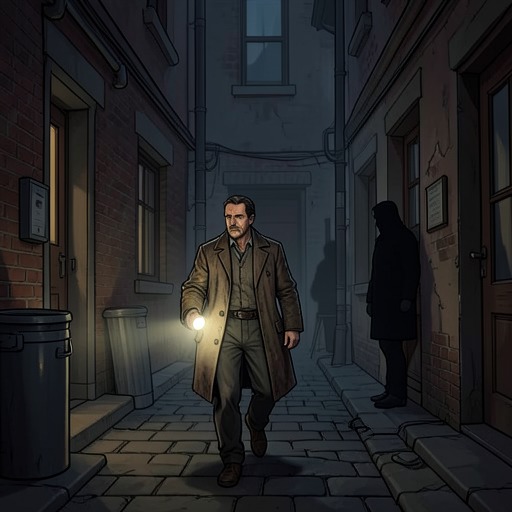
Brady’s ordinary employment gives him a second, carefully inconspicuous public face. He works at Discount Electronix, where coworker Freddi Linklatter talks to him during a break about someone who has hassled her. Brady listens and responds with agreeable acknowledgments, while privately wondering what Hodges made of the letter he sent. The contrast is deliberate: to Freddi he is a receptive colleague, and to the children who buy from his Mr. Tastey truck he is merely the ice-cream seller. He does not want them to look at him or remember him.
His truck route takes him through West Side streets into the evening, serving after-school customers who approach with backpacks and money. The role offers routine contact without recognition, an anonymity Brady prefers. On Vinson Lane he obeys the twenty-mile speed limit, wearing a sweater under his white Mr. Tastey jacket because the cargo behind him is cold. The plain details of the work—uniform, route, customers, and chilled load—anchor a cover life that lets him move through public space without drawing attention.
Deception and the Pursuit of Hodges
Brady’s first letter to Hodges is a calculated risk, but he has made its prose style unlike his own and judges the chance that the retired detective will learn anything useful from it to be nearly nonexistent. His caution coexists with a taste for risk: he recalls escaping arrest after the Mercedes massacre despite the odds, yet rejects poisoning a truckload of ice-cream treats after researching the possibility online. He concludes that such a plan would be foolish because he has other work to do. That work, in late spring and early summer, is Hodges.
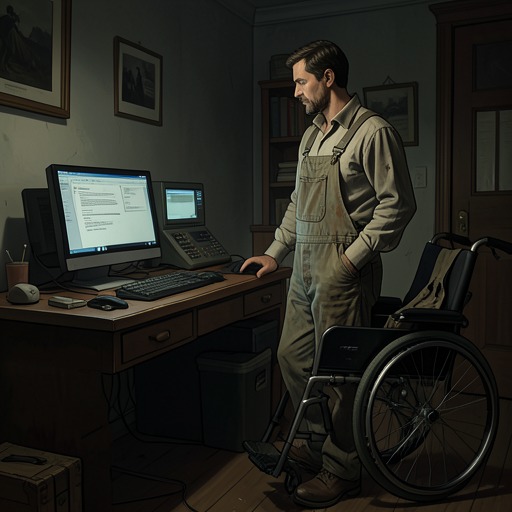
The online space Debbie’s Blue Umbrella becomes the channel through which Brady expects to draw Hodges in. He goes downstairs, uses voice commands to activate the lights and computers, and sits at his Number Three computer to check the forum, certain the retired detective has taken the bait. Instead, Hodges’s message tells him that the confession is false, that withheld evidence establishes Brady is not the Mercedes Killer, and that he should leave Hodges alone. The revelation jolts Brady from expectation to anger and fury. He restrains himself from striking the screen, but sits trembling; the exchange has reversed the intended power dynamic, with Hodges demonstrating that he has understood the deception.
Brady also constructs a fictional identity, Ralph Jones, with enough apparent credentials and a low-limit Visa card to order goods online. His explanation of the method is practical: a false identity can work if its bills are paid, but unpaid accounts can unravel it. This invented persona extends the same strategy found in his employment and correspondence: present a plausible surface, manage what others can verify, and keep the actual operator out of view.
His access to other people’s computers and homes makes that strategy more than a screen game. While working for Cyber Patrol, he visits Olivia Trelawney’s house on service calls after beginning conversations with her through Debbie’s Blue Umbrella. He notices her physical decline and trembling hands, and recognizes that access to her computer has opened further possibilities. When Mrs. Wharton is asked about Olivia’s pen-pal, she identifies that correspondent as the person connected to Olivia’s death. The online relationship thus links Brady’s concealed identity to a real-world victim and to the investigation Hodges is pursuing.
Family, Violence, and Self-Justification
Brady’s account of his brother Frankie’s death presents violence as a decision made under pressure and then disguised as inevitability. He says there was no forethought, only the looming sense that something had to be done; he compares it to driving into the people at City Center and considers calling it an accident or fate. Although he says he does not believe in God, he does believe in fate, and casts the man of the house as fate’s instrument. The language does not erase responsibility: it shows Brady trying to redescribe his own actions as forces that have happened through him.
His home life supplies another contrast between ordinary domestic routine and his threat-making. After leaving Hodges a one-sentence message threatening him, Brady plays Resident Evil until his mother calls him to dinner. He eats tuna salad, takes a second helping, and watches her pour herself a large first drink of the evening; by nine she is asleep on the couch. The scene gives his threat no heroic scale. It sits beside supper, a video game, and his mother’s drinking, as part of an everyday life in which danger and domestic habit coexist.
Brady also turns his mother into an audience for his private self-conception. At the concert, he is contemplating Barbara Robinson when Holly strikes him with the knotted sock Bill Hodges gave her, the Happy Slapper. The attack ends Brady’s ability to act and breaks the picture of Frankie he had been holding, which falls and shatters. The image of his brother and the interruption of Brady’s fixation arrive together: the violence he has framed as fate is halted by another person’s deliberate intervention.
Exposure and Ending
Hodges’s later message dismantles Brady’s belief that the old detective has been fooled. It says Hodges knows how Brady entered Olivia’s Mercedes, disputes the valet-key explanation, and has information about the other cars Brady burglarized between 2007 and 2009. It also corrects Brady’s misuse of the word perk, then announces that Hodges no longer intends to catch him and turn him over to the police: he intends to kill him. Brady’s eyes return to the message’s final taunt, calling him a mama’s boy. The letter combines evidence, insult, and a threat, making clear that Hodges has moved beyond the bait Brady set.
That reversal belongs to a wider contest of roles. Hodges imagines himself as Philip Marlowe, complete with a shabby office, a receptionist, a trench coat, and a fedora, while Brady tries to dictate the encounter through anonymous messages and false identities. Hodges’s fantasy of detective work is playful, but his investigation has consequences: Brady’s ability to keep the truth compartmentalized collapses as his letters, online conduct, and access to Olivia’s home become connected.
At the concert, Holly’s intervention leaves Brady unconscious. Later, Hodges is told that Brady has no present sense of himself, that doctors think his capacity for thought is probably gone for good, and that he is in a deep coma with minimal brain function. The prognosis closes Brady’s plot not through confession or a negotiated surrender but through the removal of the agency on which his schemes depended. He had built his identity around remaining unseen and directing other people’s attention; his final condition is one in which he can neither direct the contest nor clearly understand it.
Narrative Role
Brady functions as both the hidden criminal in a detective plot and the author of a false story about himself. His aliases, his fabricated prose style, and his confidence that Hodges has taken the bait place concealment at the center of his characterization. Yet each disguise creates a trace: the letter can be compared with its writer, the online persona connects to Olivia, and his own messages expose the arrogance beneath the performance.
His public ordinariness is not an alternative to his criminal identity but the means by which it operates. The ice-cream route makes him visible to children while allowing him not to be remembered; his electronics work grants him plausible access to computers and homes; and his online identities let him approach people while pretending to be someone else. The novel repeatedly turns these ordinary systems of trust and access into evidence against him. Brady’s ending completes that reversal: the man who sought to control what others knew becomes the object of an investigation and, finally, a patient whose doctors doubt that he will think again.