Elizabeth Wharton
Mr. MercedesElizabeth Wharton is the elderly mother of Olivia Trelawney and Janelle Patterson, and the frail, cognitively diminished witness whose scattered recollections help K. William Hodges reconsider the circumstances of Olivia’s death. Her memory cannot sustain a reliable conversation, but it retains a few sharply consequential details: Olivia did not leave her key in her car, her pen-pal never met her in person, and Olivia’s suicide was bound up with the family’s anguish over her murdered baby. Elizabeth’s death later gathers the family around the rituals she chose, even as her obituary gives Brady Hartsfield a fresh reason to watch for Hodges.
Identity and Family
Elizabeth, also called Mrs. Wharton and Betty, is eighty-seven when she dies. Her obituary identifies her as the daughter of Marcel and Catherine Sirois, the sister of Henry Sirois and Charlotte Gibney, the aunt of Holly Gibney, and the mother of Janelle Patterson. She had been married to Alvin Wharton, who predeceased her, and had already lost her beloved daughter Olivia. By the time Hodges visits, Janey is Elizabeth’s remaining daughter and the person caring for her through the decline of her body and memory.
The contrast between Elizabeth and her surroundings is immediate. Sunny Acres is ritzy, its grounds manicured and its lawn dotted with older residents playing croquet, but Elizabeth’s days of standing and playing are over. She sits hunched in a wheelchair, her twisted hands and clouded eyes marking a deterioration Hodges remembers from an earlier visit. Then she was bent; now, in his judgment, she is broken. The afternoon light makes a fine silver halo of her hair, an image of radiance set against her physical vulnerability rather than a sign of recovery.
Memory and the Investigation
Janey kneels beside her mother, strokes her badly twisted hand, and tells her she looks better. Elizabeth initially stares with faded eyes that seem to register nothing. Then, unexpectedly, her attention clears: she recognizes Janey, turns a cold look toward Hodges, and calls him Craig. Janey corrects her gently, explaining that he is her friend Bill Hodges and that they have met before. Elizabeth slowly recalls that he is one of the detectives. Hodges does not interrupt to explain that he is retired; he keeps the encounter on the straight line of her remaining recognition.
Her next recollection cuts directly into the investigation. Elizabeth accuses Hodges of having believed that Olivia left her key in her car so that a man could steal it, despite Olivia’s repeated insistence that this was not what happened. Hodges acknowledges that they may have been wrong. The statement gives added weight to a detail already central to the case: the assumption about the key had helped shape the understanding of Olivia’s actions, but Elizabeth insists that Olivia would never have left it behind. Her certainty persists even as she struggles to keep track of the people in the room.
Hodges asks who suggested that Olivia stop taking her pills. Janey returns with orange juice and what appears to be her mother’s pain medication, but Hodges gestures for her to wait, hoping to keep Elizabeth’s attention undivided and her recollection no further muddled. After a silence, Elizabeth answers that it was Olivia’s pen-pal. Asked whether Olivia met him beneath Debbie’s Blue Umbrella, she says Olivia never met him in person. The distinction matters: the pen-pal’s influence was real, but Elizabeth denies an in-person meeting, preserving the online nature of their contact.
As the interview wears on, Janey can see that her mother is tired and signals that they should leave. Hodges presses once more, asking whether Olivia said anything else about Frankie, whom Elizabeth had described as bad. Elizabeth returns to the car key: Livvy would never have left it in her car. Then she abruptly recalls a household dog that never threw up on the rug again after doing so just once. The shift from an investigative detail to an isolated domestic memory shows both the limits and the vividness of what remains: her thoughts do not follow Hodges’s line of inquiry, but an emphatic fragment can still carry meaning.
Loss, Care, and Death
The visit exposes the strain of caring for Elizabeth without making Janey’s tenderness merely sentimental. Janey strokes her mother’s hand, patiently supplies names, and recognizes when the questioning has gone far enough. When Hodges finally thanks Elizabeth, Janey kisses her mother’s cheek and the corner of her dry mouth before leading him away. Elizabeth’s attention has wandered, but the scene leaves the impression of a relationship maintained through bodily care and small rituals even as conversation becomes unreliable.
Elizabeth’s grief over Olivia emerges in a devastating statement. She says Olivia would scream, asking why she had allowed him to murder her baby, and identifies that anguish as the reason Olivia killed herself. The recollection links Olivia’s suicide to the murder of her child and to a maternal guilt that Elizabeth can state more clearly than she can sustain ordinary social recognition. Her account does not make her a complete or consistently dependable witness; its force lies in the way a broken conversation briefly opens onto the family’s central loss.
After Elizabeth dies at Warsaw County Memorial Hospital, Hodges and Janey divide the practical work. He contacts Soames Funeral Home and arranges for the hospital to release the body when the hearse arrives. Janey downloads an obituary form on her iPad, fills it out, and uses Elizabeth’s address book to call her mother’s remaining friends. Her voice wavers only once, while speaking to Althea Greene, Elizabeth’s nurse and closest companion for almost ten years. The administrative tasks continue alongside grief: by the time the hearse arrives, most arrangements are in place.
Janey explains that her mother’s body has been transported to Soames for cremation on Wednesday afternoon, following a Tuesday viewing and a brief, nondenominational service on Wednesday morning. Henry objects that cremation is barbaric; Janey replies quietly that it is what Elizabeth wanted, though Hodges notices her cheeks flush. The disagreement marks a difference between the relatives’ pronouncements and Janey’s knowledge of her mother’s wishes. Elizabeth’s preference determines the plan despite the family’s discomfort.
The Funeral and Her Narrative Significance
Elizabeth’s obituary supplies the particulars of the life and death that the family’s immediate grief leaves difficult to organize. It records that she died peacefully on May 29, 2010, at Warsaw County Memorial Hospital, and names her surviving brother Henry, sister Charlotte, niece Holly, and daughter Janelle. Her husband Alvin and daughter Olivia are listed as having died before her. The notice schedules a private visitation at Soames Funeral Home, a memorial service the following morning, and a reception at 729 Lilac Drive in Sugar Heights. It requests no flowers and suggests donations to the American Red Cross or the Salvation Army, her favorite charities.
The obituary also brings Elizabeth’s death into Brady’s attention. Reading the notice and its reference to the earlier tragedy surrounding Olivia, he calculates that Hodges may attend the visitation, memorial, and reception, and expects to find him at all three. The family announcement that records Elizabeth’s death and arrangements thus becomes part of Brady’s effort to anticipate the retired detective. Her passing has consequences beyond the family’s mourning: it gives the antagonist a public itinerary around which he can watch for Hodges.
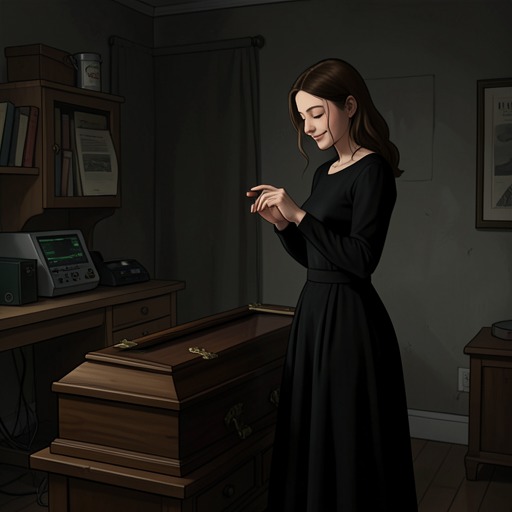
At the viewing, Hodges and Janey arrive first at the Eternal Rest parlor. Elizabeth lies in an open coffin, dressed in white with blue florets that match the blue silk covering the lower half. Her cheeks look rosy and her eyes are closed, a composed appearance that clashes with the body Janey knew. Janey hurries to the coffin and back, lips trembling, then says that the open-coffin viewing feels like a pagan rite and that the woman displayed does not look like her mother. The scene completes the contrast that defined Elizabeth’s last days: the funeral presents a still, arranged image, while the living woman had been frail, changeable, and capable of sudden recognition. In the investigation, too, her importance rests not on sustained clarity but on the stubborn fragments that survive her decline—fragments that challenge the mistaken story of Olivia’s key and preserve the intimate grief behind her suicide.