Hide in Plain Sight
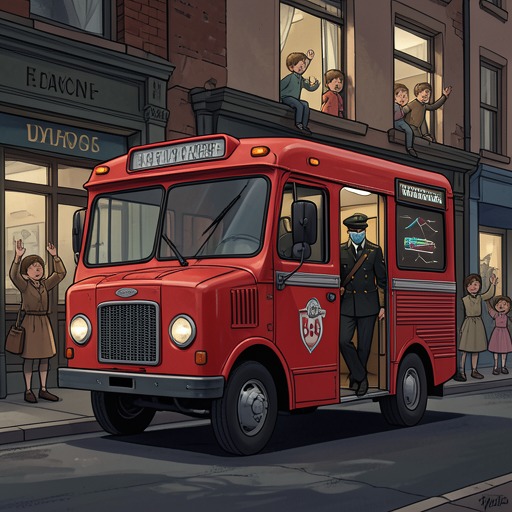
Mr. MercedesHide in Plain Sight is the expression Jerome Robinson uses to explain how Brady Hartsfield can watch people without drawing notice: he hides in everyday familiarity, not in some remote or inaccessible place. The clue resolves into a startlingly ordinary identity—Hartsfield is the Mr. Tastey ice-cream-truck driver whose bells Hodges had heard repeatedly during his depression. The phrase becomes both a practical account of concealment and a motif of belated recognition: the danger had been visible, but its routine appearance made it easy to overlook.
The Deduction
Jerome reaches the conclusion while asking whether Hartsfield is inside. Hodges is too surprised to answer. Jerome says the suspect must be there, and explains that he has worked out how Hartsfield could have been watching them: it resembles Edgar Allan Poe’s story of the purloined letter, in which concealment works by leaving something in plain view. Holly Gibney corrects Jerome’s attribution—Poe wrote the story—while Hodges tells him to slow down. The exchange gives the realization a practical, conversational shape: an allusion becomes a method for interpreting the suspect’s access to their surroundings.
Jerome’s next step is to connect that method to Hartsfield’s employment. He points out that Hartsfield has two jobs and appears to leave one by mid-afternoon to work for Loeb’s. When Hodges asks whether he means the ice-cream company, Jerome confirms it: Hartsfield drives the Mr. Tastey truck, recognizable by its bells. Jerome has bought from him, as has his sister; children across the area know the driver, and the truck is frequently on their side of town. His conclusion is blunt: Brady Hartsfield is the ice-cream man. The vehicle’s familiarity explains how Hartsfield could circulate where people lived and gathered without seeming out of place.
The Clue in the Bells
The discovery transforms a sound Hodges had been registering without consciously understanding. In the spring of his depression, he often lay in his La-Z-Boy watching afternoon television, sometimes handling the gun he carried against his ribs. He remembers hearing the Mr. Tastey bells seemingly every day, yet ignoring them because an ice-cream truck attracts children’s attention rather than an adult’s. The sound had entered his experience repeatedly; its meaning had not.
Hodges’s recollection distinguishes simple exposure from recognition. Some deeper part of his mind, the narration suggests, had not entirely dismissed the bells, just as he kept returning to an earlier conversation with Bowfinger. But he had not joined the ordinary sound to the possibility that the person behind it was the killer he sought. The clue therefore does more than identify a disguise: it reveals the gap between seeing or hearing something and understanding what it signifies.
The Invisible Man
The phrase gains a second, visual expression in Hodges’s impression of Hartsfield as “The Invisible Man.” At Hartsfield’s house, Hodges studies a large framed photograph of Brady as a teenager with his mother, their cheeks pressed together and their matching smiles giving the image a closeness Hodges reads as more like a couple than a mother and son. Yet the boy looks ordinary, someone a passerby might not notice. Hodges thinks that this, perhaps, is exactly how Brady likes to appear.
That impression links concealment to Hartsfield’s unremarkable public face, rather than to literal invisibility. A familiar worker, an ordinary-looking boy in an old photograph, and an ice-cream truck on neighborhood streets all belong to recognizable life. Their apparent harmlessness helps explain how the threat can be present without announcing itself. The phrase’s force lies in this tension: visibility is not the same as being noticed, and being noticed is not the same as being understood.
Recognition and Its Cost
Later, as Holly and Jerome leave and Hodges waits in pain, hoping the threatened explosion will not occur, he revisits the joke he and Bowfinger had shared about Mrs. Melbourne. She had said that she thought such beings walked among them; the men had laughed, assuming the concern misplaced. Now Hodges recognizes the irony: she had been right about the presence of danger among ordinary people, even though it was not the kind of explanation the joke suggested. Hartsfield had been among them, fixing computers and selling ice cream.
This return gives the expression a retrospective edge. The clues were not concealed from view: the Mr. Tastey driver passed through the neighborhood, and his bells reached Hodges again and again. What was missing was the interpretation that would make those details alarming. “Hide in plain sight” thus names both Hartsfield’s way of moving through the community and the weakness in the observers’ attention: the everyday can shelter a criminal precisely because it seems too familiar to merit scrutiny.