Loeb's Ice Cream
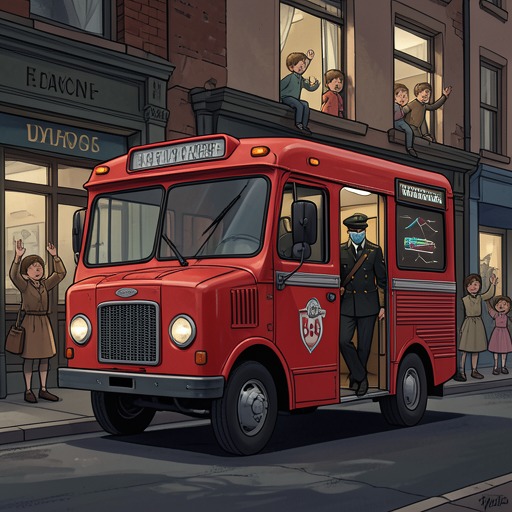
Mr. MercedesLoeb's Ice Cream is the company Brady Hartsfield works for as an ice-cream-truck driver. Its factory, fleet, coworkers, and shift system provide the ordinary routines that structure his public life, while also giving him mobility and opportunities to arrange time away from work. The company’s apparently familiar service ultimately sharpens the contrast between Brady’s harmless appearance and the danger he poses.
Work and Public Role
Brady’s employment places him behind the wheel of a Mr. Tastey truck, selling treats at parks and other public locations. The work is brisk during Little League season: at McGinnis Park, where games fill three fields, he sells his entire truckload one Saturday afternoon, including the JuCee Stix. His contact with customers is extensive enough that Jerome Robinson later points out Brady has served thousands of people.
The routine has its irritations. Brady dislikes driving his aging Subaru to work, and later recalls the discomfort of operating the Mr. Tastey truck in August with its freezers running high. The truck is thus both a practical workplace and part of a pattern of grievances that Brady privately associates with his ordinary life.
Staff and Scheduling
The factory’s daily operation is represented through Brady’s dealings with Shirley Orton, who works in the front office and appears to be a familiar, persistent presence there. After his Saturday shift, Brady asks to switch with Rudy Stanhope, who is scheduled for Sunday afternoon. He explains that his mother needs to visit her brother, a fabricated reason that helps him secure two afternoons off in a row. Shirley makes the call while Brady changes into street clothes; Rudy agrees to take Brady’s Sunday shift in exchange for Tuesday’s.
The change gives Brady time to stake out Zoney’s GoMart on two afternoons. He anticipates extending the absence by calling in sick if necessary. Loeb’s scheduling arrangements therefore have a concrete place in his private plans: a routine workplace favor becomes cover for time spent pursuing someone outside the job.
Suspicion and Concealment
The company’s hiring practices enter the story through a warning from a resident who wonders whether Loeb’s checks the people it employs to drive its trucks. She says that one driver looks suspicious and recommends that Hodges investigate him. Hodges reassures her that the drivers have references, but says he will look into the matter. Her suspicion does not itself establish Brady’s identity or guilt; it becomes one strand in a wider process of noticing the truck and its driver.
Brady’s work also helps sustain the harmless impression he deliberately cultivates. He drives a familiar delivery vehicle and serves people across the city, an ordinary role that can make him seem unremarkable. When Hodges tells Jerome that the suspect has made himself look harmless, he notes that Jerome has bought ice cream from that very truck. Jerome replies that Brady has sold to thousands of people; Hodges counters that the number of Black customers on the West Side may be much smaller. The exchange makes the truck’s broad public visibility a double-edged fact: it normalizes Brady’s presence, but it also gives investigators a specific, local point of recognition.
Narrative Significance
Loeb’s links mundane labor to concealed intention without making the company itself an instrument of the crimes. Its trucks move through parks and neighborhoods, its employees negotiate ordinary shifts, and its customers encounter a driver who appears to belong to daily civic life. Brady exploits those routines to manage his availability and maintain a benign public role. Later, the same familiar service helps Hodges and Jerome connect the apparently ordinary ice-cream vendor to the suspect they are seeking.
The company’s narrative function rests on this tension between visibility and concealment. Brady is not hidden from the public in any literal sense: he is repeatedly present, selling ice cream from a recognizable truck. What remains concealed is the meaning of that presence. Loeb’s provides the everyday setting through which the story shows how a person can be widely encountered yet still evade suspicion until investigators learn to read the ordinary details differently.