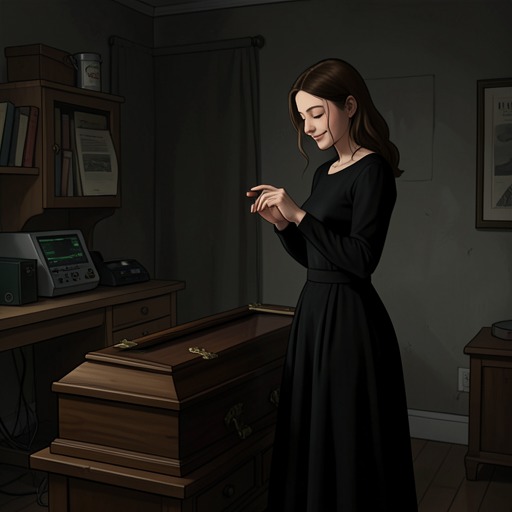
Olivia Trelawney’s computer
Mr. MercedesOlivia Trelawney’s computer is more than a password-protected personal device: its concealed audio program and remote-access software turn it into a record of intrusion and a possible link to the surveillance of Olivia. When Jerome Robinson and Holly Gibney examine it, an obscure sound effect plays a woman’s accusation, and their investigation uncovers software capable of accessing files and deactivating programs remotely. The computer thus converts a seemingly private object into both a clue and a means by which someone could have reached into Olivia’s digital life.
Discovery and Examination
Jerome finds the computer password-protected, but the password is written on the underside of the keyboard: OTRELAW, a simple barrier undone by turning the device over. He begins searching for audio that might account for sounds connected with the investigation, trying terms such as CRYING BABY, WEEPING INFANT, and SCREAMING WOMAN. None returns a result. Holly, initially standing in the doorway and nervously flipping the collar of her housecoat, suggests that the material could be hidden and directs him to inspect the computer’s sound settings.
Holly’s guidance changes the pace and character of the search. She has taken a computer course remotely and says she knows Mac programs inside and out; as Jerome follows her suggestions, she moves from watching to participating at the keyboard. The turn from ordinary searches to the settings menu matters because the relevant item is not presented as a plainly named recording. Among familiar sound effects—FROG, GLASS, PING, POP, and PURR—Jerome finds an unfamiliar option labeled SPOOKS.
The Hidden Sound
When Jerome selects SPOOKS, the speakers play an audio sequence: a baby cries, a woman asks why someone let a person murder her baby, and the cycle repeats before stopping. The sounds transform the computer’s routine interface into the point of contact with a disturbing, concealed message. The program does not simply yield a file that the investigators can read; it makes the evidence audible through the device, and its recurrence suggests a programmed sequence rather than a sound triggered by their ordinary search.
Jerome and Holly are startled by the playback. Holly does not react to the initial baby’s cry in the same way she reacts to the woman’s accusation, and Jerome takes her hand as they watch the computer. The sequence repeats three times and then ends. Their reaction is not itself proof of who created or installed the program, but the scene marks a shift: the machine has revealed hidden content, while leaving its origin and purpose unresolved.
Installation and Remote Access
Holly investigates when the program was installed and finds that it dates to July 1 of the previous year, when numerous other items were installed as well. That date establishes a point of technical activity but does not, by itself, identify who made the changes. Jerome asks whether the program could have been set to play at particular times, run through three cycles, and stop; Holly confirms that this is possible. The fact that it has not continued playing while she and Jerome have been staying at the house therefore does not rule out scheduled or controlled activation.
The more consequential discovery is a hidden slave program called Looking Glass, concealed in Olivia’s Mail Contacts. Holly explains that it cannot, as far as she knows, turn on a computer, but that someone could use it from another computer once Olivia’s machine was on. The remote user could open files, read emails, inspect search histories, or deactivate programs. Jerome immediately connects that capability to the period after Olivia’s death. The possibility is unsettling because the device could have been accessed or altered without a visible user sitting at it, though the evidence presented does not establish exactly who operated Looking Glass or what they did through it.
Investigative Consequences
Jerome reports the computer findings to K. William Hodges, who listens closely and is pleased by Jerome’s praise of Holly’s work. But there is no direct link to the Computer Jack who had worked on Olivia’s machine. Jerome thinks Janey Patterson may have thrown away the technician’s business card; Hodges considers the alternative that Mr. Mercedes ensured Olivia had no card, while also questioning why a satisfied customer would not have asked for and kept one. The absent contact information leaves an investigative gap rather than resolving the computer’s history.
Hodges asks Holly whether the person who planted the SPOOKS sounds could also have deleted Olivia’s address book. Holly says that would be easy. The possibility connects the missing contact information to the same broad problem exposed by Looking Glass: computer contents may have been remotely accessed or changed. Holly also tells Hodges she is taking Lexapro, a brief personal disclosure amid the technical discussion; it does not resolve the case, but accompanies Hodges’s evident hope that she will be pleased by his appreciation of her skill.
Significance as an Object
The computer’s successive revelations depend on distinctions between what appears accessible and what is hidden. A password is left on the keyboard, searches for obvious audio descriptions fail, an unfamiliar sound effect conceals the accusation, and a remote-access tool sits inside the contacts application. Each layer makes the device less like a transparent instrument and more like an uncertain source: it can store information, play it in a controlled sequence, and potentially expose or alter data from elsewhere.
That uncertainty places Olivia’s computer within the investigation’s wider concern with privacy and technological access. Jerome has described privacy sites such as Debbie’s Blue Umbrella as protection against intrusive surveillance, while explaining that car-entry signals can be captured with a purpose-built gadget. The computer supplies a different kind of vulnerability: not physical entry into a car, but possible access to a person’s files, email, and search history through hidden software. Its importance lies in making that possibility concrete, while leaving the evidence incomplete about the person behind it and the full extent of the intrusion.