Patti Cray
Mr. MercedesPatti Cray is the infant daughter of Janice Cray, a job seeker waiting outside an auditorium, and a victim of the City Center job-fair massacre. The contrast between her vulnerable presence in the employment line and Brady Hartsfield’s later account of taking pleasure in her death makes Patti a stark emblem of the massacre’s human cost: a child with no agency in the circumstances that put her in danger, reduced in the killer’s telling to a name and a source of excitement.
Identity and Introduction
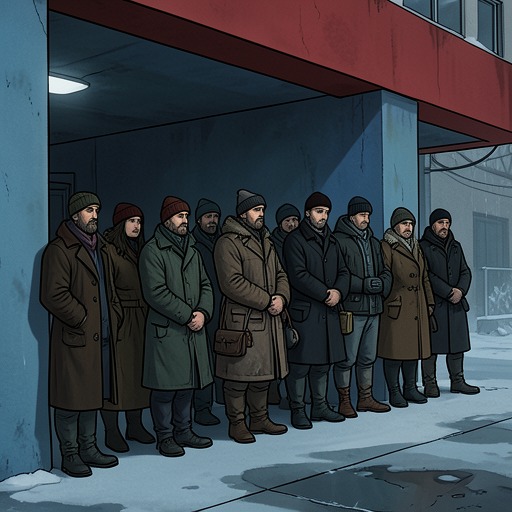
Patti is introduced asleep in a Papoose carrier at the end of the growing line of applicants outside the auditorium. Her cheeks are flushed from the cold, and her breathing has a faint rattle. Her mother, Janice Cray, is young, visibly tired, and recently laid off from housekeeping work for a family in Sugar Heights. Janice introduces the baby as her little bundle of joy while explaining that she, too, has been downsized.
The scene places Patti within the material pressures surrounding the job fair before it reveals her fate. Her mother has lost paid work, and the two are among people waiting for an opportunity; Patti’s presence makes that economic precarity immediate and physical. She is not simply part of Janice’s account but an infant needing warmth and care in a public queue.
Care and Vulnerability
When Janice gets into a sleeping bag, she entrusts Patti to August Odenkirk. He holds the baby at arm’s length, captivated by her red, furious face, the bead of snot on her tiny nose, and her legs bicycling inside a flannel onesie. At Janice’s request, he gives her back, and she burrows farther into the bag. Two young men stare at them; Odenkirk tells them to mind their own business, and they look away.
This small exchange gives Patti a brief scene of ordinary care amid the crowd: Janice seeks warmth, Odenkirk helps, and he rebukes onlookers who intrude. The scene also underscores how dependent Patti is on adults for protection. She cannot understand the queue, the job fair, or the risks around her; her safety rests entirely with those who happen to be nearby.
Death and the Killer’s Account
After the massacre, Brady Hartsfield writes that he relives the impact of the car striking people and says he was delighted when he learned that a baby had been among his victims. He identifies the child as Patricia Cray and treats her death as an occasion for amusement, alongside the injuries inflicted on other victims. His letter’s taunting address to K. William Hodges turns the death into part of Brady’s effort to provoke the retired detective.
The difference between Patti’s earlier presentation and Brady’s account is central to her significance. The narrative first makes her particular through the cold, her rattling breath, her face, and Janice’s care; Brady then strips away that specificity, boasting of her death as proof of his own thrill and lack of conscience. His language exposes the moral gulf between a helpless infant and the killer who interprets killing as entertainment.
Narrative Significance
Patti’s brief appearance connects the job fair’s line of people seeking work to the lasting consequences of the massacre. Janice’s unemployment and the crowd’s ordinary hopes form the setting for violence that reaches people who came only to pursue a job. Patti’s death is not an abstract casualty in Brady’s letter: the name he gives her recalls the baby Odenkirk held and Janice tried to keep warm.
The book’s movement between these perspectives makes Patti’s vulnerability a measure of the crime’s indiscriminate reach. She has no developed arc beyond the care she receives and the death Brady boasts about, but that very asymmetry matters: the infant’s fleeting human presence is set against the killer’s attempt to turn her into a trophy. Her place in the narrative keeps the victims’ lives visible where Brady’s account tries to make their suffering serve his performance.