Camera
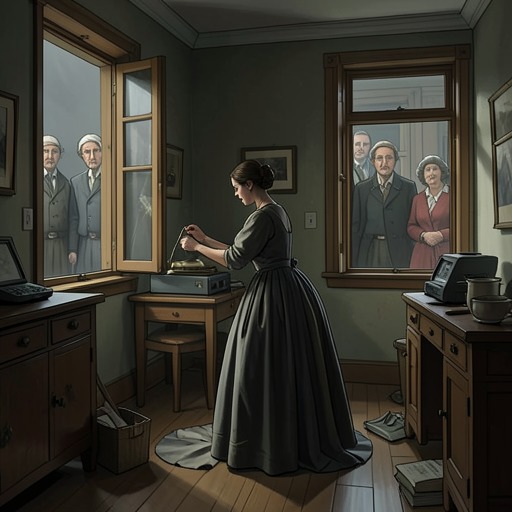
My Tender MatadorThe Camera enters the story during an outing in the Cajón del Maipo, where Carlos photographs the Queen of the Corner as the presidential motorcade passes on the road behind her. Its brief use gives the scene a double charge: Carlos is making an image of their private moment, but the frame also catches the movement of the President’s convoy and brings their encounter into the orbit of state power.
The Photograph on the Mountain
The Queen and Carlos have left the city and stopped on a grassy rise overlooking the road, the river, and the mountains. Carlos asks her to hold still while he looks for the Camera and adjusts its focus. She first wants to pose with her yellow hat; he asks her to remain as she is. As the police cars and armored vehicles pass in the background, she smiles for the photograph.
The Queen treats the moment as a tableau, imagining herself posed beside Carlos in a scene whose importance lies in the memory it will preserve. The Camera gives Carlos control over the image: he positions the road behind her and tells her not to move, fiddle, or breathe. She participates in his composition, but the romantic significance she attaches to the occasion exceeds anything the photograph itself can establish about his feelings.
A Private Image and Public Power
The passing convoy changes the meaning of the picture-taking. What begins as an apparently secluded picnic becomes a scene in which the presidential motorcade occupies the background. The Queen is focused on Carlos and the photograph; the convoy passes close enough to be remembered by the President, who later recalls the young man with the Camera and the woman in the yellow hat.
That recollection exposes the gap between the couple’s understanding of the encounter and the regime’s. The Queen experiences the photograph as part of an intimate, staged memory. The President, reconsidering what he saw, identifies the pair as homosexuals and responds with anger, resolving to alert the mayor of the Cajón del Maipo. The Camera is not described as recording that later recognition or as producing evidence used by the authorities; its significance lies in how the act of photographing helps make the couple visible within the scene that the President subsequently remembers.
The Image’s Limits
The episode does not say what happens to the photograph, whether it is developed, or whether the Queen ever sees it. Its narrative force instead rests on the captured instant: Carlos chooses the background, the motorcade passes, and the Queen smiles. For her, the image promises a lasting souvenir of proximity to a man she loves; for the reader, the same composition foreshadows that their private world is exposed to a hostile public gaze.