Chilean Army
My Tender MatadorThe Chilean Army is the coercive institution at the center of the novel’s depiction of Augusto Pinochet’s rule. It appears not only in public displays and the suppression of protest, but in the private history of the Queen of the Corner, whose father treats military discipline as a remedy for gender nonconformity. Across these settings, the Army’s claim to impose order is repeatedly set against the fear, exclusion, and violence that its authority enables.
Discipline and Personal History
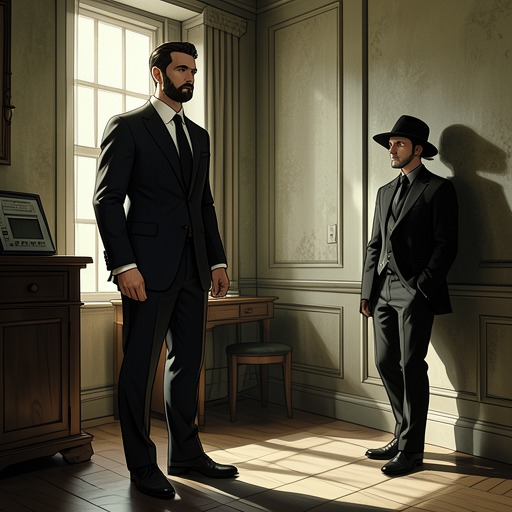
The Army enters the Queen of the Corner’s life before she is involved with Carlos or his clandestine associates. As a child, she is mocked and beaten for her voice and manner of walking. Her father rejects a teacher’s suggestion that she see a doctor and insists that only the military can make her conform. When she turns eighteen, he arranges her enlistment through a sergeant friend. She later tells Carlos that she left her father’s home and never saw him again; the account does not describe her military service itself. The episode nevertheless establishes the Army as an instrument her father imagines using to correct a child whose gender expression he considers shameful.
That personal history gives the institution’s authority a domestic dimension. Military discipline is not presented simply as a matter of barracks or battlefield: it is invoked within a family as a means of enforcing masculine behavior. The Queen’s refusal to remain in her father’s household is a consequential break from that attempted discipline, though the text does not say what happened to her after enlistment or whether she served.
The Army’s Political Order
The Army also figures in the regime’s public argument about who serves the nation. While protest and labor mobilization build toward September, Pinochet travels to his country estate in the Cajón del Maipo and reads Roman strategies for suppressing rebellion. He dismisses Radio Cooperativa as Marxist propaganda and praises workers repairing the Achupallas grade who remove their hard hats as his motorcade passes. In his account, obedience and work mark good citizenship; protesters are cast as threats to law and order. The contrast exposes how military authority frames dissent not as a political claim but as disorder to be controlled.
The novel ties that outlook to the Army’s decisive role in the 1973 coup. During a later drive, Pinochet recalls directing the attack on La Moneda from a command room in Peñalolén and presents the assault as a historic action that saved the nation. His self-justifying recollection sits beside the regime’s suppression of news and his contempt for left-wing critics. The institution is thus associated with both the seizure of political power and the continuing effort to represent that power as national protection.
Protest, Force, and Street-Level Encounters
The Army’s authority is felt beyond the presidential motorcade. The novel’s opening account evokes a Santiago of protest, blackouts, armored vehicles, gunfire, and urgent radio bulletins. In another account, student demonstrations end with more than twenty injured and at least as many arrested by special police forces, who are immediately handed over to military authorities. The sequence shows how street-level arrests feed into a wider system of military control.
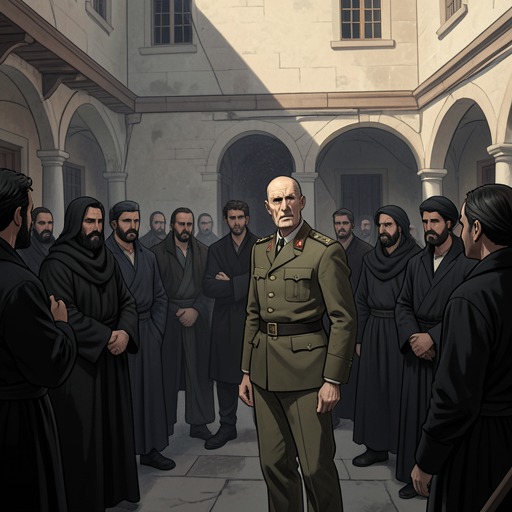
The Queen’s encounter with a soldier at a checkpoint makes that system intimate and precarious. Ordered to divide into lines for men and women, she responds with a joke that refuses the premise that she can be sorted neatly into either category. The soldier turns the encounter into a sexualized interrogation, but she answers that she has embroidery to deliver to military households, including a colonel’s mother. He lowers his weapon and lets her continue without searching her. Her escape depends on quick improvisation and the social usefulness of her sewing; it does not erase the threat represented by the armed checkpoint or the people detained nearby.
Military Occupation and Its Consequences
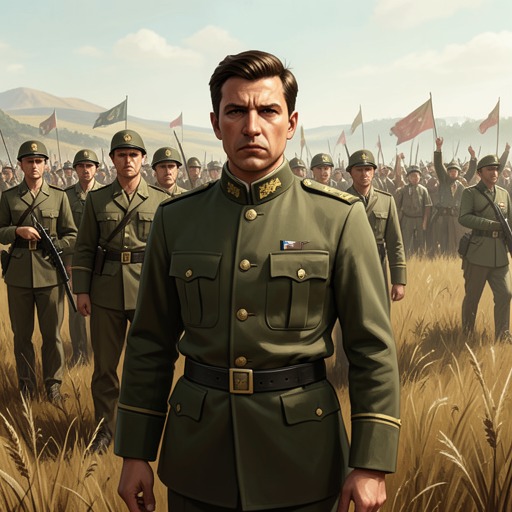
After the failed attack on Pinochet’s motorcade in September 1986, Santiago is placed under siege. The Army cuts off roads into and out of the city as soldiers search cars, houses, and whole neighborhoods. Residents may be kept overnight on football fields, and people can be beaten and taken away in trucks on the basis of hesitation or minor suspicion. The broadcasted instruction that citizens remain indoors and report anything suspicious makes the occupation part of daily life, extending state surveillance into homes and neighborhood relations.
For the Queen, the crackdown turns her house and her relationship with Carlos into sources of danger. She waits through the night with a kettle ready in case Carlos or his friends arrive, listening to low-volume news bulletins and reacting to every sound on the stairs. By dawn, she has spent the night trying to erase traces of herself: burning papers bearing addresses and phone numbers, cleaning surfaces, and packing her possessions into two bags. She leaves the house and seeks refuge with La Rana. The Army’s searches therefore bring about not only public confinement and fear but the Queen’s forced departure from the home that had been her refuge.
Narrative Significance
The novel does not present military power only through the dictator’s orders or grand political events. It traces the institution through a father’s proposed cure for his child, the handover of arrested students, a soldier’s checkpoint, and the night-long searches of ordinary homes. Those encounters reveal how national claims of order reach into bodies, streets, and private spaces, while also showing the unequal means available to resist them. The Queen cannot confront the institution on equal terms; her wit and care for others sometimes open a passage through its controls, but the 1986 occupation ultimately forces her to abandon the place she had made her own.