Chilean Military Dictatorship Period
My Tender MatadorThe Chilean Military Dictatorship Period forms the political pressure surrounding the novel’s intimate story: in 1986 Santiago, state power enters homes, streets, buses, and broadcasts, while protest and clandestine resistance become part of everyday life. The Queen of the Corner begins as someone frightened by political news and largely removed from public debate, but the violence and uncertainty around her increasingly make neutrality impossible. Her house, her affection for Carlos, and her encounters with people in danger bind private attachment to the consequences of dictatorship.
A city shaped by protest and fear
The spring of 1986 arrives amid political graffiti, union mobilization, student demonstrations, and police water cannons. Students return to the streets after being dispersed, while explosions and blackouts interrupt the city’s routines. People buy candles, and the narration links their effort to keep streets illuminated with the desire to preserve memory of the disappeared. The annual approach of September brings renewed hopes for change, but those hopes repeatedly fail to dislodge the ruler. This cycle of expectation and disappointment gives political time its recurring rhythm: one September passes, and the next approaches under the same authority.
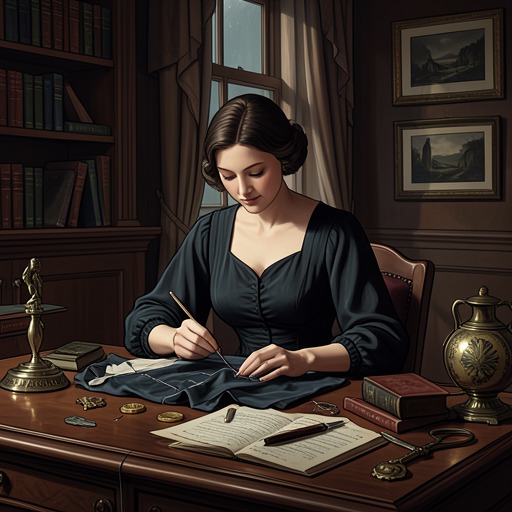
Political information circulates through the neighborhood grocery store and Radio Cooperativa, whose bulletins report demonstrations, arrests, threats, and armed resistance. The Queen prefers old songs because the station’s urgent reports frighten her, while the shop’s customers discuss the Opposition, government threats, and calls for action. The broadcasts make national events audible inside ordinary life; they do not, at first, make the Queen a participant. Her home remains a refuge where she embroiders tablecloths for wealthy clients and decorates the rooms with birds, lace, and other cherished objects.
The contrast between political positions is also staged through social geography. The Queen travels from her working-class neighborhood toward the Barrio Alto, passing unemployed young men and passengers who dismiss students as ungrateful troublemakers. When a woman on the bus condemns demonstrations, the Queen answers that soldiers are everywhere and that explosions and shootings have made it difficult to sleep. Students applaud her, and the other passenger leaves amid their jeers. The Queen has not presented herself as politically experienced; what emerges instead is a conviction formed from the conditions she can see around her, and she is surprised by her own willingness to speak in public.
Resistance, repression, and contested information
The novel presents political conflict through different accounts of the same country. The Movement for Change mobilizes against the regime, while the dictator retreats to the Cajón del Maipo and rejects Radio Cooperativa as leftist agitation. He imagines that loyal workers and orderly citizens represent the nation, and remembers the 1973 attack on La Moneda as a decisive act he believes restored order. The contrast between his self-justifying account and the reports of protest and repression exposes the distance between official authority and the experiences of those living under it.
Radio bulletins make that distance concrete. After students are injured and arrested during university rioting, the Queen worries that Carlos may be among those taken into military custody. Later, a government communiqué announces that a subversive plan for September has been uncovered. When she turns to Radio Cooperativa, she hears that the Organization of Families of Detained and Disappeared Persons is holding a vigil at the Plaza de Armas, demanding justice for human-rights violations. The reports move her: she has begun to say dictatorship rather than the government’s preferred description, and testimony from families whose relatives have been taken prompts tears. Political understanding develops through repeated listening and the people affected, rather than through a single formal conversion.
State violence becomes physically immediate when the Queen carries a package for Carlos through a demonstration. Tear gas and confusion briefly separate her from the package; after recovering it, she continues through the city. A crowd fleeing police moves past her, and she then faces a formation of officers beating demonstrators. She insists on being allowed through as if she were simply shopping, and passes the police line before delivering the package to a waiting man. The episode places an apparently ordinary errand inside a violent public confrontation: her composure and improvisation help her complete the delivery, while the officers’ force falls on demonstrators around her.
The home as refuge and point of risk
The Queen’s house is both a domestic sanctuary and a place used by Carlos and his associates. She initially accepts boxes on the explanation that they contain censored books and lets the young men meet upstairs. Neighbors notice the boxes and visitors, and the radio increasingly links the Manuel Rodríguez Patriotic Front with weapons and plans for an uprising. The Queen’s household care and her desire to protect Carlos thus coexist with a political use of her home whose full implications she does not always want to investigate.
A small object brings that concealed danger close. After Carlos’s associates remove boxes, the Queen finds an identity card and wonders whether it belongs to Carlos, but chooses not to check it, putting it in her pocket and turning on the radio instead. At the same time, reports about disappeared people have made her more receptive to the families’ demand for justice. Her uncertainty is not simply a lack of information: it reflects the risk of knowing more, the limits of her position, and her attachment to a young man whose name and purposes she does not fully understand.
The dictatorship’s emergency measures eventually transform the city into a place of searches and checkpoints. After the September violence, soldiers occupy Santiago, roads into and out of the city are cut off, and house-to-house searches, arrests, and nighttime detentions spread through poorer neighborhoods. The Queen keeps a kettle ready in case Carlos or his friends arrive and listens to low-volume radio bulletins warning citizens to stay home and report anything suspicious. The familiar house no longer guarantees safety; its occupants and contents may attract the very forces that have sealed the city.
Marginal lives within the political order
The political crisis unfolds alongside the Queen’s marginal social position and her ties to other queer people. Her friends Lupe, Fabiola, and Rana live in Recoleta, where precarious work, street life, and police patrols shape daily survival. Rana had once given the Queen shelter and food when she was homeless, encouraging her to avoid alcohol and drugs and to keep living. Their friendship, marked by teasing as well as affection, provides a history of mutual care outside the respectable households and official institutions that structure the dictatorship’s public image.
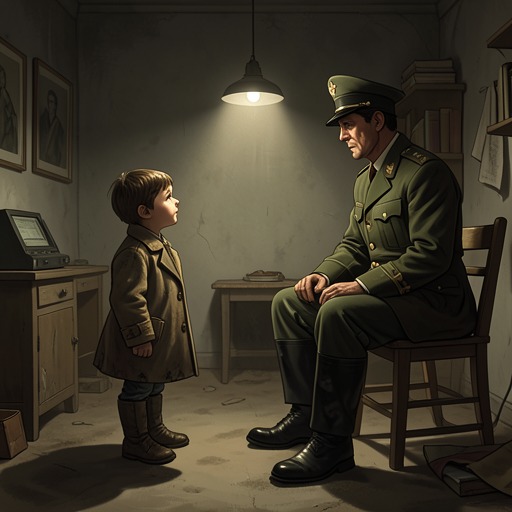
At a military checkpoint, the Queen has a photograph of a disappeared person in her pocket. Ordered to choose whether to stand with the men or the women, she answers with a joke about having to split herself in two. She redirects the soldier’s attention by speaking about embroidery for officers’ families and avoids being searched. Her performance draws on the social assumptions attached to her appearance and her work; it gives her a brief passage through a system that subjects others to inspection. The photograph remains a reminder that the political violence she has heard about on the radio is carried into the street and held against her own body as evidence of another person’s absence.
Evacuation and the limits of refuge
As the danger closes in, the Queen imagines soldiers returning to her house and fears that the neighbors might identify the boxes and the young men who visited. She reaches home without knowing whether Carlos is there, climbs the stairs through the dark, and finds no one. The uncertainty leaves her listening for news and hoping that he or his friends may still appear, even as the house becomes harder to defend.
At dawn, she prepares to leave. She burns scraps of paper containing telephone numbers and addresses, cleans surfaces, and packs her possessions into two bags. From the rooftop, she looks over the city before a car arrives to take her away. The view that had been part of the home she cherished becomes something she expects never to see again. She leaves for Rana’s house, carrying her belongings and an unresolved attachment to Carlos. The period’s political violence has made the Queen’s refuge untenable; her departure turns the domestic story into an account of displacement, while leaving open whether love, memory, or the city itself can be recovered.