Curfew in Chile
My Tender MatadorCurfew in Chile is more than a restriction on movement in the novel: it is an instrument of state control that also reorganizes street life, work, and risk. It helps expose how people marginalized by poverty and queer identity navigate a city where ordinary journeys can become encounters with police violence, but also where the curfew’s disruptions create openings for mutual aid and survival.
Curfew and the Political Climate
In the spring of 1986, Santiago is marked by demonstrations, cordoned streets, burning tires, blackouts, and urgent broadcasts from Radio Cooperativa. The chant “Now he will fall!” carries through the nights, while news bulletins keep residents alert to political events. For the Queen of the Corner, the radio brings distressing reports, but political fear is not abstract: it exists alongside the threat of arrest and the practical question of how to move through the city.
The novel sets this atmosphere against ordinary routines. The Queen embroiders tablecloths for wealthy clients, listens to old songs, and encounters political news through neighborhood conversation and the radio. These domestic details do not insulate her from public events. Reports of students injured and arrested by special police forces leave her anxious about Carlos, who has not contacted her; when she sees him return, relief briefly displaces fear.
A Double-Edged Constraint
The Queen’s friend Lupe describes the curfew as a source of opportunity as well as danger. Men stranded outside their homes, avoiding patrols or unable to get home, may seek company and offer money or other small necessities. In a setting of unemployment and precarious street economies, the restrictions can make encounters possible that would otherwise not happen. Lupe even voices gratitude toward the government for maintaining what she calls law and order, a view that contrasts sharply with the Queen’s growing recognition of the regime’s violence.
That contrast reflects differences within the queer community rather than a single shared political outlook. Lupe treats the dictatorship’s order as compatible with her immediate survival; the Queen increasingly sees the regime as a tyranny. Their exchange shows how economic precarity can shape political perception, and how people facing the same curfew may interpret its effects in opposing ways.
Movement Through a Militarized City
The curfew’s risks become tangible when the Queen travels by bus carrying a package for Carlos. Amid tear gas and a street demonstration, she nearly loses the parcel, then retrieves it and continues through Paseo Ahumada. A new crowd runs toward her, and she finds herself facing a police formation advancing with shields, helmets, and batons. Rather than join the fleeing demonstrators, she insists that she should be allowed to pass as an older woman going shopping. Her composure and audacity let her get through the police line and deliver the package at the designated shop.
The episode makes the Queen’s movement through public space a negotiation with authority. Her claim to be an ordinary shopper momentarily confounds the police, while her errand binds private loyalty to the wider atmosphere of repression. The curfew and police violence do not simply keep people indoors; they make even a short journey uncertain, requiring improvisation and exposing civilians to force.
Searches, Surveillance, and Unequal Exposure
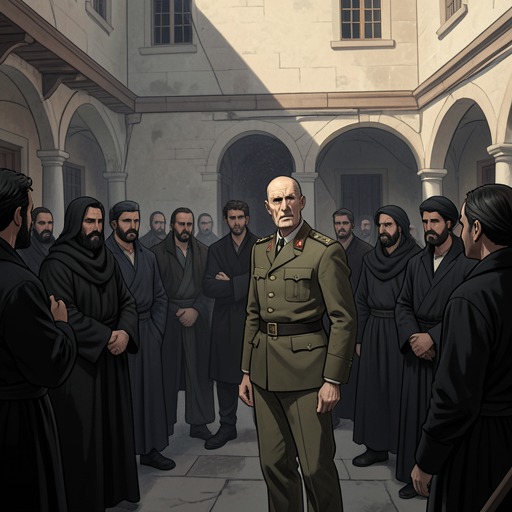
After the September ambush on Augusto Pinochet’s motorcade, Santiago is placed under an intense military lockdown. Soldiers search cars, houses, and entire neighborhoods; roads into and out of the city are cut off, and residents may be held standing through the night in football fields. People can be beaten and loaded into trucks after even a small hesitation. The Queen listens to Radio Cooperativa’s warning that citizens should remain at home and report anything suspicious, while keeping a kettle ready in case Carlos or his friends arrive.
The same security apparatus that polices movement also creates moments of unequal, precarious passage. At a checkpoint, a soldier directs men to one side and women to another. The Queen, unsure where she is expected to go, answers with a joke about having to split herself in two. The soldier responds with sexualized banter and lowers his machine gun, allowing her to leave without a search. The exchange offers no dependable protection: her safety rests on a brief interaction with an armed official, while other passengers remain under guard.
Consequences and Significance
The Queen’s experience of curfew is inseparable from her precarious position. Her work, home, and social ties provide ways to endure, but none shield her from surveillance or violence. She can use wit and a performed persona to pass through an encounter, yet she remains alert to the possibility that soldiers may follow her or discover the resistance network connected to her house.
As the military searches spread through Santiago, the Queen spends a sleepless night listening for Carlos and his friends. By morning, she has destroyed papers bearing addresses and telephone numbers, cleaned the house, and packed her possessions into two bags before leaving for La Rana’s home. Curfew thus culminates not merely in restricted movement but in displacement: the state’s control of streets and homes helps make the Queen’s own refuge impossible to keep. The novel presents the curfew as a coercive condition that reaches into domestic life while showing how vulnerable people continue to make choices, take risks, and care for one another within it.