Drag Performance and Self-Fashioning
My Tender MatadorDrag Performance and Self-Fashioning is a recurring practice through which the Queen of the Corner turns clothes, objects, music, and gesture into a deliberately shaped public self. It is not merely decorative: performance helps her make a home for her queer friends, diverts attention from clandestine meetings, and, at a military checkpoint, helps Carlos and her pass without inspection. In quieter moments, it becomes a language of affection and creativity, even when Carlos does not answer her love in the way she hopes.
A Home Made into a Stage
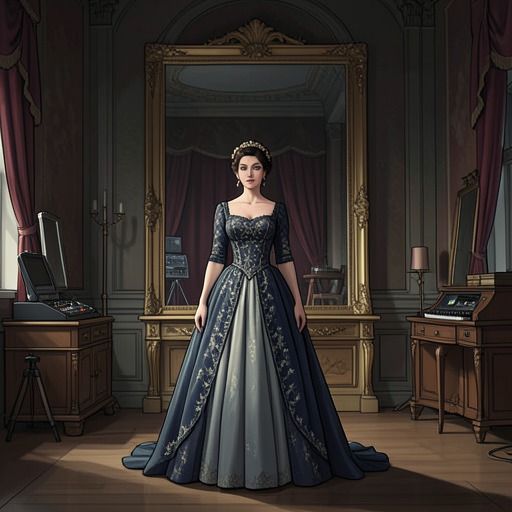
The Queen’s house acquires the look of a fantasy setting assembled from whatever is at hand: crushed silks, old mannequins transformed into angels and centurions, and boxes and crates made into thrones, armchairs, and divans. The extravagant arrangement gives her queer friends room to visit and lounge together. Its theatricality makes the house feel like a world of her own, fashioned from objects that might otherwise have seemed ordinary or discarded.
The same rooms also shelter Carlos’s university friends, who meet there at midnight or dawn. The Queen serves them coffee and sings along to love songs, while the radio’s music distracts from their plans until they switch to Radio Cooperativa and its reports of violence and barricades on Alameda Bernardo O’Higgins. She is not told the full purpose of the meetings. When she tries to approach the visitors with coffee, Carlos gently keeps her away, saying they do not want to be disturbed while studying. Her performance as a genial, hospitable hostess thus unfolds alongside a secret she senses but does not know.
The contrast is apparent in the house’s different audiences. A small group of queens visit for tea and teasingly call Carlos and his companions the señora’s suitors, asking to see her supposed arsenal of admirers. She parries their jokes and sees them out before the young men arrive. The Queen’s home is at once a queer social space, a set for her flamboyant self-presentation, and a place used for meetings whose political character is concealed from her.
Costume, Objects, and Concealment
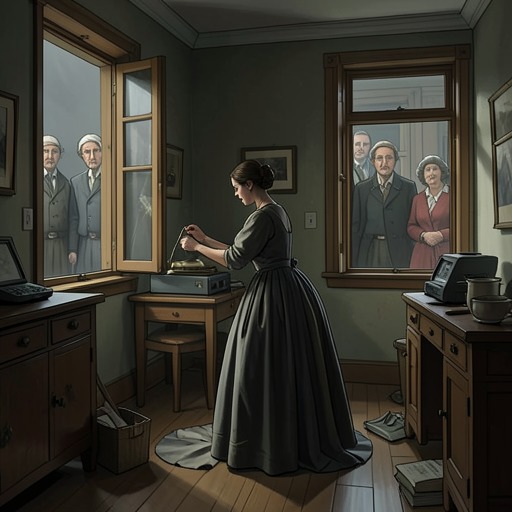
When Carlos and two friends arrive before dawn carrying a heavy metal cylinder, the Queen treats the unfamiliar object as material for her domestic imagination. She speculates that it contains valuable manuscripts, then jokes that it looks like an enormous condom; after Carlos hurries away without explaining, she considers opening it but decides she would rather trust him than discover a betrayal. Instead, she drags it into the living room, sets it in a corner, and disguises it with a pot of gladiolas, yellow silk lace, and ribbons. The concealed object becomes part of her interior decor, and her aesthetic transformation gives it an innocuous appearance without revealing what it is.
When Carlos sees what she has done, he praises the arrangement and embraces her with evident gratitude. The scene joins two kinds of meaning: for the Queen, the cylinder is an ugly mystery made beautiful; for the clandestine visitors, the disguise has practical value. Her styling does not depend on knowing the secret. It depends on her ability to turn a strange object into something that belongs in her home, while choosing not to force the truth from Carlos.
Her most consequential costume change takes place on the road. Carlos asks her to put on a yellow hat, cat’s-eye glasses, and polka-dot gloves when soldiers stop cars at a checkpoint. He tells her to do her drag-queen act but does not explain why. She follows his request, turning the encounter into a comic display that leaves the soldiers laughing and unsettled. They barely examine the documents Carlos hands over and let the car pass. The Queen later understands that they were looking for something else, though she does not know precisely what. In this instance, performance is both an expressive flourish and a means of evading scrutiny amid political unrest.
Performance as Shared Play
On a countryside outing, the Queen’s careful appearance and chatter contrast with the landscape they pass: impoverished outskirts, the remnants of fires, and then roadside vendors selling kites and little flags. Her jokes keep the conversation moving until a police checkpoint interrupts their journey. Once they are through, Carlos laughs, reaches affectionately toward her shoulder, and praises her performance. She explains that she has an actress’s soul and that the display was an act. The exchange makes theatricality a form of collaboration: Carlos provides the cue, the Queen improvises, and their shared laughter follows their escape from inspection.
The countryside also offers a stage for performance without an immediate practical purpose. While Carlos measures and sketches the terrain, the Queen ties a tablecloth around her neck like a cape, wears her cat’s-eye sunglasses and yellow gloves, and dances to music from a tape deck. Carlos pauses his work to become her audience, applauding her turns and gestures. She sends him phantom kisses and dances barefoot on the earth. The scene shows her imaginative transformation of a picnic into a performance, but it also gives Carlos a different way of seeing her: he is amused, absorbed, and briefly distracted from his calculations.
That attention does not resolve the difference between them. Carlos eventually asks her to stop the music so he can finish his work before the light fades and the car must be returned. The Queen’s performance has drawn him in, but his attention remains divided between her and the task he has brought into the countryside. The episode holds creative intimacy and unequal emotional investment together: her gestures make a moment for the two of them, but they cannot determine what Carlos feels or what he will disclose.
Comic Deflection and Emotional Exposure
At home, the Queen sometimes uses theatrical melodrama to provoke Carlos into greater candor. Frustrated that he keeps secrets about the boxes and treats her with careful politeness, she complains that he is behaving as though she were an elderly, sickly woman. Her challenge is less about the objects than about their relationship: she wants him to trust her and respond to her feelings. Yet her flaming comic style makes it difficult for him to recognize the seriousness beneath the performance. He answers by changing the subject and telling her about a Cuban custom of holding neighborhood birthday celebrations together.
The scene reveals both the power and the limits of her self-fashioning. The Queen can control her entrance, her costume, and the tone of a conversation, but she cannot make Carlos confide in her or return her love. She turns disappointment into wit, even as the story makes clear that the joking surface conceals a wish for intimacy. Performance protects her from speaking plainly and exposes what she cannot safely ask for directly.
Hosting, Kinship, and Narrative Significance
The Queen’s theatrical skill also shapes her role as a host. For Carlos’s birthday, she decorates with purple, royal-blue, yellow, and red balloons, chooses red because she thinks he will like it, and crowns him in advance with a shiny cardboard crown. She arranges plastic cups, horns, birthday plates, and hats, and obtains an immense pineapple cake from a neighborhood shopkeeper. When more than twenty children arrive, she stops their rush into the house, assigns them places, and organizes a poem, a birthday song, and the lighting of the candles. The booming, effeminate voice that directs them becomes part of the performance, while its purpose is practical: to make the surprise orderly and joyful.
The children address her as Uncle, Auntie, or another kinship term, and she responds by guiding rather than rejecting them. The episode broadens her self-presentation beyond glamour or romantic display. She can command a room, improvise a role that children understand, and create a celebration for the neighborhood. Her theatricality makes social connection possible: it gives the children a shared event and turns her home into a place where care is organized through play.
Across these episodes, Drag Performance and Self-Fashioning names a way of making meaning from appearances without reducing the Queen to appearance alone. A flowerpot and ribbons conceal a mysterious cylinder; a yellow hat and gloves turn a checkpoint into a comic diversion; a tablecloth becomes a cape; balloons and a cardboard crown help stage a communal birthday. These transformations are creative acts, but their outcomes differ. Some protect clandestine activity, some win Carlos’s momentary attention, and some express affection or sustain community. The Queen’s performance can alter how a scene unfolds, but it cannot erase political danger or guarantee the love and trust she longs for.