FPMR reconnaissance of Pinochet's convoy route
My Tender MatadorThe reconnaissance of Augusto Pinochet’s convoy route turns a seemingly playful outing into a covert survey of the road where the dictator’s motorcade will later be attacked. Carlos’s photographs, measurements, and terrain sketches give the excursion its concealed purpose; the Queen of the Corner supplies an unplanned disguise at a checkpoint, while the narrative’s later return to the same road reveals that the pair’s presence has been noticed. The episode’s suspense rests on unequal knowledge: she reads the trip as intimacy, Carlos does not explain his work, and Augusto Pinochet only recognizes the danger in retrospect.
An outing with a concealed purpose
Carlos drives the Queen away from the city and through a military checkpoint on a road marked by curves and roadside decorations. When soldiers stop cars, he suddenly asks her to put on her yellow hat and perform her drag persona, saying that he will explain later. He does not explain. She complies, adding her cat’s-eye glasses and polka-dot gloves, and turns the encounter into a comic performance. The soldiers laugh, barely inspect the car or Carlos’s documents, and let them pass. The scene makes her skill consequential without making her a knowing participant: she helps them evade scrutiny, but the purpose of the outing remains hidden from her.
The hill, the camera, and the route
Farther along, Carlos pulls over at a hill and calls the stop fieldwork. He helps spread the embroidered tablecloth on a grassy terrace overlooking the road, river, and surrounding mountains. The Queen sees an isolated, beautiful place for the two of them; Carlos is there to study the terrain. He takes photographs, makes measurements, and draws maps, repeatedly moving over the hill, checking his watch, and returning to his notes. His activities identify the excursion as reconnaissance rather than the botanical project the Queen assumes he is doing.
The camera briefly seems to belong to their flirtation. As the sound of a helicopter and the presidential motorcade approaches, Carlos positions the Queen against the road and photographs her with the passing vehicles behind her. She asks to wear her hat; he tells her to stay as she is while he adjusts the camera. The vehicles pass, and the image-making that had seemed part of their playful encounter takes place against a presidential procession. The scene does not establish exactly what Carlos records in that photograph, but it places his camera, the road, and the motorcade in the same frame.
An encounter read differently by each person
The Queen’s attention remains fixed on Carlos and the closeness she hopes the trip might bring. She performs for him, asks to play music, and turns the tablecloth into a cape; Carlos is amused by her theatricality, but repeatedly returns to his calculations and the fading daylight. He needs to finish his plans and take more photographs before they lose the light. When she looks at him in a way that unsettles him, he asks her to stop and to turn off the music until his work is done. Their different understandings of the outing sharpen the secrecy: the Queen experiences its details as signs of intimacy, while Carlos’s attention is divided between her and a task he will not explain.
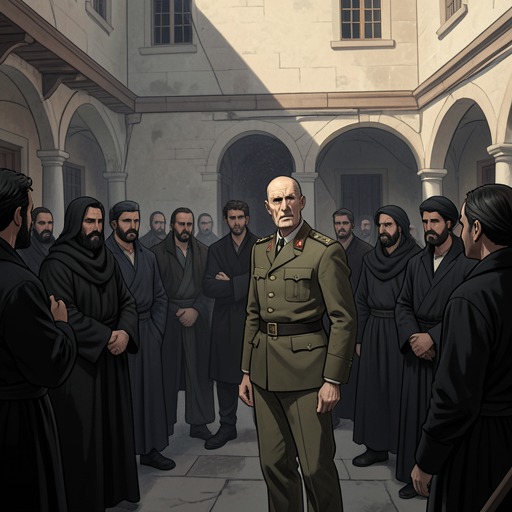
The same encounter is later recalled from Augusto Pinochet’s perspective. During the motorcade, he remembers the couple on the rocky slope: Carlos with a camera, and the Queen seated nearby in her hat. At first he has read them as ordinary visitors. Looking back, he recognizes them as two gay men and reacts with homophobic anger, resolving to contact the local mayor. His recollection gives the earlier scene a second political meaning. The pair were not simply unseen: the dictator’s own gaze had passed over them, though he understood neither Carlos’s activity nor its threat at the time.
The road revisited
The route’s political significance becomes clearer when Augusto Pinochet’s thoughts turn to the drive through the Cajón del Maipo. He prefers the canyon road, where the narrow gorge, river, and high road give the motorcade a sense of danger that he also finds exhilarating. He recalls the 1973 attack on La Moneda, which he directed from a command room in Peñalolén, and interprets the landscape as evidence of a country made orderly under his rule. This self-assurance contrasts with the practical work of the reconnaissance: Carlos has measured and mapped a road that Augusto Pinochet treats as safely under control.
On the later drive, Augusto Pinochet dismisses the security services’ objections to his chosen itinerary and insists on proceeding along the Achupallas grade despite their warnings. He believes that nothing can happen without his knowledge and that an attack is implausible. The narrative thus connects Carlos’s earlier surveying to the dictator’s complacency without claiming that this outing alone accounts for every operational detail of the later ambush. The reconnaissance is one strand in a larger chain of events, but it makes the route’s vulnerability legible before the motorcade encounters it.
Parallel action and dramatic irony
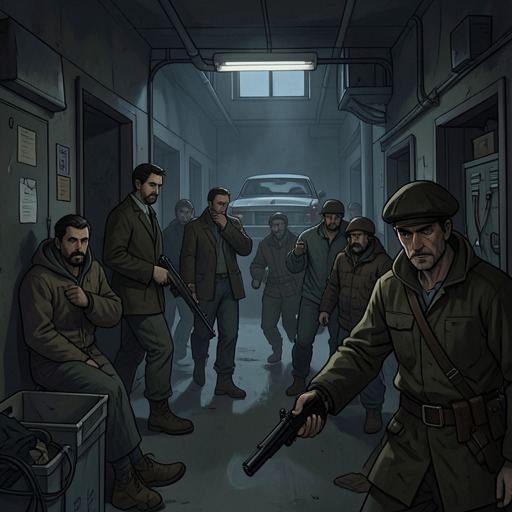
The novel makes the connection between survey and attack through a later sequence that alternates clock-marked scenes of the Queen at a movie theater and Augusto Pinochet in his convoy. The Queen watches an action film and, as the military operation unfolds, imagines Carlos under fire; on the road, the motorcade continues toward the ambush. The screen’s pursuit imagery and her anxious projection do not provide a factual report of Carlos’s movements. Instead, the parallel construction binds her private longing to the real danger generated by the route and the political struggle around it.
When the attack begins, Augusto Pinochet’s convoy is caught in the violence on the Cajón del Maipo slopes. His car escapes as the chauffeur reverses and turns it around, leaving damaged vehicles behind. The failed journey to secure the dictator’s death does not erase the earlier reconnaissance’s importance: the outing has already established how the road was observed, photographed, and measured, while the dictator’s memory has shown how easily the observers could be mistaken for harmless travelers. The episode therefore makes reconnaissance both a practical operation and a narrative device, transforming a private excursion into advance knowledge of the landscape on which the later attack will occur.