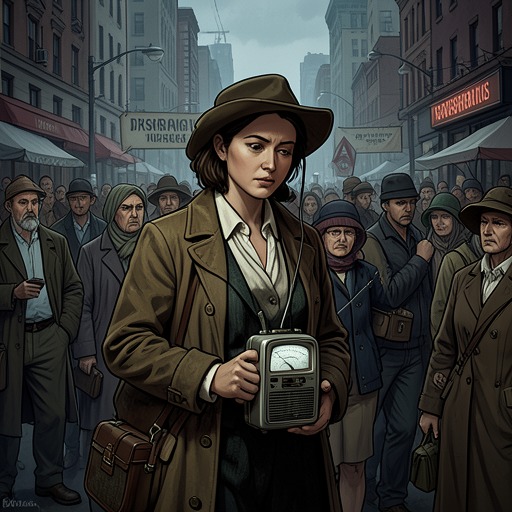
Forced Disappearance in Chile’s Dictatorship
My Tender MatadorForced disappearance in Chile’s dictatorship appears not as a distant political abstraction but as an absence pursued by families and carried into daily life through demonstrations, radio reports, and fear. The Queen of the Corner’s gradual response to accounts of missing people links her private world to the public struggle to learn what happened to those taken by the authorities.
Political Climate and Public Protest
In the spring of 1986, Santiago is marked by street demonstrations, student protests, police water cannons, and sudden blackouts. Protesters return to the streets despite being dispersed, while the annual build-up to September brings renewed calls for people to demonstrate. The Queen hears political discussion in the neighborhood grocery store, but initially prefers old songs to the news and finds the reports frightening.
That distance narrows as she listens more often to Radio Cooperativa. The station reports both political developments and the suffering of families seeking information about missing relatives. Its news gives her a way to encounter events beyond her immediate surroundings, even as she continues to spend her afternoons embroidering tablecloths and sheets for wealthy clients.
Families Seeking the Disappeared
The accounts that move the Queen describe women searching through rubble and repeatedly knocking on doors that remain closed. Some have been drenched by police water cannons while trying to find out what happened to their loved ones; others wear photographs over their hearts and chain themselves to lampposts. The broadcast imagery makes the search visible as both a demand for information and a public act of protest.
A later report announces a vigil by the Organization of Families of Detained and Disappeared Persons in front of the Vicaría de la Solidaridad at the Plaza de Armas. The families demand that those responsible for human-rights abuses be brought to justice. By then, the Queen has become emotionally affected by the testimonies of people whose husbands, sons, or other relatives have been taken away. She has also begun to call the system a dictatorship rather than the military government, adopting language that marks a change in how she understands the reports.
State Violence in Everyday Life
The narrative places these appeals for justice beside the ordinary mechanisms of intimidation: demonstrations broken up by police, arrests, military authorities, and warnings from the government. A radio report says that more than twenty students were injured and at least as many arrested after university unrest, then turned over to military authorities. The Queen worries that Carlos may be among those arrested, showing how political news can become an immediate personal fear even when she does not know what has happened to him.
The pressure intensifies during the September 1986 searches of Santiago. Soldiers occupy the city, roads are cut off, and searches extend to cars, houses, and entire neighborhoods. People may be kept standing through the night in football fields or taken away in trucks as suspects. A broadcast asks citizens to stay home, remain vigilant, and report anything suspicious. In this atmosphere, disappearance is connected to a broader system of surveillance and coercion: families seek answers while neighbors and residents are also urged to watch one another.
Witness, Memory, and Private Response
The Queen encounters the issue through repeated listening rather than through an official investigation. Radio Cooperativa’s reports become part of the household rhythm, interrupting sewing and domestic routines with accounts of protests, missing relatives, and state action. Her response changes over time: what first frightens her becomes difficult to ignore, and the families’ testimonies draw her into a wider recognition of the harm around her.
The narrative sets that recognition against the Queen’s own vulnerability and her concern for Carlos. Her personal anxieties do not stand in for the families’ loss, but they show how fear and uncertainty travel from public events into private life. By placing the families’ demands for justice within the same narrative as household work, radio listening, and military searches, the account makes forced disappearance an ongoing presence in everyday experience rather than a matter confined to official announcements.