Forced disappearances under the dictatorship
My Tender MatadorForced disappearances under the dictatorship are presented as an ongoing condition that reaches from grieving families into the Queen of the Corner’s neighborhood, work, and movements through Santiago. The missing remain present through photographs, unanswered questions, and the danger attached to anyone who listens, speaks out, or carries a trace of their story; their families’ demand to know what happened becomes a public challenge to a state that offers force and warnings instead of answers.
Families’ Search and Public Witness
The Queen’s concern for people who have been killed and disappeared is tied to the testimony of women she hears while embroidering sheets for wealthy clients. She remembers their grief and persistence: searching for loved ones, asking for news, and carrying photographs as they seek recognition. Their struggle is not distant political commentary to her. It is the human reality that has moved her all along, set against the ordinary labor through which she earns her living.
The search becomes visible at the steps of the cathedral near the Plaza de Armas, where women—wives, mothers, grandmothers, and sisters—gather with photographs of arrested and disappeared family members. They chant for justice and demand to be told where their relatives are. A young woman invites the Queen to join them; she takes up a placard bearing a disappeared person’s photograph and adds her voice to the group. In this collective setting, she feels a sense of safety and belonging rather than embarrassment. The gathering gives individual loss a public form, though the arrival of police sirens quickly forces the demonstrators to scatter.
Photographs, Risk, and Everyday Life
The photograph does not lose its force when the demonstration breaks up. After escaping the dispersal, the Queen carefully removes the image from the placard, folds it, and puts it in her pocket. That small act carries the protest into the rest of her day: the photograph is at once a record of a missing person and a potential danger to the person carrying it. Her political participation is therefore expressed not only in the moment of joining the women but also in the decision to preserve the image afterward.
This burden recurs when soldiers separate men and women during a street check. The Queen still has the photograph in her pocket and is unsure where to go. She responds to the soldier’s questioning by drawing on her drag persona and her work embroidering tablecloths and sheets for military families. The scene links her precarious position to the disappearances: the state’s power to sort and scrutinize people makes an ordinary object of remembrance feel perilous, while her quick-witted self-presentation helps her negotiate the encounter. The novel does not claim that this moment resolves the missing person’s fate; it shows how the unresolved case follows her through public space.
Official Speech and Neighborhood Awareness
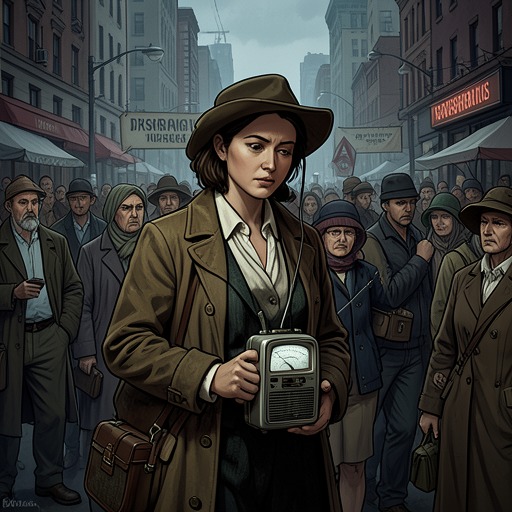
The disappearance of political detainees also enters domestic life through radio. A government communiqué announces that a subversive plan scheduled for September has been uncovered and that measures have been taken to prevent violence. The Queen turns to Radio Cooperativa, which reports the transfer of detainees to military authorities. The contrast between official assurances and news of arrests sustains her anxiety, including her fear that Carlos may have been detained with other revolutionary students. The broadcasts make clear that a missing person’s fate is not merely a private matter: arrest, military custody, and the absence of reliable information are part of the political conditions shaping her expectations.
Political talk is likewise woven into the neighborhood’s everyday routine. At the local grocery store, residents exchange opinions about demonstrations, opposition statements, the Dictator’s threats, and calls for action in September. Their hope that 1986 will bring change exists alongside unemployment and dependence on credit for basic food. The juxtaposition shows how national conflict is discussed amid ordinary material hardship, while the families’ search for the disappeared gives that conflict an intimate and continuing human cost.
Repression and Its Consequences
At the Plaza de Armas, the police response interrupts a peaceful act of collective witness. The Queen flees with the others and later takes refuge, still carrying the folded photograph. In the aftermath, her anger at state violence and her sympathy for the families remain intertwined with her support for Carlos and his associates in the Manuel Rodríguez Patriotic Front. The novel places her participation in the demonstration beside her hope for revolutionary retaliation, without suggesting that the families’ demand for information has been answered.
The larger crackdown intensifies after the September 1986 ambush on Augusto Pinochet’s motorcade. Santiago is placed under military control: roads are closed, soldiers search cars and homes, and residents may be detained during searches. Against this citywide climate, the Queen remains awake with the kettle ready in case Carlos or his friends arrive, listening to the radio for news. She spends the night erasing traces of herself from her house, burning papers with addresses and telephone numbers and cleaning surfaces before packing her possessions into two bags. The disappeared person’s photograph, carried earlier through the city, belongs to the same atmosphere of uncertainty: evidence and personal connections may expose people to danger, while those already taken remain unaccounted for.
The Queen leaves the house at dawn facing a future in which even familiar places may not be seen again. Her departure does not resolve the search for the disappeared or restore the security that the crackdown has destroyed. Instead, the novel makes disappearance legible through its effects: families continue to ask where their loved ones are, public witnesses are dispersed, a photograph becomes a risk to carry, and fear reshapes the most ordinary decisions about listening, traveling, and remaining at home.