Queen of the Corner
My Tender MatadorThe Queen of the Corner is a queer, working-class Santiago resident whose home and unreturned devotion to Carlos become entangled with clandestine resistance to the dictatorship. Initially she offers him space for boxes and meetings without knowing what they contain; by the time the danger is clear, she has carried a package through tear gas and a police line, joined women demanding justice for the disappeared, and been driven from the city. Her trajectory makes a private refuge into a site of political action, while preserving the painful difference between Carlos’s trust and the romantic future she imagines with him.
Identity and the House
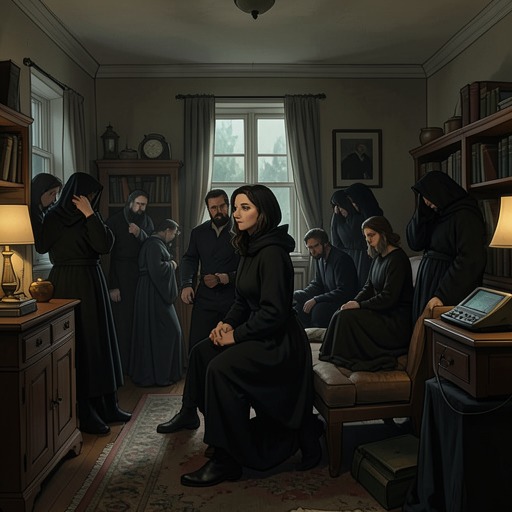
In the spring of 1986, the Queen lives in a dilapidated three-story corner house in Santiago, its narrow rooftop room looking over the city. She clears the neglected building herself and turns it into a richly decorated refuge, filling its walls and furniture with birds, lace, scarves, and embroidered cloth. The care she gives the house is more than ornament: it is the one place she can call her own, an ordered, imaginative interior set against a precarious life and a city marked by demonstrations, blackouts, and police violence.
Her work embroidering sheets and oversized tablecloths for wealthy older women provides an income. The neighborhood knows her through the songs she sings while working and the music that spills from her open windows, waking the block like a communal alarm. The grocery store, meanwhile, is a local forum for gossip and political talk. The Queen listens more readily to old songs than to Radio Cooperativa’s urgent bulletins, which frighten her, but she is not untouched by the violence around her. Her domestic routines place her close to the political crisis even before she takes part in it.
The house also becomes a practical refuge for Carlos and his associates. At first he describes the heavy boxes he asks her to store as books, and she accepts the explanation without pressing him. She helps arrange them around the rooms, making them part of her domestic landscape, and allows meetings upstairs. Her attachment to Carlos helps explain this generosity, but it is not the only measure of what she does: she supplies space, discretion, and eventually direct assistance to people engaged in underground work.
Love, Memory, and Social Belonging
The Queen falls for Carlos after meeting him at the neighborhood store. His university education, polished manners, and beauty become the focus of an elaborate romantic imagination. When he visits or leaves boxes at her home, she savors his name and interprets his compliments as tokens of intimacy. She understands, however, that his courtesy and presence do not amount to the love she wants. His kindness gives her room to hope, while the limits of their relationship repeatedly bring that hope up against reality.
Her longing takes shape against an earlier life of exclusion and hurt. In the long vigils while Carlos’s group meets, she recounts memories of street life and of growing up without her mother, amid her father’s rejection and punishment for her femininity. As an adult she finds a chosen family among queer friends, including Lupe and Rana. Before she had a home of her own, Rana gave her shelter and food and urged her to stay sober and keep living. The Queen tolerates her friends’ teasing because their relationship is grounded in years of care, a form of belonging distinct from the deferential but emotionally limited bond she has with Carlos.
The contrast also shapes her response to public hostility. On a bus crossing Santiago, she challenges a passenger who condemns students for protesting and striking. She points to soldiers in the streets and the explosions and gunfire that make ordinary life frightening. Her intervention surprises her as much as it does the students who applaud her. She imagines Carlos approving of her courage, but the act is her own: someone who has stayed apart from political debate has found a public voice when the official account of the country no longer fits what she sees.
From Shelter to Political Action
The Queen’s help becomes more direct when Carlos asks her to deliver a heavy package downtown. He gives her directions to a meeting with a mustached man on the Paseo Ahumada and tells her to memorize them rather than write them down. When tear gas and mortar blasts disrupt the bus journey, she briefly loses the package in the confusion, then searches for it and recovers it. Despite the chaos, she reaches the designated location and hands it over. At this point she does not know the full contents, but the metal weight makes clear that the package is not ordinary household material. Her decision to carry it is an act of trust in Carlos and a concrete contribution to his clandestine work.
On the way to the meeting, she encounters a police formation confronting demonstrators. Rather than flee, she adopts the composure and sharp wit of her public persona, presenting herself as an older woman who simply needs to pass. Her audacity briefly unsettles a policeman and helps her get through with the package. This episode reveals her ability to use the very mannerisms that expose her to ridicule as tools of survival. The performance does not erase the danger; it lets her move through it.
Later, after a policeman strikes her for picking up a leaflet calling for a demonstration, the Queen heads toward Plaza de Armas. There she sees women holding photographs of detained and disappeared family members and joining their voices in a demand for justice and answers. She accepts a placard bearing a photograph and joins the protest, finding a sense of safety among the women that she does not usually feel in public. When police arrive to break up the gathering, she escapes through the plaza and keeps the photograph, carefully folding it into her pocket. Her participation links her personal opposition to repression with the families’ search for the missing; it also marks a widening of her political engagement beyond helping Carlos.
Exposure, Flight, and the Limits of the Romance
After the failed attack on Augusto Pinochet, soldiers and police search Santiago, and the Queen’s house is at risk because it has served as a safe house. Carlos’s associate Laura tells her that the other safe houses have been searched and that the secret police may reach hers within hours. The Queen protests that she cannot simply abandon the home she has made, but Laura insists that leaving is necessary for everyone’s safety. She agrees on the condition that she may see Carlos again. Told to remove anything that could expose the network, she returns to the house and spends the night burning papers, erasing addresses, cleaning surfaces, and packing her most valued belongings into two bags.
Before leaving, she looks from the rooftop over the city she has made her home. Her departure is both a practical escape and a personal dispossession: the house is the only place she has loved as her own, and leaving it makes the rupture with Carlos’s life of clandestine action tangible. She is not given a destination in advance, and the people arranging her departure pay for her transport, expenses, and lodging. Her removal is necessary because the refuge that once protected the group has become a danger to her and to them.
Carlos eventually meets her in Viña del Mar, where she has reached under the protection of the network. He guides her onward toward Laguna Verde, avoiding a direct route while security checks continue. In their final conversation, he offers to take her to Cuba: the people involved in the operation are leaving the country, and her departure could be part of the plan to save her. She recognizes the generosity of the offer but refuses to treat it as a promise of love. She tells him that she fell in love with him and that he allowed himself to be loved, but that the relationship they did not have in Chile will not materialize elsewhere. Her refusal preserves the distinction between escape and romantic fulfillment. She has risked herself for Carlos and his cause, yet does not mistake gratitude or rescue for the future she wanted.
Narrative Significance
The Queen’s arc turns the boundaries between domestic life and political resistance into a central dramatic tension. Embroidery, music, boxes, a radio, and a cherished house belong to her daily world; as the crisis deepens, the house shelters clandestine meetings, and an ordinary trip across town becomes a dangerous courier mission. Her political awakening is not presented as a sudden conversion detached from her circumstances. It develops through what she hears, sees, and endures: news of arrests, soldiers on the streets, a police assault, and the women carrying photographs of the disappeared.
Her femininity is also a form of public performance and practical intelligence, not a simple disguise or a route to acceptance. The Queen is mocked and threatened, yet in moments of danger she uses wit, manners, and theatrical self-possession to move through spaces where force is arrayed against demonstrators. The same society that treats her as an object of gossip underestimates her capacity for discretion and action. Her courage does not cancel her vulnerability, and the narrative does not make political usefulness a substitute for emotional reciprocity. The final offer of escape saves her from remaining in an exposed safe house; it cannot give her the mutual love she has imagined. That unresolved separation is what makes her journey both a story of resistance and one of loss.