Santiago
My Tender MatadorSantiago is not merely the setting of the Queen of the Corner’s story: it is the city through which the dictatorship enters daily life, and the place she must ultimately abandon. Its radios, buses, shops, demonstrations, and crowded streets bring political danger into ordinary routines; its poorer neighborhoods become the terrain of military searches. For the Queen, Santiago is also home: the city of her friends, her work, and the corner house she had made her own. When that house is exposed as a refuge for Carlos and his associates, the city that contains her life becomes too dangerous to remain in.
City, Neighborhood, and Everyday Life
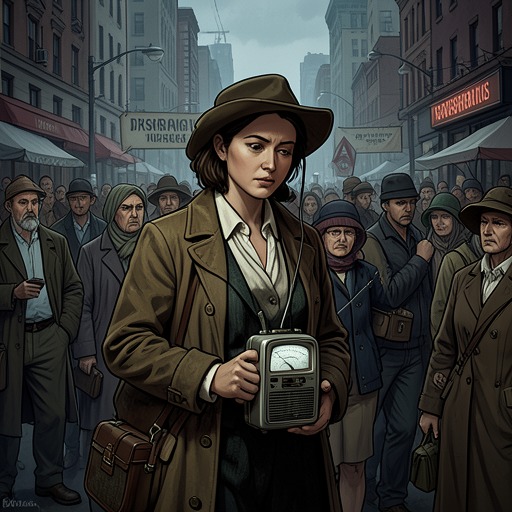
The narrative first presents Santiago in the spring of 1986, marked by cordoned streets, banging pots and pans, power blackouts, and urgent broadcasts from Radio Cooperativa. The city’s political unrest is heard as much as seen: news bulletins and chants circulate through neighborhoods where people discuss demonstrations, the opposition, and the dictator’s threats. For the Queen, this atmosphere is frightening. She prefers golden-oldies programs and spends afternoons embroidering sheets and tablecloths, keeping at a distance from the political news even as it reaches into the life around her.
Her place in Santiago is shaped by the contrast between political turmoil and neighborhood routine. The Queen’s three-story corner house, once boarded up and neglected, becomes a home she carefully adorns and a refuge she values above all. Her songs wake the block, while the neighborhood grocery store serves as a meeting point for gossip and political discussion. The residents’ talk moves between demonstrations and the practical pressures of unemployment and borrowing food on credit. The city’s history thus enters through local conversation, domestic labor, and the sounds coming from the radio, rather than through public events alone.
Santiago also holds a broader queer social world. The Queen remembers her friends Lupe, Fabiola, and Rana, who live together in Recoleta near the General Cemetery. Their home is poor and modest, but it has offered her shelter and food when she had nowhere else to go. Her journey back toward downtown and the Mapocho River takes her through markets and crowded avenues, reaffirming the city as her own place and her people as those who struggle under the surviving dictatorship. The journey makes clear that Santiago is not simply the stage for her attachment to Carlos: it contains relationships and forms of belonging that precede and exceed it.
Streets of Protest and Repression
The political crisis becomes personal when the Queen carries a package for Carlos through a demonstration. Amid tear gas and confusion, she searches for the package, finds it under a bus seat, and holds on to it because she fears Carlos would not forgive her if she lost it. On Paseo Ahumada, a new crowd surges into the street, chanting against Pinochet and the secret police. The Queen initially refuses to flee, believing she should be allowed to go about her business; when she meets the advancing police line, she asserts that she is simply trying to go shopping. Her audacity lets her pass through the formation with the package and reach the appointed shop, where a mustached man takes it from her. Santiago’s commercial thoroughfare has become a route for covert delivery, and a routine errand places her directly in the path of state violence.
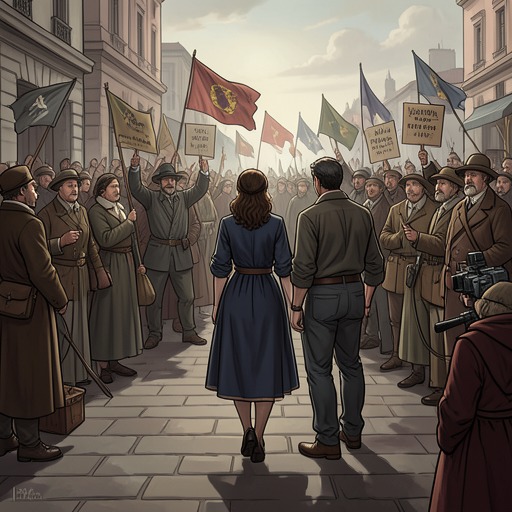
The same streets bring her into contact with the people most visibly affected by repression. After a police officer strikes her for reaching toward a leaflet, she limps toward the Plaza de Armas and encounters women carrying photographs of detained and disappeared family members. She joins them, takes up a placard, and adds her voice to their demand for justice. Among the women, her high-pitched voice is no longer a source of embarrassment; she finds a temporary sense of safety in the shared protest. When police sirens arrive to break it up, she flees through the plaza and takes refuge in a shopping arcade. The scene connects her private worry about Carlos’s safety to a public community of families seeking answers about those taken by the authorities.
Military control also shapes movement beyond the center. During a checkpoint, the Queen has the photograph of a disappeared person in her pocket and is ordered to separate from the men and women. Instead, she answers the soldier with an improvised performance, presenting herself as an embroiderer of household linens for military families. The soldier is distracted by his own lewd advances and lowers his weapon, allowing her to continue without a search. Her escape depends on her ability to read the encounter and turn the expected scrutiny aside, but it does not erase the threat surrounding her: gunfire sounds nearby, and she fears both that Carlos may need help and that the authorities may be tracking her.
The City Under Siege
After the September violence, Santiago is placed under an extensive military lockdown. Roads in and out are cut off, soldiers search cars and homes, and entire neighborhoods are subjected to searches. People may be forced to stand through the night in football fields, while hesitation can be enough to bring a beating or arrest. The Queen remains awake, startled by noises in her house, with a kettle ready in case Carlos or his associates appear and the radio turned low for news. The city’s crisis is no longer a series of disturbances she can hear about from home: surveillance and raids make the house itself vulnerable.
When Laura contacts her the following morning, she explains that the other safe houses have been searched and that the Queen’s is likely to be next. She is told she must leave Santiago urgently. The Queen resists because leaving means abandoning the house she loves, but Laura insists that the danger is a matter of life and death and that the others could be endangered if she remains. Their car carries her through a city that now looks different from the one she once travelled beside Carlos. What had been a familiar urban journey becomes a forced departure, and the receding streets make the loss of home inseparable from the loss of the love story she had built around Carlos.
Santiago as Home and Loss
At dawn, before leaving, the Queen tries to erase traces of herself from the corner house. She burns scraps bearing telephone numbers and addresses, sweeps away footprints, and cleans windows and surfaces. Her two packed bags mark how little of a life she can take with her; the house that once gave her a place of her own has become a site that must be cleared for safety. From the rooftop, she looks over the city and asks herself how to look at something she will never see again. Below, Santiago catches the timid morning light, but the view does not console her: it makes the departure visible.
The novel gives Santiago a double significance. It is the political city of blackouts, leaflets, raids, disappearances, and military roadblocks, but it is also a lived place of neighborhood music, old friends, markets, and a home decorated with the Queen’s care. Her political involvement grows through specific encounters in its streets: carrying Carlos’s package, confronting the police, joining the families of the disappeared, and passing a checkpoint. Her eventual evacuation does not turn those actions into a separate political plot; it shows how state repression acts on the same person who has built a fragile life through domestic work, queer community, and unreturned love. Leaving Santiago is therefore both a practical escape from danger and the destruction of the only home she had been able to claim.