Santiago’s military lockdown after the 1986 ambush
My Tender MatadorSantiago’s military lockdown after the 1986 ambush transforms the capital from a city of ordinary traffic and errands into a place governed by searches, military orders, and uncertain reports. Through the Queen of the Corner’s movement across downtown, her anxious attention to Carlos, and her flight from her home, the episode shows how the response to the ambush enters everyday life and narrows the space in which people can move safely.
From an ordinary city to a searched city
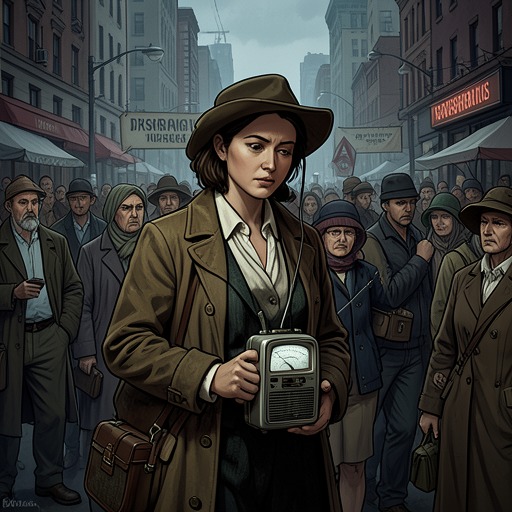
The change becomes apparent when the Queen leaves a movie theater. The normally busy central streets are nearly empty; patrol cars flash red across the Plaza de Armas, buses crowd with passengers, and helicopters pass overhead as authorities search people at street corners. The contrast is not simply between a busy and a deserted city: familiar public space has become a checkpoint system, and even finding transportation means entering a situation in which passengers may be stopped and inspected.
On the bus, the Queen hears fragments of news about an ambush on Augusto Pinochet’s motorcade. Passengers disagree or speculate about whether Augusto Pinochet was killed, wounded, or safe, and whether the members of the Front escaped. An older passenger tells her that Augusto Pinochet survived without a scratch and that every guerrilla escaped. The Queen’s relief at hearing the latter is personal: she fears for Carlos, whose whereabouts are uncertain. These are rumors exchanged among passengers, not an authoritative account of the operation, and the scene makes uncertainty itself part of the lockdown’s atmosphere.
That uncertainty gives way to direct enforcement when the bus brakes and passengers are ordered to get off one at a time for searches. The Queen remembers that she is carrying a photograph of a disappeared person and is unsure how to respond when soldiers divide the passengers into men and women. She answers one soldier’s questions by invoking her work embroidering tablecloths for generals’ wives and sheets for a colonel’s mother. Her quick-witted self-presentation draws on her employment among military families at the very moment she is subject to military scrutiny; the encounter shows how ordinary social connections and practiced performance become resources under pressure.
Public memory and the threat of arrest
The lockdown follows a history of violence and disappearance that has already shaped the Queen’s attention. Earlier, while driving with Carlos, she recalls the accounts of women searching for their missing relatives: women who ask for news, carry photographs, and seek answers from institutions. Her distress comes from listening to these stories while embroidering for wealthy clients, an intimate juxtaposition of domestic work and political suffering.
Radio Cooperativa gives that suffering a public voice. The Queen hears its report that the Organization of Families of Detained and Disappeared Persons is holding a vigil at Vicaría de la Solidaridad in the Plaza de Armas and demanding justice for human-rights abuses. The broadcast matters to her because she has begun to call the dictatorship a dictatorship rather than adopt Lupe’s preferred description of military government. News of the ambush and the subsequent searches therefore arrives in a city where arrests and disappearances are not abstractions but subjects she has heard discussed and mourned repeatedly.
Her own participation in a demonstration makes the danger immediate. After being struck by a soldier, she reaches the Plaza de Armas, where women hold photographs of disappeared relatives and call for justice and information. A young woman invites her to join; the Queen takes a placard bearing a disappeared person’s photograph and adds her voice to the group. The gathering briefly gives her a sense of safety and belonging, but police sirens announce its dispersal. She escapes into a nearby shopping passage and removes the photograph from the sign. The episode links public demands for the disappeared with the practical risks of being identified during a crackdown.
A city under siege
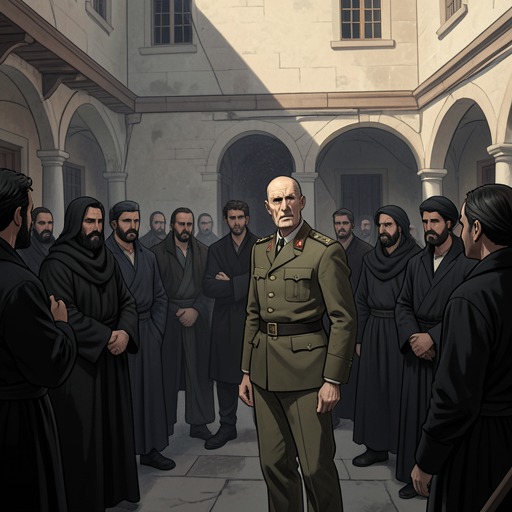
The response extends well beyond the downtown streets. On the night of the ambush in September 1986, the army occupies Santiago and cuts off roads into and out of the city. Soldiers conduct searches of cars, houses, and whole neighborhoods; in some places residents are made to remain awake through the night in football fields. People may be taken away on suspicion or after hesitating when confronted. The narrative presents the lockdown not as a single checkpoint or announcement but as a citywide system of restrictions and searches, imposed across both public roads and private homes.
The government’s public instruction reinforces that system. Radio Cooperativa reports the Interior Undersecretary’s request that citizens stay home, remain vigilant, and report anything suspicious. The call to watch one’s neighbors turns domestic space into part of the security operation: staying inside does not mean being beyond its reach, and ordinary observation can be recast as a duty to the authorities.
For the Queen, the announcement and the searches converge on the possibility that Carlos or his friends may come to her house. She stays awake, keeps a kettle ready, and listens quietly to the radio for updates. At dawn she has spent the night removing traces from the three-story corner house: burning papers with telephone numbers and addresses, sweeping, washing windows, and dusting surfaces. She packs her most valued possessions into two bags. These actions make the lockdown’s consequence concrete: the house that had been part of her everyday life becomes a place whose associations must be concealed, and leaving requires both practical preparation and a painful reckoning with what is being left behind.
Fear, departure, and significance
The lockdown also sharpens the contrast between the Queen’s political environment and her neighborhood’s everyday routines. The neighborhood grocery store is a center for talk about demonstrations, opposition statements, threats from the dictator, and the hope that 1986 will bring change. Political discussion has long been woven into ordinary life, but the military response turns that expectation into an immediate problem of safety: buses are stopped, public gatherings are dispersed, and homes are searched.
At dawn, the Queen climbs to the roof and looks toward the gray horizon after packing her bags. Her question about seeing something she will never see again frames departure as both a material and emotional consequence of the crackdown. The lockdown does not end with the broadcast or with the night of searches in the passage provided; instead, its force is registered in her sleeplessness, the clearing of her home, and her readiness to leave. In that progression, political repression is rendered through daily objects and actions: a radio, a photograph, a kettle, scraps of paper, and two packed bags.