The embroidered tablecloth
My Tender MatadorThe embroidered tablecloth is among the Queen of the Corner’s most cherished belongings, but its importance exceeds its practical use. It links her strained dealings with Doña Catita to her friendship with La Rana and, most poignantly, to an improvised beach meal with Carlos. Carried through the Queen’s hurried departure and then left behind on the shore, the cloth becomes a modest domestic object caught between the life she is fleeing and the romantic future she can only imagine.
A Possession and an Unfinished Obligation
At four o’clock, the Queen is awakened by a neighbor with an urgent telephone message from Doña Catita. Still suffering from a headache, she goes downstairs already composing an excuse for having left Doña Catita’s house without giving her the tablecloth. Her resentment quickly overtakes any sense of obligation: she thinks Doña Catita is haughty and treats her like a servant over a stupid piece of cloth. The object thus enters the scene not as a neutral household item but as the focus of a relationship marked by unequal treatment and irritation.
The Queen does not take the call. Instead, she asks a woman in the store to tell Doña Catita that she has moved away and that nobody knows where she went. The lie lets her evade the immediate demand, and as she leaves she feels the knot in her heart ease slightly. But the tablecloth remains part of the practical and emotional debris of her sudden separation from her former home: later, when told to leave and remove anything that might implicate her, she gathers the few possessions she cannot bear to abandon.
Among the Things She Chooses to Carry
The Queen’s belongings amount largely to old odds and ends, and she recognizes that she could build another poor little home out of boxes, rags, and imagination. Still, some things matter enough to save from oblivion. The embroidered tablecloth is named alongside her yellow hat, polka-dot gloves, cat’s-eye sunglasses, old issues of Ecran magazine, articles about Sarita Montiel, and a photograph of herself in drag. In this hurried inventory, the cloth belongs not to a valuable collection but to the small, particular world she is trying to preserve while being forced to leave.
Its place among these objects connects material attachment with the Queen’s effort to retain a sense of herself. The photograph lets her imagine a younger, more beautiful self and a life in which Carlos might have loved her; the tablecloth, by contrast, is not a fantasy image but a usable possession that accompanies her into the uncertain journey. The text gives no account of its history or how it came into her hands. What it establishes is the Queen’s decision to keep it, and the contrast between how little she owns and how much meaning she invests in the few things she takes.
A Table Made from Almost Nothing
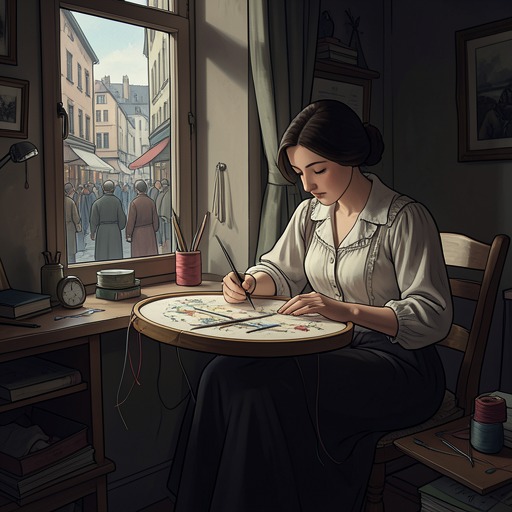
On the beach with Carlos, the tablecloth becomes the center of a small domestic scene. While Carlos runs off to buy food, the Queen searches nervously among her bags for it. Finding it, she unfurls the white cloth, embroidered with birds and cherubim, and arranges it with napkins and wildflowers placed in seashells. Carlos returns carrying bread rolls, Swiss cheese, and Chilean wine, and admires the arrangement, telling her that she can create a kingdom out of nothing.
The scene gives practical form to the Queen’s resourcefulness: a cloth, napkins, flowers, and shells turn a deserted beach into a place set for a meal. The tablecloth also briefly supports the language of equality and shared intimacy. Carlos presents the wine as a revolutionary brew that erases the difference between social classes; the Queen playfully invokes the distinction between a lady and her chauffeur before asking why, if they are equals, she still does not feel his love. The meal is tender and teasing, but her question exposes the disparity between the shared setting she has made and the love she wants from him.
Left Behind on the Shore
The tablecloth’s final appearance reverses its earlier rescue from abandonment. When Carlos invites the Queen to leave with him for Cuba, she recognizes the invitation as an offer to save her, but refuses to mistake it for a promise of romantic love. She says their stories were brought together by events without becoming one story, and that what did not happen between them will not happen anywhere. After she admits that the ambush was also her failure, a taxi horn breaks the silence. They collect their bags and return to the car; when Carlos asks whether she has everything, she nods, although she has not taken everything with her.
Behind them, the tide creeps up the dark beach toward the white tablecloth. The object the Queen had insisted on saving, and had used to create a moment of domestic grace with Carlos, is left exposed to the advancing water. Its fate is not described further, but its placement makes the departure tangible: the Queen and Carlos leave together in the taxi, while the makeshift table that briefly held their meal remains on the shore. The cloth’s movement through the story—from an obligation she resents, to a possession she protects, to the setting for a shared meal, and finally to something left behind—gives material shape to the fragile, unfulfilled intimacy between them.