Theatricality, Cinema, and Life as Performance
My Tender MatadorTheatricality, Cinema, and Life as Performance connects the novel’s characters’ private feelings to the images and roles through which they understand themselves. For the Queen of the Corner, home is a deliberately arranged mise-en-scène for Carlos, while a movie theater turns fictional action into an imagined encounter with him. As political violence closes around the city, the language of stages, screens, costumes, and endings becomes more than ornament: it shows how longing and fear shape perception, and how the Queen’s performed identity both protects and exposes her.
Home as a Designed Scene
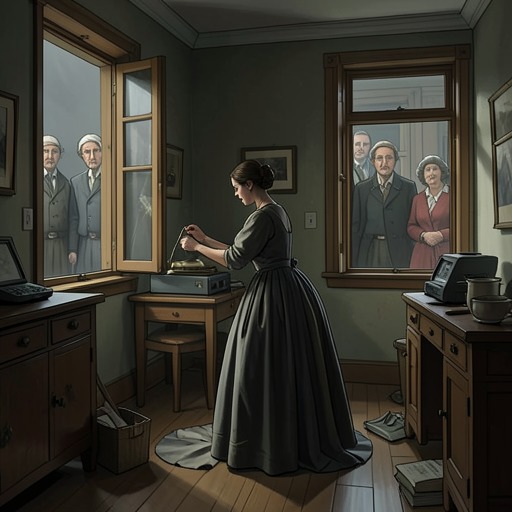
After Carlos has taken away the last boxes, the Queen faces a room emptied of the arrangement she had made for him. Rags, tablecloths, curtains, and draperies lie across the floor; in the half-light, the piles resemble human forms strewn across a battlefield. The scene’s theatrical vocabulary sharpens the contrast between her earlier design and its collapse: her Persian palace, curtained backdrops, and tortoiseshell sets had composed a world meant to seduce Carlos, but that entire mise-en-scène has come apart under the weight of their urgent, asymmetrical history.
The staging makes the loss concrete. The room is not merely untidy after a departure; its props have lost the purpose that organized them. The fabrics that once helped construct a romantic setting now suggest absent bodies, while the deserted main room becomes a space in which the Queen must confront the distance between the scene she prepared and the relationship she hoped it would produce.
The Movie Theater and the Imagined Carlos
At seven o’clock, the Queen sits in the front rows of a theater showing Hard to Kill, II. The film’s action plays against activity elsewhere in the theater, but she remains still, watching the screen while the man beside her waits for her to respond to him. The contrast is telling: although she is physically present with a companion and surrounded by the theater’s distractions, her attention is elsewhere, and her heart seems to be moving toward an imminent crisis.
At a quarter past seven, the film blurs in her vision. The hero’s face becomes difficult to make out; she sees, or imagines she sees, Carlos’s hands gripping a cannon, then pictures him moving among rocks, running and dodging gunfire. She calls warnings to him, and the imagined Carlos looks up with a smile, as if he has heard and is grateful for his Queen’s help. The movie screen supplies a stage on which her helpless concern can briefly become effective action. The episode does not establish that she can reach Carlos; instead, it reveals how longing transforms spectatorship into an imagined exchange, with the Queen cast as his distant protector.
Names, Roles, and the Performance of Fear
The Queen’s theatrical awareness turns inward when she reaches her house during the night of searches and gunfire. She imagines what might happen on the stairs: being shot, rolling downward, and calling Carlos’s name. The name itself becomes a kind of stage device, a false identity made up of six letters, a name waiting in the wings. She recognizes both its usefulness as a disguise and its fictionality, linking it to the act she is putting on by pretending to be afraid. Once upstairs, she hopes for applause, but hears only the echo of her own voice asking whether anyone is there.
That self-conscious performance unfolds against real danger. The Queen has a pamphlet bearing the face of a disappeared person in her pocket, and fears that soldiers may be following her or that neighbors may report the weapons and young men who had entered her house. The army has occupied Santiago, closed the roads into and out of the city, and carried out house-to-house searches. She returns through this atmosphere of surveillance to a home that she fears may no longer be safe. The tension between acting and danger does not make the threat unreal; it shows how, under repression, a person must read gestures, names, and possible witnesses as both social performance and practical risk.
Departure as a Final Image
By dawn, the Queen has spent the night removing traces of herself from the three-story corner house. She burns scraps bearing telephone numbers and addresses, sweeps away footprints, and cleans windows and surfaces before packing her possessions into two bags. Only after this work is done does she climb to the roof and look across the city. The view becomes a Cinerama backdrop for what she calls a foolish ending: she wants one last glimpse of Carlos crossing the street and smiling up at her, though she knows this is an image of what she wishes for, not a reunion that takes place.
The language of performance gives form to grief she cannot express openly. She longs to cry, but imagines that even tears would be dismissed as artificial because they belong to a queer person whose feelings are presumed to be theatrical. The passage turns that judgment against the conditions that impose it: the Queen’s sorrow is real, while the social expectation that she must prove its authenticity is another part she is made to play. As the rooftops brighten in the sun, a car stops outside. She leaves a kiss for yesterday and goes, carrying two bags rather than the elaborate scenery of the home she has abandoned.
The Queen gives La Rana her belongings to keep, leaves her unfinished work for La Rana to complete for extra money, and gives her the radio. Pressed to explain why she is leaving, she can only say that it is a matter of life and death. The car horn interrupts their conversation. The exit is thus both practical flight and an ending staged through familiar cinematic images, but without the tears or final meeting the Queen imagined. Throughout these scenes, cinema and theatricality expose the gap between a role’s consolations and its limits: imagination lets her accompany Carlos and compose a goodbye, but it cannot undo the danger that makes her leave.