Annexia
Naked LunchAnnexia is presented as a state whose coercive power operates through bureaucracy as much as through direct force. Under Dr. Benway’s assignment of Total Demoralization, routine paperwork, unpredictable inspections, and deliberately prolonged uncertainty make citizens responsible for their own supposed inadequacy, while the system keeps its actual intentions obscured.
Political setting and Benway’s role
The narrator is assigned to engage Dr. Benway’s services for Islam Incorporated after Benway has been called in as an advisor to the Freeland Republic. The contrast between that republic’s reputation for free love, continual bathing, and civic tolerance and Benway’s involvement signals that an orderly public appearance does not prove that a society is free of coercive practices. The account also identifies his previous Annexia assignment as Total Demoralization.
Benway’s stated preference is not for overt brutality, which he regards as inefficient, but for prolonged mistreatment designed to generate anxiety and a sense of personal guilt. The target is made to believe that the treatment is deserved because something is wrong with them, though the supposed fault is never specified. An arbitrary, intricate bureaucracy conceals the people exercising control and prevents the subject from confronting an identifiable enemy.
Documents and inspection
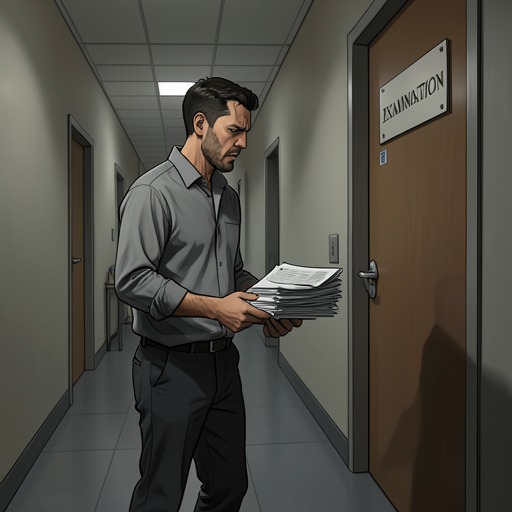
Every citizen must apply for and carry a portfolio of documents at all times. Anyone may be stopped in the street by an Examiner, whose role is difficult to predict: the Examiner may be in plain clothes, a uniform, bathing clothes, or even nearly naked except for a badge. The variation makes inspection feel less like a stable public service than an unpredictable assertion of authority.
The paperwork system turns compliance into a trap. After checking a document, an Examiner stamps it; at the next inspection, the citizen must present papers bearing the correctly entered stamps from the previous encounter. When a large group is stopped, the Examiner may stamp only a few people’s cards, leaving the others liable to arrest because their documents are now improperly marked. Arrest is termed provisional detention, and release depends on an Affidavit of Explanation being correctly signed and stamped by an Assistant Arbiter of Explanations.
That route to release is obstructed by procedure. The affidavit must be presented in person, but the official responsible for approving it hardly ever comes to the office. People seeking an explanation therefore spend weeks or months waiting in unheated offices without chairs or toilet facilities. Documents printed in vanishing ink fade into useless scraps, forcing citizens to seek replacements and hurry from one bureau to another against impossible deadlines. Administrative delay and document failure are not exceptions to the system’s operation; they are among the means by which it keeps citizens under pressure.
Consequences and narrative significance
After a few months of this treatment, the citizens cower in corners like neurotic cats. The transformation makes visible the intended result of Benway’s method: control is achieved not only by the threat of arrest but by making daily life feel uncertain and making people internalize blame for conditions the state has engineered.
The account also describes suspected agents, saboteurs, and political deviants being processed by the police on an assembly-line basis. Benway’s comments on interrogation extend the same logic: the threat of torture may be used to produce helplessness and gratitude for its suspension, while punishment is imposed once a subject has been made to accept it as deserved. The Switchboard, one of his disciplinary procedures, requires a subject to respond to bells and lights by making connections on an arbitrary switchboard, with mistakes punished. Annexia thus joins administrative obstruction to psychological conditioning: both make obedience difficult to understand as anything other than the citizen’s own failure.