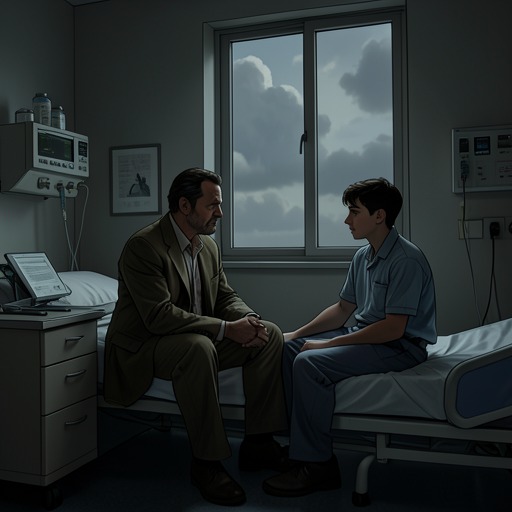
Carl
Naked LunchCarl’s passages connect intimate illness and addiction to institutions that claim to classify and manage them. He seeks care for Joselito, confronts the sanitarium’s impersonal administration, describes the routines and bodily costs of his own dependence, and later undergoes an examination in which medical language turns sexuality into a diagnostic problem. Across these scenes, the distance between lived experience and official explanation becomes one of his defining conditions.
Identity and Narrative Perspective
Carl is shown less through a continuous biography than through sharply distinct encounters and recollections. In one scene he speaks with a doctor about Joselito’s illness; elsewhere he appears in first-person material about withdrawal and daily drug use, and later he is the subject of a formal medical interview. This shifting presentation makes him both a participant in the action and a consciousness through which illness, fear, and institutional behavior are registered.
The narrative places particular weight on what Carl sees and feels when he cannot make events orderly. At Joselito’s bedside, his thoughts widen from the room to a succession of places and settings, while the later scenes at the sanitarium break into displaced images. In the examination room, his composed view of himself gives way to a sense of entrapment. The changes in perspective are not a stable account of recovery or diagnosis; they disclose the strain of being made to interpret experience through other people’s categories.
Joselito and the Search for Treatment
Carl asks the doctor whether Joselito can be treated somewhere. The doctor says that a sanitarium may be available at the District Capital and offers to write down its address. Carl also asks about chemical therapy, but the exchange does not establish a treatment plan or show that the proposed care will cure Joselito. The practical answer is limited to referral and a place to go.
When Carl sees Joselito in a large, bright room with a private bath and a concrete balcony, the setting offers comfort without companionship. The room is cold and empty, and Carl has little to say as fear comes and goes in Joselito’s eyes. Joselito smiles, but the moment does not erase the fear; it seems to recede rather than resolve. He tells Carl that he will be sent to the new sanitarium the next day and asks him to visit because he will be alone there. He coughs and takes codeine, leaving the scene suspended between a promised transfer and the continuing presence of illness.
Carl follows the referral to the sanitarium, where the commandante receives his letter beneath a vine trellis. Rather than discuss Joselito’s condition, the commandante silently reads the letter, places it on a spike above a toilet, and turns to copying numbers from a ledger. The procedure gives Carl no visible assurance that the letter will result in attention or care. In the same setting, Carl’s thoughts fragment into a memory of a heroin overdose, with an older woman trying to revive him using hot coffee. The scene links the institution he has come to for Joselito with his own history of vulnerability, without making the two illnesses equivalent.
Addiction, Withdrawal, and Daily Routine
The withdrawal notes identify paranoia as an early feature and describe the world as appearing blue, while the body seems depleted and without tone. They also describe recurring dreams of searching for drugs, including a search for a poppy field, directions to a café where opium is available, and attempts to obtain heroin. These episodes make withdrawal more than a sequence of physical symptoms: the craving reorganizes attention around possible supply and imagined routes to it.
The account distinguishes the initial acute sickness from the final step away from drugs. At that point, it describes a period of panic and suspended transition, followed by an intense resurgence of longing. The danger lies partly in how circumstances seem to bring drugs within reach: the person in withdrawal may encounter someone able to supply them or an attendant who can exploit the need. The narrative thus presents recovery not as a simple decision but as a vulnerable interval in which desire and opportunity converge.
In another first-person passage, the speaker describes clothing left unchanged for months and days strung along by the syringe’s thread of blood. The Spanish boys call him El Hombre Invisible. He says that drug use has displaced sex and other bodily pleasures, and characterizes himself as a ghost bound to drugs. The passage gives dependence a social dimension as well as a bodily one: the nickname marks his near-invisibility to others, while the routine of seeking drugs structures the passage of time.
The daily record also complicates any simple image of physical collapse. The speaker does twenty push-ups each morning and observes that drug use removes fat while leaving much of the muscle intact. He even wonders whether the fat-removing effect could be isolated, a moment in which an observation about his body becomes a speculative medical question. Yet the same account describes spending the day trying to obtain two boxes of Eukodol, with the drug store filled by mutterings about control. Physical routine and practical resourcefulness persist, but they remain organized around dependence.
Medical Authority and Examination
Carl’s encounter with the doctor over Joselito’s illness introduces medicine as both information and performance. The doctor discusses lung disease and infection, then shifts into crude, disruptive behavior and jokes about the patient population. His manner makes the consultation unreliable as a source of humane care: clinical statements coexist with mockery and breaches of professional boundaries. Carl’s request for treatment is answered with a referral, while the doctor’s conduct makes clear that medical authority does not guarantee respect for the person it addresses.
In a later examination, a doctor explains that the department is concerned with sexual deviation under certain circumstances. Carl watches the doctor’s eyes and suddenly feels cut off from warmth and certainty; the composed, faintly contemptuous self-image he had maintained loses its force. The shift is important because the examination is not only a discussion of policy. It alters Carl’s sense of his own position in the room, as if his vitality were being absorbed into its impersonal atmosphere.
The doctor says that treatment is symptomatic, then laughs in a way that leaves Carl appalled. He thinks the man is insane, but the doctor’s face becomes unreadable and he returns to the file. He later discusses a possible hereditary factor, social pressure, marriage, infantile environment, and other diagnostic ideas, ranging beyond the question in front of him. Carl dozes during the monologue. When he wakes, the doctor describes a semen test as a tool that may be useful as part of a broader assessment and directs a nurse to collect a specimen. The nurse leads Carl into a bare, white-walled cubicle and hands him a jar. The abrupt move from abstract theories to a specimen-taking procedure shows how institutional scrutiny converts a person into evidence, even while the doctor admits that the meaning of the test is limited.
Narrative Significance
Carl’s scenes place caregiving, dependence, and examination alongside one another without resolving them into a single account of illness. He seeks an address and a possible treatment for Joselito, but the sanitarium’s commandante offers no visible response beyond paperwork. In the withdrawal passages, the first-person voice records craving and habit from within; in the examination, Carl is instead watched, discussed, and assessed by others. These shifts expose the unequal terms on which experience becomes legible: the person may describe his condition, yet institutions retain the power to name it and decide what counts as evidence.
The passages also make repetition a formal part of Carl’s characterization. Drug-seeking dreams, the ordinary effort to obtain medication, and the clinical request for a specimen all return attention to the body as something pursued, observed, or measured. His account of himself as the Invisible Man sits beside the sanitarium’s refusal to make its administrative process meaningful to him and the examination room’s reduction of him to a case. The result is not a completed arc of cure or escape, but a recurring confrontation with systems that promise explanation while leaving the person’s lived experience only partially understood.