Carl—Joselito
Naked LunchCarl—Joselito is a relationship shaped by Carl’s effort to help a sick young man and by the widening gap between personal concern and the institutions charged with treatment. Joselito’s illness brings the two together in a sequence of examination, referral, and separation; Carl can ask questions, pursue admission, and contemplate bribery, but he cannot secure a meaningful answer or a clear remedy. Joselito’s invitation to visit and the later cries of his name give the relationship its emotional arc, while the narrative leaves the precise circumstances of his eventual fate unstated.
Illness and the Search for Treatment
Joselito first appears as a young man who has written class-conscious poetry and begun to cough. A German doctor examines his ribs and tells Carl that the diagnosis is a lung infection. In a later conversation, the doctor says both lungs are affected and describes pneumonia as a recurring danger among the local population. His remarks mix medical authority with condescension, leaving Carl to navigate care through a practitioner whose manner makes the encounter difficult to trust.
Carl asks whether Joselito can be treated somewhere. The doctor points him toward a sanitarium at the district capital and offers to write an address. Carl also asks about chemical therapy, pressing the doctor to compare it with sanitarium treatment. The question shows Carl looking for more than a referral: he wants an intelligible account of what treatment can offer. Instead, the doctor answers with assurances about modern furnishings and writes a letter, shifting attention from medical prospects to the institution’s outward credentials.
The Sanitarium and Carl’s Attempts to Help
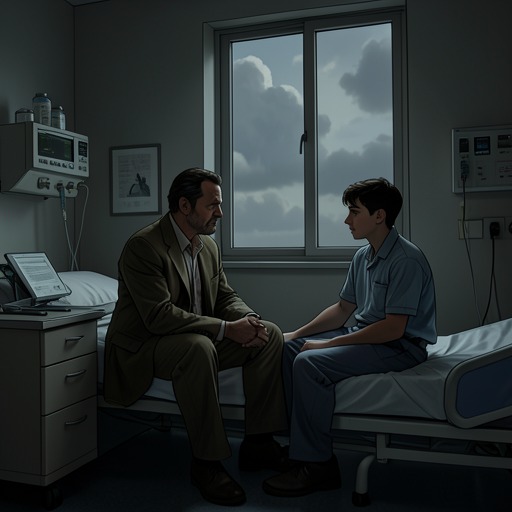
Carl sees Joselito in a large, bright room with a private bath and a concrete balcony. A yellow bowl of water hyacinths and the empty room frame an encounter in which conversation is scarce and fear remains visible in Joselito’s expression. His smile briefly dispels that fear, but does not alter the uncertainty surrounding his illness or what will happen to him.
Joselito tells Carl that he will be sent to the new sanitarium the following day and asks him to visit. He expects to be alone there. The request makes their relation concrete: Joselito seeks Carl’s continued presence, and Carl is positioned as a visitor who might keep him from facing the institution entirely by himself. The text records the invitation, but does not show Carl making the promised visit.
At the sanitarium, the letter passes to a commandante seated beneath a vine trellis. He reads it by tracing the words with his left hand, puts it on a spike above a toilet, and begins copying entries from a ledger. Carl watches this procedural response rather than a discussion of Joselito’s condition. He considers bribing the official, but the consideration does not become an effective intervention; the episode ends with Carl overcome by weakness and fear.
Separation and the Uncertain Ending
The account later returns to the name Joselito in a night scene. Carl calls it aloud, and boys at street games, bull rings, and bicycle races look up as the name carries away and fades. Other names follow, but Joselito’s is the first in the series. The passage gives no explicit report of a death or an explanation of what has become of him; its force comes from the unanswered distance between the name being called and the person who might answer.
The sanitarium’s sign then stirs and bursts into blue flame, a sharp image attached to the same sequence of separation. It does not establish Joselito’s fate, but it closes the scene in an atmosphere of institutional unease rather than resolution. Carl’s earlier willingness to ask questions and consider bribery has not produced any narrated reunion, and Joselito’s request for a visit remains unanswered in the account.
Narrative Significance
The relationship contrasts Carl’s personal attention with medical and administrative systems that render care difficult to understand. The doctor supplies a diagnosis and referral, yet his behavior undermines confidence in his authority; the commandante receives a letter but responds by filing and copying rather than addressing Carl’s concern. These encounters give Carl actions to take without granting him reliable knowledge or control over Joselito’s treatment.
The narrative also moves from direct interaction to absence. In the bright room, Joselito can speak, smile, and ask Carl to come; later, he is present only through the name Carl calls into the night. That shift makes the relationship significant without resolving its outcome: the text shows care, dependence, and attempted advocacy, but leaves the reader without confirmation that Carl and Joselito meet again.