IND
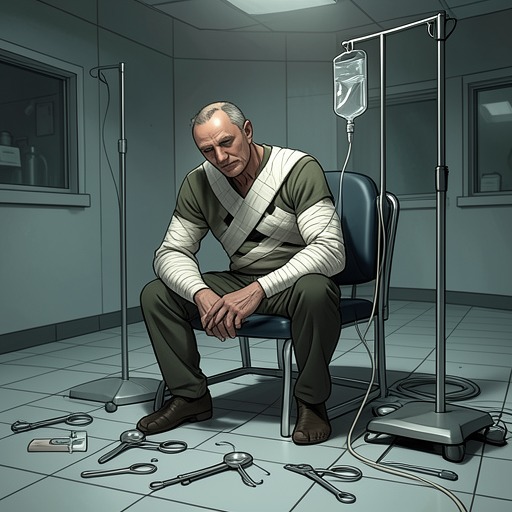
Naked LunchIND, or Irreversible Neural Damage, names a condition in which awareness appears extinguished while bodily reflexes persist. The novel gives the diagnosis a brutal material form: a man’s blank response to another person is followed by an involuntary, prolonged reaction to chocolate. When the Reconditioning Center’s subjects are released, INDs reappear amid the city’s disorder, expanding a ward’s clinical category into a public crisis. The scenes make the term both a medical label and an instrument of institutional exclusion: the people it identifies are observed, displayed, and passed toward disposal rather than treated as patients with recoverable lives.
Diagnosis and the Ward
Dr. Benway identifies the seated man as an IND and expands the initials as Irreversible Neural Damage. His explanation is glibly managerial: the man is, he says, “a drag on the industry.” The diagnosis thus arrives already entangled with a system that measures people by their usefulness. “Irreversible” makes the damage sound final; “industry” translates that finality into a question of burden and efficiency.
The narrator approaches and looks into the man’s eyes, finding no answering presence. A hand passes in front of them without a response. This small test establishes the scene’s defining distinction: the man does not appear to recognize or attend to another person, but his body is not simply inert. The passage gives no account of his earlier life or of how the damage occurred, and the diagnosis supplies no personal history to replace that silence.
Reflexes as Spectacle
To demonstrate what remains, Benway takes a chocolate bar from his pocket, unwraps it, and holds it under the man’s nose. The smell sets off a chain of physical reactions: sniffing, working jaws, grasping hands, saliva hanging from the chin, a rumbling stomach, and the body writhing in peristalsis. The sequence is described at length, shifting attention from the man’s absent response to social contact toward the body’s involuntary response to food.
Benway then holds the chocolate out of reach. The man drops to his knees, throws back his head, and barks; when Benway tosses the bar, he snaps and misses, scrambles across the floor, crawls under the bed, finds it, and stuffs it into his mouth with both hands. The demonstration therefore does not merely establish that reflexes survive. Benway controls the stimulus and its availability, turning the man’s hunger into an exhibition that the man cannot direct or refuse. The ward’s clinical observation becomes a scene of humiliation.
The reaction also sharpens the difference between bodily activity and recovered awareness. The man can smell, move, pursue, and eat, but the scene offers no sign that he can interpret the encounter or communicate with those watching. The chocolate is at once nourishment and a tool in Benway’s test. That ambiguity makes the surviving response seem less like evidence of recovery than evidence of how readily a damaged person can be made to perform for an observer.
Institutional Disposal
Benway responds to the display with contempt for the INDs, calling them classless and a liability to the tourist business. He summons an attendant, who has been sitting at one end of the ward reading a book of J. M. Barrie plays, and orders him to get the INDs out. Asked what should be done with them, Benway disclaims responsibility: he is “a scientist. A pure scientist.” He tells the attendant to use proper channels and contact the District Coordinator, while casting doubt on whether that official even exists.
The exchange makes the diagnosis part of a bureaucratic relay. Benway can name the damage and stage its visible effects, yet refuses to decide what care or destination the people require. The attendant is left with the practical question; an uncertain coordinator becomes the proposed next step. Benway’s pause at the doorway briefly turns the people he is leaving behind into “Our failures,” but the phrase does not reverse his decision. His closing insistence that it is all in the day’s work makes abandonment sound routine.
The song that follows gives the condition an especially stark boundary: INDs do not come back, will not come back, once they are gone. That statement confirms the scene’s emphasis on irreversibility, while the surrounding action exposes the gap between acknowledging permanence and accepting responsibility for those who live with it. The people remain physically present, but in Benway’s professional accounting they have already been placed beyond return.
Release and Public Crisis
INDs recur on a much larger scale when the electronic brain at the Reconditioning Center goes berserk during a game of six-dimensional chess and releases every subject in the Center. From the roof, observers survey a city transformed by the release. INDs stand near cafe tables with saliva hanging from their chins and stomachs noisily churning; elsewhere in the same panorama, Latahs imitate passers-by, junkies loot drugstores and inject themselves on street corners, catatonics occupy parks, and agitated schizophrenics rush through the streets. Partially Reconditioned subjects also surround a group of homosexual tourists.
In the ward, the IND man’s response to chocolate had made his body the focus of a controlled demonstration. After the release, INDs are one element in a wider spectacle of people rendered vulnerable by institutions and then encountered as signs of urban disorder. The shift from a single bed to the view from the Center’s roof enlarges the scale without offering an account of individual outcomes: the evidence shows the subjects loose among the population, not what becomes of any particular IND afterward.
Meaning of the Term
The two appearances connect medical diagnosis with administrative and social exclusion. In the ward, Benway treats the INDs as bad for business, calls them failures, and delegates their removal. During the Center release, their visible bodily condition is folded into an overwhelming city scene. In neither setting does the label lead to an exploration of the people’s own experience; it organizes how others classify, display, and respond to them.
The chocolate episode’s drawn-out physical detail makes the familiar idea of a reflex newly disturbing: a stimulus produces movement, but movement is not the same as agency or communication. That distinction grounds the term’s force without supplying a cure, interior testimony, or account of the original injury. IND remains a diagnosis presented through the gaze of observers—and a measure of the distance between a body that still reacts and an institution willing to regard the person as beyond its concern.