Interzone
Naked LunchInterzone is a vast, crowded city whose unstable spaces and competing political factions turn it into more than a backdrop: it is a social world where commerce, identity, and authority continually overlap. Its defining image is a single building that flexes around its inhabitants, while its surrounding scenes extend the city into a collage of political satire, colonial power, and altered perception.
The City and Its Physical Form
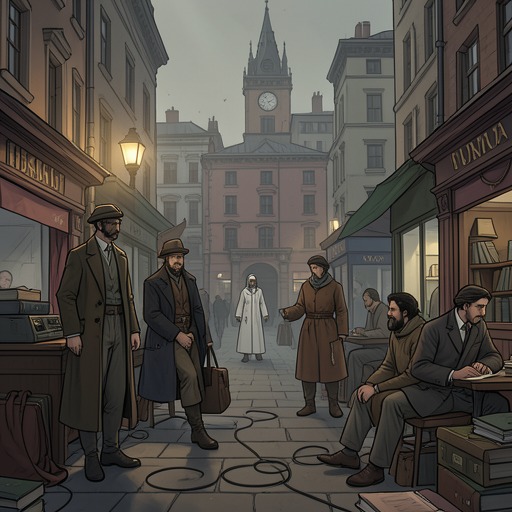
Interzone is described as a single vast building. Its rooms are made of plastic cement that bulges to accommodate people; when a room becomes too crowded, someone may be squeezed through a wall into the next house. Since rooms are mostly beds, the city’s physical structure makes private space and commercial activity nearly indistinguishable. The Zone is at once architecture and an active system of circulation, with movement through walls echoing the traffic of people and business within it.
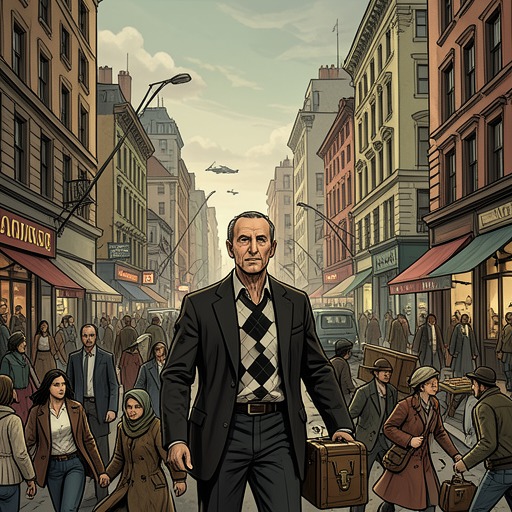
The city’s title also frames it as a meeting place for incompatible worlds. In a Yage-intoxicated account, its market becomes a composite city in which the blood and substance of many peoples and imagined future populations pass through the body. The same vision ranges across migrations, deserts, jungles, mountains, and an outrigger journey across the Pacific to Easter Island. This is not a neutral map of a stable place: the narrative explicitly identifies the City and Meet Cafe passage as written in a state of Yage intoxication, and the accompanying notes describe images arriving slowly, defenses falling away, and a sense that experience can travel through space and time. Interzone’s geography thus expands into a subjective, unstable field of perception.
Commerce, Factions, and Social Performance
The City Market contains the Meet Cafe, where obsolete trades, unfamiliar substances, speculative cures, bureaucratic services, and black-market goods gather in an inventory of impossible commerce. The catalogue includes sellers and practitioners dealing in drugs not yet synthesized, longevity serums, telepathic sensitivity, dreams, memories, and diseases imagined as emerging from ruined cities, laboratories, atomic war, the ocean floor, and the stratosphere. The market’s commercial logic absorbs even the unknown past and emergent future: everything is potentially a service, product, or commodity awaiting a customer.
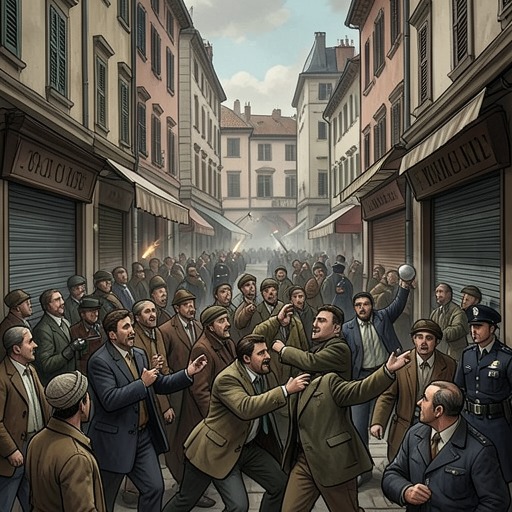
Interzone’s parties give this world an overt political structure, though not one of stable or transparent allegiance. The Liquefaction Party is described as almost entirely composed of dupes, with the question of who is deceiving whom unresolved until the final absorption. Its members are associated with perversion, especially sadomasochistic practices. The Senders are contrasted with them: they are characterized as ignorant of the nature and endpoint of sending, self-righteous, and hostile to facts. The Factualists’ intervention prevents the Senders from institutionalizing Einstein and destroying his theory. The account presents factional politics as a contest over knowledge and control, but also as a landscape in which manipulation, ignorance, and coercion are difficult to separate.
Colonial Authority and Civic Ritual
Interzone’s relations with the nearby Island make the city’s wider political geography visible. The Island is a British military and naval station opposite the Zone, held on a rent-free yearly lease whose renewal requires a formal ceremony. The whole population must assemble at the municipal dump; the Island’s President crawls across the garbage to deliver the residence permit and lease, signed by every citizen, to the Resident Governor. The Governor pockets the papers while soldiers in jeeps sweep mounted machine guns across the crowd. The ceremony maintains the appearance of consent under armed supervision, turning an administrative renewal into a public performance of imperial authority.
Democratic forms on the Island are similarly restricted. A Senate and Congress conduct prolonged sessions over garbage disposal and outhouse inspection, the only subjects within their jurisdiction. Their former authority over Baboon Maintenance was withdrawn after absenteeism in the Senate. Purple-assed baboons, brought to the Island by pirates in the seventeenth century, are protected by a capital prohibition on killing them, despite the hardship their behavior causes residents. The President’s office is itself a punishment: it is imposed on an unpopular citizen, and its humiliation is said to drive many officeholders to die before completing their term. The Expeditor once served the full five years, then changed his name and underwent plastic surgery to distance himself from the disgrace. Together, these details make civic authority a system of ritualized degradation, narrow jurisdiction, and coercive spectacle.
Stories, Satire, and Unstable Knowledge
Interzone’s social life is presented through scenes that expose how authority can be performed, imitated, or made absurd. An English colonial, assisted by five police boys, detains a subject in a club bar and holds forth about illness, first recounting malaria and then dysentery. Elsewhere, an explorer in a sun helmet has incapacitated a citizen with a blowgun and curare dart; he administers artificial respiration with one foot while launching into a story of his travels. These episodes turn the hotel and club into stages where colonial self-importance and personal anecdote displace the people being detained or incapacitated. Their accumulation makes the city’s social order feel less like a coherent system than a succession of performances backed by unequal power.
Political theater also spills into the city’s larger world. A male United States citizen is said to have given birth in Interzone, a claim voiced by a Diplomat amid a scene in which the Arc de Triomphe is rent open and the Diplomat’s words can no longer be heard. The juxtaposition places official language beside an impossible-sounding report and a breakdown in communication. Elsewhere, A.J., the financier of Islam Inc. and a notorious merchant of sex, scandalizes international society by appearing at a ball dressed as a walking penis beneath an oversized condom bearing his motto, “They Shall Not Pass.” His exchange with the Duke of Ventre turns the city’s political and commercial associations into a deliberately crude public joke; A.J.’s repartee is also described as referring to events that have not yet occurred. Interzone is therefore connected to an order in which identity, political slogans, and future consequences can all become material for performance.
Narrative Significance
Interzone gathers the novel’s recurring concerns into a place where the boundaries between room and street, private life and commerce, public authority and farce are continually unsettled. Its single-building design gives literal form to the pressure of crowding, while the market extends that pressure into the circulation of goods, services, beliefs, and speculative futures. The city’s factions promise rival explanations of collective life, but their politics are marked by deception, ignorance, and attempted control.
The narrative does not offer Interzone as a stable object of observation. Its scenes shift from sharply concrete institutions—the lease ceremony, the restricted legislature, the market’s traders—to intoxicated visions in which races and journeys move through the body. That contrast makes the city both a material setting and a way of representing perception under strain. Interzone’s force lies in this double role: it is a place where political arrangements can be examined, and a composite vision in which no boundary between social world, imagined future, and subjective experience remains secure.