Interzone riot
Naked LunchThe Interzone riot is a Market uprising in which political hostility spills into public violence and ends with a police crackdown. Its progression—from nationalist antagonism and an unexplained death to a crowd attack and organized repression—presents street disorder not as an isolated eruption but as a spectacle shaped by competing performances of power.
Causes and Participants
The scene establishes a charged political setting before the mass violence begins. A group of Nationalists sit outside the Sargasso, sneering at the queens and speaking Arabic. Clem and Jody sweep in with theatrical bravado, announcing that they have come to feed on the group’s backwardness. A Nationalist answers that his people are hungry. Their exchange places material grievance beside deliberate provocation: the encounter is not a reasoned political discussion, but a public contest in which antagonism is staged and sharpened.
The escalation is not given a single, clearly explained trigger. A Nationalist drops dead, and Dr. Benway rushes forward, asks the crowd to stand back, and takes a blood sample. He then remarks that nothing more can be done. The narration associates the death with hatred, but provides no further medical or political explanation. The moment instead serves as a hinge in the scene: the argument gives way to a wider disturbance, while the brief intervention fails to restore order.
Riot and Police Response
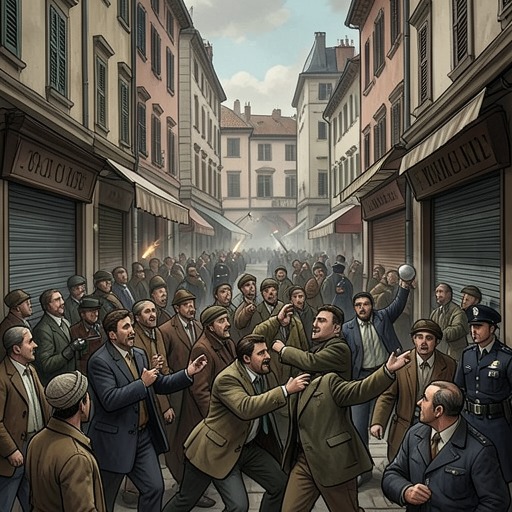
Riot noises rise at a distance, and the Market empties with startling speed: shutters slam, while patrons are pulled indoors in the panic. The disturbance then reaches the square, where the rioters attack an old drunkard who has been left unconscious there. Their cries of “Death to the French” turn the violence into an openly nationalist spectacle, although the victim is identified only as a man of uncertain nationality. The episode offers no evidence that he took part in the dispute that preceded the riot; his vulnerability, rather than any stated political act, makes him its target.
The spectacle also draws an approving audience. Salvador Hassan watches the crowd through a keyhole and celebrates the apparent sameness of the rioters, dancing the Liquefactionist Jig. His reaction frames the crowd as an image to be appropriated for an ideological fantasy of collective uniformity, even as its violence is directed against an exposed individual. The contrast makes the riot’s claim to collective purpose uneasy: the crowd acts as a mass, but its victim is isolated and defenseless.
Police squads enter the Market from every adjoining street and beat and kick the rioters with methodical brutality. The coordinated arrival turns scattered street violence into an encounter with organized force. Once the rioters have been carried away in trucks, residents emerge into a square littered with teeth and sandals and marked by blood. The clearing of the streets restores public access, but not a sense of safety or political resolution; the aftermath leaves the costs of both mob violence and police repression visible in the ordinary civic space.
Political Context and Institutional Echoes
The Market riot belongs to a wider Interzone landscape in which political identity is performed under coercive conditions. Elsewhere, Clem and Jody are described as old-time vaudeville performers who pass themselves off as Russian agents whose purpose is to represent the United States unfavorably; their shifting political roles make their provocation at the Sargasso part of a larger pattern of politics treated as theatrical performance. The riot scene does not explain how that background causes the outbreak, but it places the pair’s taunting beside nationalist grievance and the sudden collapse of public order.
The city’s other institutions offer a parallel picture of authority as procedure backed by force. On the Island, a British military and naval station opposite Interzone, residents must formally renew an annual lease and residence permit in a compulsory ceremony. The Island’s President crawls across the municipal dump to deliver the papers to the Resident Governor, while soldiers sweep the crowd with mounted machine guns; its Senate and Congress retain jurisdiction only over garbage disposal and outhouse inspection. These details do not describe the riot itself, but they sharpen its political setting: public participation and official procedure can coexist with constrained power and armed supervision.
Institutional Parallels and Narrative Form
The riot’s portrayal of political authority resonates with other episodes in Interzone, though those episodes are not presented as causes of the outbreak. On the Island, a British military and naval station opposite the city, residents are required to attend an annual renewal ceremony for their lease and residence permits. The Island President crawls across the municipal dump to deliver the papers to the Resident Governor, while soldiers sweep the assembled crowd with mounted machine guns. The Senate and Congress retain jurisdiction only over garbage disposal and outhouse inspection. Beside the Market’s abrupt violence, this ritual presents another form of public power: official participation persists, but within sharply limited bounds and under armed supervision.
The episode’s abrupt shifts—from political taunting to a death, a vulnerable bystander’s killing, and a coordinated police crackdown—leave the conflict without a settled account of its origin or a political resolution. Its closing image is not a restored civic order but residents returning to a square marked by the violence. By placing crowd action and methodical repression within the same sequence, the narrative makes the Market both a public stage for political hostility and a space where ordinary people bear its consequences.