Joselito
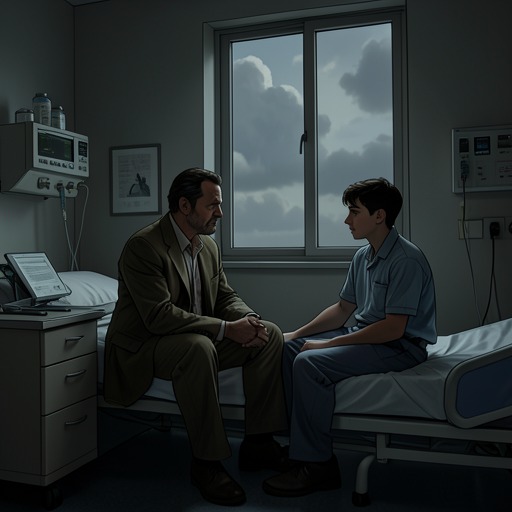
Naked LunchJoselito is a sick young man whose illness is briefly observed and diagnosed, while his uncertain future opens onto the book’s recurring conflict between lived experience and medical or institutional language. Carl sees him in a bright, private room, hears that he is to be sent to a sanitarium, and watches his name recede into the night. The episode gives Joselito a fragile human presence without resolving what becomes of him.
Identity and Introduction
Joselito is introduced as someone who writes class-conscious poetry and has begun to cough. A German doctor examines him, touching his ribs, before announcing that he has a lung infection. The doctor’s elaborate list of professional identities—physician, concert violinist, mathematician, chess master, and Doctor of International Jurisprudence—sets his cultivated self-presentation against the short, plain diagnosis he gives aloud. Carl, meanwhile, is present as an observer and interlocutor, but the scene does not establish the precise nature of his relationship with Joselito.
The difference between the doctor’s public diagnosis and his earlier private manner is telling. He first signals to Carl that the diagnosis should be phrased in a way the patient can understand without frightening him, then calls it a lung infection. The exchange makes medical speech appear both protective and condescending: Joselito is treated as a patient to be managed, while the doctor and Carl share an unspoken sense of educated understanding.
Illness and the Sanitarium
Carl later sees Joselito in a large, clean room with a private bath and concrete balcony. Its light and comfort do not dispel the fear that flickers in Joselito’s eyes. At moments, when he smiles, that fear seems to lift; it remains close, however, as the narrative places it in the room’s high, cool corners. The scene gives his condition a personal dimension that the diagnosis alone cannot convey, while leaving the underlying cause of his fear unstated.
Joselito tells Carl that he will be sent to a new sanitarium the next day and asks him to visit because he will be alone. He coughs and takes a codeineeta. The account establishes the planned transfer and Joselito’s appeal for companionship, but does not confirm that the visit takes place or explain what treatment the sanitarium will provide. The prospect of chemical therapy arises in the adjacent conversation, where its value is questioned; the passage does not establish that Joselito himself receives it.
Carl’s Attention and the Narrative Form
The illness is filtered through both observation and recollection. Carl talks with the doctor beneath a narrow arcade in the rain, then imagines the varied rooms, landscapes, and lives that seem to lie behind the doctor’s eyes. Later, as Carl looks at Joselito, the narration turns inward to broken images associated with sleep and the feeling of death nearby. This shift does not supply a medical explanation or a complete account of Joselito’s experience. Instead, it makes the limits of Carl’s knowledge part of the scene: he can see fear, hear a request, and anticipate separation, but cannot settle what either will mean.
Joselito’s illness also appears in the book’s wider documentary fragments. A hospital note labels paranoia as an early stage of withdrawal, and a later passage describes withdrawal’s final step as a crisis in which longing for junk intensifies. Another first-person account describes the days passing around a syringe and a speaker becoming a ghost bound to junk. These passages establish the book’s broader attention to addiction and bodily distress, but they do not identify Joselito as the speaker or prove that his lung illness is caused by withdrawal. Keeping those threads distinct matters: Joselito is presented as ill, while the surrounding material offers a larger, unsettled field of bodily and institutional experience.
Name, Separation, and Unresolved Fate
After the room scene, Carl calls Joselito’s name. Boys occupied with street games, bullfights, and bicycle races look up as the call passes and fades. Other names follow—Paco, Pepe, Enrique—turning the moment from an individual appeal into a series of cries carried across a warm night. A sign for Trak stirs and bursts into blue flame immediately before the heading “THE BLACK MEAT,” a formal turn that places Joselito’s fading call beside the book’s next fragment without explaining his fate.
Joselito’s narrative arc is therefore brief and unfinished. He is diagnosed, placed in a room, and told that a move to a sanitarium is imminent; he asks Carl to come see him, and afterward his name becomes a call receding into the night. The text confirms neither the promised visit nor Joselito’s recovery, death, or later whereabouts. His importance lies in the sharp contrast between institutional plans made for him and the simple companionship he asks for, and in the narrative’s refusal to turn that request into a resolved outcome.