Junk withdrawal
Naked LunchJunk withdrawal is not a single, neatly bounded episode but a recurring condition in which the effort to stop using drugs makes the body and the past newly difficult to inhabit. Its significance lies in the way physical dependence becomes a problem of time, memory, and control: the addict is caught between the remembered promise of a dose and the uncertain prospect of a cure, while episodes from different moments surface without forming a dependable personal history.
The cure and its altered time
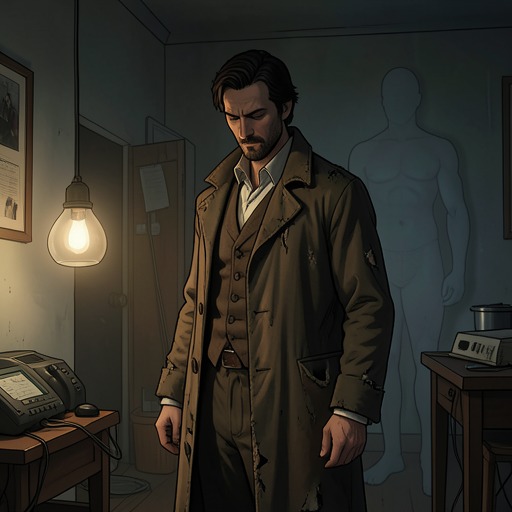
During Junk withdrawal, Lee is identified as taking the junk cure, and the experience is presented as a space-time trip whose corners seem portentously familiar to the addict. Past and future shuttle through his spectral substance, and the invitation to pick any shot makes the cure feel less like a straight route out of dependence than a passage among recurring scenes. The form matches that condition: memory does not proceed in a settled chronology, but returns in images that seem to belong to several times at once.
One fragment places Lee in a police precinct cell, where the prospect of a shot of Heroin is raised with mocking laughter. Another gives only tentative impressions dissolving in light. These discontinuous glimpses make withdrawal inseparable from the drug world it is meant to leave behind: even the cure carries the familiar corners, exchanges, and humiliations of addiction into the present.
A further recollection takes the form of old photographs, their surfaces curling and cracking like mud in the sun. They show Panama City and Bill Gains carrying out a paregoric scheme with a Chinese druggist. The worn photographs are not a complete account of the past; they are partial records that surface amid withdrawal’s shifting images. Their material deterioration reinforces the larger uncertainty about whether a remembered scene can restore a continuous history.
The body and the cost of dependence
The novel represents withdrawal through bodily exposure rather than through an orderly clinical explanation. A junky’s death has no smell, yet withdrawal makes that absence paradoxically perceptible: the missing smell is experienced as a sensory loss, something that shuts off breath and blood. The description treats the absence not as a poetic ornament detached from the body, but as a disturbance in the addict’s ordinary ways of sensing and locating the world.
That condition also reaches beyond the individual. During withdrawal, the junky is said to give off the death smell, making an entire apartment unlivable; airing the room can restore the ability to breathe, but the smell returns. The image places the burden of withdrawal in shared domestic space, where one person’s condition alters the environment for others. It also makes recovery provisional: relief is possible, but it does not amount to a final removal of the condition.
The body appears elsewhere as a vulnerable instrument rather than a secure possession. In a recollection of a shot taken before D.L., Lee probes for a vein in his dirty bare foot. The scene belongs to the larger account of addiction’s erosion of shame and the addict’s impersonal appraisal of bodily tissue. In the withdrawal material, that exposure is condensed into an image of the junk hourglass spilling its last black grains into the kidneys. Time runs out through the body itself, giving the cure a physical cost rather than an abstract promise.
Memory, repetition, and unstable identity
Withdrawal repeatedly opens onto memories without making them fully recoverable. After an overdose of Majoun, the narrator recalls returning from a room in a villa outside Tanger and suddenly not knowing where he is or who he is. The passage links a drug-altered state to a breach in orientation and personal identity: the narrator can only look around and infer where he has arrived, rather than possess a complete account of how he got there. It offers a parallel to the withdrawal fragments, in which experience is encountered through partial, unstable images instead of a continuous autobiographical narrative.
The book also makes the act of remembering itself uncertain. The writer sees himself reading to a mirror and checking that the Crime of Separate Action has not occurred—that his reflection still obeys him. In this image, the effort to preserve a separate self becomes a repeated check on whether separation remains possible. Read alongside the cure’s shifting recollections, the mirror scene makes identity feel less like an assured possession than something that must continually be verified.
This fragmentation is connected to the novel’s account of control. At Interzone’s Reconditioning Center, Dr. Benway describes methods for manipulating subjects through drugs, hypnosis, and the reinforcement of a cover identity; in another explanation, he outlines sexual humiliation as an instrument of coercion. These passages are not the same as Lee’s withdrawal, but they establish a world in which altered states and identity can be deliberately managed by authorities. Against that background, the addict’s loss of reliable control over body and memory carries both personal and political weight.
Relapse, refusal, and the limits of recovery
The cure is not presented as a clean break from dependence. A companion objects that it would not feel right to undermine the effort to quit, while the narration names the courage involved in kicking a habit. That exchange frames recovery as a vulnerable undertaking whose progress can be threatened even by the familiar practices of the drug world. The language of encouragement does not guarantee success; it emphasizes the effort required to continue without turning the cure into a triumphant endpoint.
The novel gives that instability a stark image when a man’s body changes dramatically during withdrawal. Thirty pounds materialize in a month after kicking, only for ten pounds to disappear in ten minutes as he stands holding a syringe and his trousers. The rapid reversal makes apparent improvement fragile: the body’s change can be undone almost as quickly as it appeared. The passage refuses a simple before-and-after account in which the cure steadily restores a stable physical self.
A separate image reduces the cure to an imperative: letting go and jumping. It offers no step-by-step method and no assured destination. Instead, it makes recovery sound like a risky relinquishment, a leap away from the arrangements that have organized the addict’s life. In the novel’s recurring crossings between present dependence and remembered scenes, the cure remains both necessary and uncertain: it interrupts the drug’s hold without erasing its memories, physical consequences, or claim on the future.