Leif the Unlucky
Naked LunchLeif the Unlucky is a tall, thin Norwegian, one-eyed and permanently smirking, whose business failures and bodily misfortunes make him a walking chronicle of risk in Interzone. As Marvie’s partner in Interzone Imports Unlimited, he pursues a dubious pharmaceutical commission through bribery, quarrels, reconciliation, and a long wait for payment. His history turns commercial optimism into grim farce: every new venture seems to promise an escape from bad luck, while his body records the cost of surviving it.
Identity and Background
Leif’s appearance is rendered as a fixed contradiction: tall and thin, with a patch over one eye, his face held in an ingratiating smirk. Behind that accommodating expression lies what the narration calls an epic saga of unsuccessful enterprises. He has tried raising frogs, chinchillas, Siamese fighting fish, rami, and culture pearls; promoting a Love Bird Two-in-a-coffin Cemetery; cornering the condom market during a rubber shortage; operating a mail-order brothel; and selling penicillin as a patent medicine. He has also followed disastrous betting systems at European casinos and American racetracks. The list is less a record of one failed career than a comic inventory of repeated attempts to turn some unlikely opportunity into a livelihood.
The Cost of Bad Luck
The business reverses are matched by injuries and medical disasters. American sailors in Brooklyn stomp out Leif’s front teeth; after he passes out in a Panama City park from a pint of paregoric, vultures eat one of his eyes. During an episode of junk sickness, he becomes trapped between floors in an elevator for five days. Elsewhere, while stowing away in a foot locker, he suffers delirium tremens. These are not incidental mishaps alongside his career: the same pattern of exposure and defeat that ruins his schemes is written across his body.
His Cairo hospitalization makes that pattern grotesquely literal. With strangulated intestines, perforated ulcers, and peritonitis, Leif is placed in a latrine because the hospital is overcrowded. A Greek surgeon mistakenly sews a live monkey inside him; Arab attendants rape him, and an orderly steals the penicillin, replacing it with Saniflush. The account then recalls an English doctor treating his gonorrhea with an enema of hot sulfuric acid. Leif’s medical history is presented not as a sequence of reliable cures but as another arena where institutions and supposed experts compound his danger.
Medicine, Misrule, and the Body
Leif’s encounters with medicine continue the pattern of treatment becoming a fresh injury. A German practitioner of Technological Medicine removes his appendix with a rusty can opener and tin snips, dismissing germ theory as nonsense. Flush with this apparent success, the doctor begins cutting out whatever parts he considers unnecessary, arguing that a person can manage with one kidney and that the body’s interior is too crowded. Leif’s recollection turns the doctor’s crude surgery into a grotesque political joke: the body, like territory, is imagined as needing more lebensraum. The story does not present Leif as an authority on the procedures inflicted upon him; instead, his history accumulates as evidence of how little protection the sick and vulnerable receive from men claiming medical expertise.
That accumulated vulnerability shadows his later work with Marvie. Interzone Imports Unlimited specializes in pharmaceuticals and operates a twenty-four-hour venereal-disease station as a sideline, while the partners seize a commission involving a shipload of lubricant made from whale waste, quarantined by the Board of Health in Tierra del Fuego. The deal requires them to arrange sexual services for a Greek shipping agent and an entire shift of customs inspectors. Their enterprise thus links medicine, commerce, sexual services, and corruption without offering a clean boundary between them: remedies and supplies are commodities, and access to the transaction depends on bribing the officials who control its passage.
Partnership, Feud, and the Commission
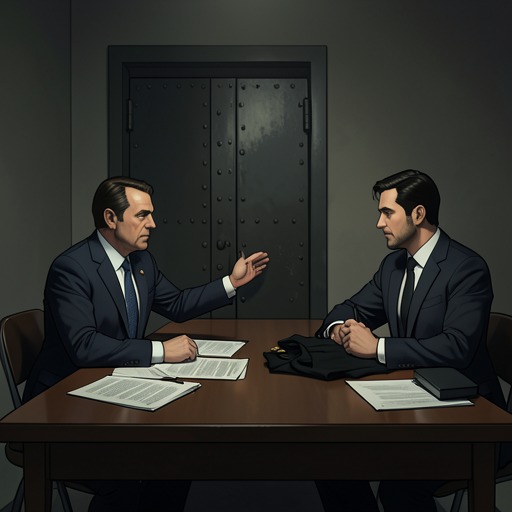
The commission exposes how quickly the partnership between Leif and Marvie turns from cooperation to mutual suspicion. At the embassy, each accuses the other of trying to cheat him out of the commission: Leif insists that he holds the bill of lading, while Marvie counters that the check will be issued in his name. Leif refuses to surrender the document until his share is deposited in escrow. The quarrel ends not in trust but in a theatrical truce: they say they might as well make up, shake hands without enthusiasm, and peck each other on the cheek. Their intimacy is transactional, and its rituals of reconciliation do not erase the underlying contest over who controls the paperwork and the money.
The deal drags on for months, so they hire the Expeditor, a figure whose usefulness is itself disputed. Eventually Marvie emerges with a check for forty-two Turkestan kurds, drawn on an anonymous South American bank and routed through Amsterdam; clearing it is expected to take about eleven more months. Leif’s share is therefore not a ready fortune but a promise encumbered by delay. Marvie displays a photostatic copy in the cafés of the Plaza, guarding the original against possible damage, while telling would-be celebrants that he cannot afford a drink: he has already spent the money on Penstrep for Ali’s recurring gonorrhea. The comic check, the uncollected funds, and the medicine bought on credit make the commission’s apparent success another form of postponement rather than a clean escape from precariousness.
The Expeditor and the Island
Leif’s jibe at the Expeditor reaches beyond the immediate business dispute. When the Expeditor is mocked over his Island origins and a remembered past of selling his body in the Plaza’s public toilets, Leif adds that there were few takers, pronouncing the final word as ither. The insult strips away the Expeditor’s attempted performance of English aristocratic reserve. He begins to whimper and snarl like a kicked dog, his pre-surgery face emerging in an arc of hatred, before spitting curses in the Island dialect. The Islanders, in turn, claim not to know that dialect and insist, “We are Breetish,” denying that they have any bloody dialect at all.
The episode makes Leif a participant in the scene’s vicious comedy, not merely its emblem of misfortune. His taunt helps provoke the Expeditor’s exposed rage, and the response unsettles Marvie and Leif: they fall back twittering as saliva gathers at the Expeditor’s mouth and he seems surrounded by a green cloud of spiritual vileness. The business partners’ amusement thus gives way to alarm. The scene’s performance of class, nationality, and respectability breaks down into bodily signs and local speech, while the men who had hired the Expeditor remain unable to know whether his services are valuable or worthless.
Narrative Function
Leif’s catalogue of failed ventures, injuries, and disastrous treatment belongs to the book’s episodic, grotesque portrait of life in Interzone. His permanently ingratiating smirk sits beside an accumulation of pain that no successful enterprise seems to redeem. Yet he is not simply a passive sufferer: he pursues dubious opportunities, enters corrupt arrangements, fights Marvie over the commission, and joins in humiliating the Expeditor. The contrast between his accommodating face and his combative self-interest keeps bad luck from becoming a simple explanation for his life.
His presence also connects the novel’s commercial absurdities to its recurring concern with the body as both vulnerable matter and an object of exchange. The pharmaceutical business, the venereal-disease station, the commission’s sexual services, and the long-delayed check all place bodily need within systems of trade, bureaucracy, and opportunism. Leif’s misfortunes do not produce a narrative of recovery: even the venture that appears to pay off yields a disputed claim and months of waiting. His story remains open to the same unsettled rhythm as the transaction itself, where apparent resolution only creates another interval of uncertainty.