O’Brien
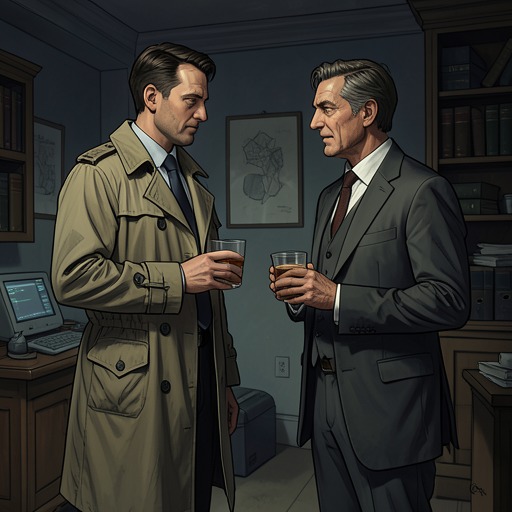
Naked LunchO’Brien is a veteran City Narcotic Squad officer whose genial, persuasive manner complements Hauser’s toughness. When the partners come to arrest William Lee, O’Brien tries to turn their old familiarity into leverage; Lee instead escapes, killing him and Hauser. The department’s subsequent denial that O’Brien exists makes the officer’s death more than a personal loss: in Lee’s telling, it becomes a boundary between the world of active police connections and an irretrievable junk past.
Identity and Police Partnership
O’Brien has served on the City Narcotic Squad for twenty years, alongside Hauser. Lee, who has been addicted to heroin for sixteen years, describes the two as old-timers like himself. Their partnership works through contrasting roles: Hauser is the tough one, while O’Brien is the con man. Lee likens them to a vaudeville team, a comparison that makes their police work sound like a rehearsed performance built on alternating pressure and reassurance.
The difference is clearest in their handling of a suspect. Hauser tends to bring out his gun before speaking, using its presence for psychological effect and to forestall escape. O’Brien, by contrast, offers a cigarette and begins a persuasive, apparently companionable pitch. His ease is not proof of kindness: Lee recognizes the friendliness as part of the police con, a method for drawing a person into a conversation on the officers’ terms.
The Arrest at the Hotel Lamprey
O’Brien and Hauser arrive at Lee’s room at eight in the morning after receiving instructions to pick him up at the Hotel Lamprey. The lieutenant tells them to bring in not only Lee but also all books, letters, manuscripts, and anything else printed, typed, or written. Hauser knows Lee from an earlier encounter, and the pair approach the arrest as something routine. Lee understands that it is not routine for him: he sees it as his only chance to avoid being taken into custody and possibly subjected to experiments.
The officers enter with a pass key while Lee is preparing his morning injection. Junk, a syringe, alcohol, cotton, and water are laid out in the room. Hauser orders Lee to put on his coat, while O’Brien greets him with a familiar, easy manner. Lee asks to take a shot first, ostensibly because there is enough evidence already present. O’Brien refuses, addressing him as Bill in a sweet, coaxing voice. Lee interprets the refusal as an unspoken demand for information or cooperation, not merely as a rule of procedure.
Lee offers to set them up with Marty Steel, a careful dealer the officers have been unable to prosecute. The offer reflects the partners’ leverage over him and Lee’s attempt to buy an opening: he knows they want Steel, but also knows Steel will not serve a man he has not known long enough. Lee’s reputation, he says, is that he has never caused anyone to do time. The conversation leaves the bargain unresolved, while Hauser searches the room and O’Brien waits nearby.
Lee’s Escape and O’Brien’s Death
Lee uses the officers’ divided attention to reach his suitcase. He pretends to inject himself, then sprays alcohol into Hauser’s eyes. As Hauser reacts, Lee gets to the case, takes out his gun, and shoots Hauser. O’Brien reaches for his own weapon, but Lee steadies his shooting hand and fires at him. O’Brien falls from the chair; Lee gathers his notebooks and drug equipment, takes ammunition, and leaves the room in his coat.
The contrast between O’Brien’s relaxed posture and the sudden violence sharpens the reversal. Just before Lee acts, O’Brien is sitting on a chair arm, smoking an Old Gold and looking out the window. His dreamy air suggests someone momentarily absorbed in the prospect of retirement, even as Lee sees him as an active threat. O’Brien’s reassuring police persona cannot protect him when the negotiation gives way to Lee’s desperate escape.
O’Brien is also connected to Lee’s first arrest. Lee recalls that O’Brien was the persuasive partner when he was first arrested, about fifteen years earlier; at the time, O’Brien’s hair was grey. The recollection places their hotel-room encounter within a longer history of repeated contact between the addict and the police. Familiarity has not made their roles equal: Lee knows the officers’ methods, but the only chance he sees is to break the encounter by force.
Aftermath and Narrative Significance
After leaving the hotel, Lee phones the narcotics department and asks to speak to O’Brien. The person who answers says there is nobody by that name in the department, and gives the same answer when Lee asks for Hauser. Lee then claims to have information about a large heroin shipment, insisting that he will deal with no one else. The office’s denial makes his former police contacts unavailable even as he tries to use them to re-enter the network of dealings he knows.
Lee hangs up and leaves the area by taxi, understanding what has happened: he has been cut off from space-time, locked out of the world in which a Key or Point of Intersection could still connect him to others. He imagines himself consigned, with Hauser and O’Brien, to a landlocked junk past where heroin remains twenty-eight dollars an ounce and opium ash can still be found in the laundry. O’Brien’s death thus accompanies a larger shift in Lee’s sense of time and access. The officer who once helped define Lee’s place within the narcotics system becomes part of a past that the institution itself now refuses to acknowledge.