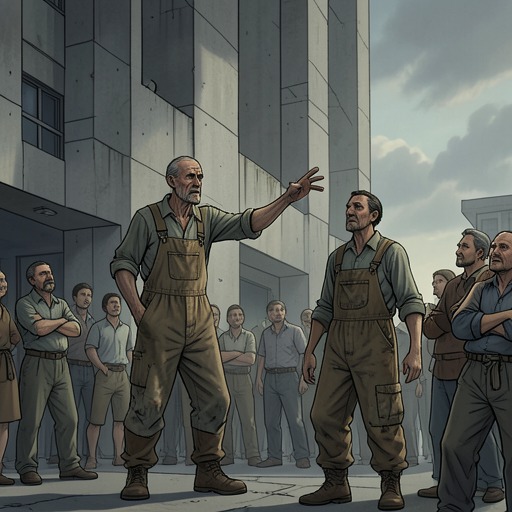
Republic of Hassan
Naked LunchThe Republic of Hassan is a setting where political maneuvering and commercial calculation converge in the disastrous aftermath of poisoned wheat. Its defining episode joins Clem and Jody’s scheme to a banquet served to local officials and citizens: the guests eat food made from the contaminated crop, become ill, and many die. The account treats the crisis both as a consequence of deliberate poisoning and as part of a wider world in which political affiliations and stated objectives are persistently unreliable.
Political and commercial entanglements
The Republic of Hassan is associated with Islam Inc., an organization whose exact objectives remain obscure. Those involved approach it from different angles and intend, sooner or later, to cross one another. Salvador Hassan O’Leary is connected indirectly: a subsidiary company has contributed to the organization, while one of his subsidiary personalities serves in an advisory capacity. The account carefully distinguishes these ties from an explicit commitment to Islam Inc.’s policies or objectives, making qualified association itself part of the political landscape.
The list of figures connected to the wider episode includes Clem and Jody, identified as the Ergot Brothers, as well as Autopsy Ahmed and Hepatitis Hal, a fruit and vegetable broker. Clem and Jody are described elsewhere as old-time vaudeville performers acting as Russian agents whose purpose is to represent the United States unfavorably. Their theatrical and political identities sit beside their commercial operations: they have interests that need not match the causes they publicly appear to serve.
Their declared objectives are similarly self-interested. A. J. agitates for Israel’s destruction under a cover story about difficulties obtaining Arab amenities. Clem and Jody, by contrast, claim an interest in destroying Near Eastern oil fields to raise the value of their Venezuelan holdings. The competing explanations do not resolve into a coherent common program; they illustrate the account’s description of a network in which participants pursue separate angles and plan to obstruct one another.
The poisoned-wheat banquet
The episode’s central chain of events begins with Clem and Jody’s poisoned-wheat scheme, which is said to have decimated the Republic of Hassan. In the questioning about their conduct, they are asked whether, on reaching the country, they gave a banquet for the Caid and served couscous made from the wheat. Their answer confirms the banquet and the use of the wheat. They claim that the guests were also heavily affected by marijuana and became agitated during the meal; Clem and Jody say they themselves ate only bread and milk, citing ulcers.
The guests’ illness continues beyond the banquet. The account reports that people ran about in distress, with most dying the following morning and others dying the morning after that. The delay gives the episode a grim sequence: the consequences are not confined to the meal itself, but unfold over successive mornings. The description that the victims turned black and lost their legs is tied to the explanation of ergotism rather than presented as an unrelated detail.
Ergotism and bodily consequences
The narrative identifies ergot as a fungal disease affecting bad wheat and explains that outbreaks of ergotism periodically devastated Europe during the Middle Ages. The condition was known as St. Anthony’s fire; gangrene could follow, turning the legs black and causing them to fall off. This background supplies a specific medical explanation for the reported effects in the Republic of Hassan and connects the poisoned food to a recognizable disease process.
The explanation does not lessen the political force of the episode. The wheat is not simply an unfortunate crop: it is the instrument of a scheme that kills many banquet guests, while the perpetrators’ own account emphasizes their supposedly separate meal. Their claim to have eaten bread and milk does not undo the consequences for the people assembled at the banquet. The contrast between the guests’ deaths and the agents’ self-protective explanation sharpens the story’s portrait of calculated conduct and evasive responsibility.
Narrative significance
The Republic of Hassan episode is told through a mixture of factual-sounding explanation, retrospective questioning, and extravagant political satire. The banquet gives the poisoning a concrete social setting, while the account’s details about subsidiary companies, advisory personalities, cover stories, and private financial interests make political affiliation difficult to read at face value. The country becomes a point where food, ideology, and profit meet, but none provides a stable account of what the actors truly serve.
The episode’s structure also places a specific chain of harm inside a larger field of competing motives. The poisoning and the subsequent deaths are clearly reported, as are the fungus and its effects; the organization’s precise objectives, by contrast, remain unspecified, and the participants are described as intending to cross one another. That contrast keeps the Republic of Hassan’s catastrophe legible without pretending that the surrounding political order is coherent: the outcome is stark, even when the motives around it remain divided and self-serving.