The Expeditor
Naked LunchThe Expeditor is an intermediary whose occupation is to speed the delivery of merchandise, but whose usefulness is so uncertain that his name itself starts arguments. His position in Interzone is shadowed by a humiliating former life on the nearby British-controlled Island: he served its full five-year presidential term, then changed his name and underwent plastic surgery to distance himself from the disgrace. When Marvie and Leif cannot pay him promptly, their dispute over a dubious shipment turns that buried past into the scene’s central conflict, and his cultivated composure gives way.
Identity and Reputation
The Expeditor’s profession is to expedite deliveries, yet the text refuses to settle whether he actually does so. People cite cases as proof both of miraculous efficiency and of complete worthlessness. The uncertainty is not incidental: merely mentioning him precipitates an argument, leaving his standing dependent on competing accounts rather than an established record of success.
His origins are similarly pointed. He is said to have been born on the ferry between Interzone and the Island, a boundary-crossing birthplace that links him to both places without securing him an uncomplicated place in either. The Island later becomes the source of the identity he tries to escape; in Interzone, his former connection to it remains available to his rivals as a weapon.
The Island and the Presidency
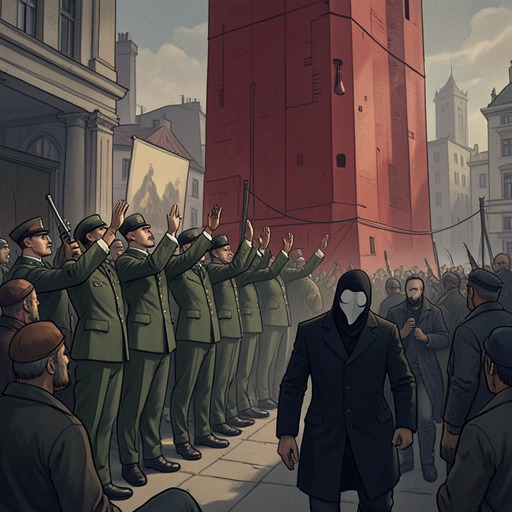
The Island is a British military and naval station directly opposite Interzone. England holds it on a rent-free lease that must be formally renewed each year, along with the inhabitants’ permits of residence. The renewal ceremony makes the imbalance of power visible: the entire population is required to gather at the municipal dump, where the Island’s President must crawl across the garbage to deliver the papers to the Resident Governor, who stands in dress uniform.
The Governor takes the documents and jokes that the Islanders have decided to let the British stay another year, asking whether anyone is unhappy. Soldiers in jeeps sweep mounted machine guns slowly across the crowd. The ceremony calls itself a renewal freely granted by the Island, but compulsory attendance and armed surveillance undermine that appearance. The Governor’s laughter is echoed by the gathered population under the guns, making public consent inseparable from the conditions imposed upon it.
The Island also maintains democratic forms within narrow limits. Its Senate and Congress hold prolonged sessions on garbage disposal and outhouse inspection, the only matters within their jurisdiction. For a short period in the mid-nineteenth century, they could control the Department of Baboon Maintenance; that authority was withdrawn because senators failed to attend. The purple-assed Tripoli baboons, brought to the Island by pirates in the seventeenth century, are protected by a capital prohibition on killing them. A legend says that the Island will fall when they leave, although neither the meaning of that fall nor its destination is specified. Their disruptive presence makes the inhabitants’ enforced protection of them another expression of the Island’s arbitrary constraints.
Within this system, the presidency is not an honor but a punishment. The office is forced on a particularly noxious and unpopular citizen, and election is described as the greatest misfortune and disgrace that can befall an Islander. Its humiliations are so severe that few Presidents complete their terms; many die after a year or two, their spirits broken. The Expeditor is exceptional because he served all five years. Afterward he changed his name and underwent plastic surgery, trying to blot out the memory of the office and the person he had been while holding it.
The Unpaid Shipment
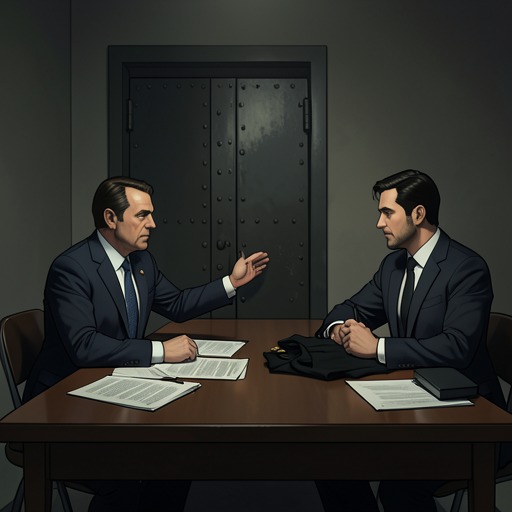
In Interzone, the immediate dispute begins with money that has not arrived. The Expeditor has not been paid, and Marvie faces the prospect of keeping him waiting eleven months until a check clears. Marvie promises payment but asks him to be patient. The Expeditor rejects the delay, turning a business problem into a confrontation over the consequences that waiting will bring him.
He enumerates those consequences through the threatened repossession of his wife’s artificial kidney and the eviction of his grandmother from her iron lung. The exchange establishes the personal stakes he attaches to the unpaid sum, even as the circumstances are presented in the dispute’s sharp, comic register. Marvie, meanwhile, regrets having become involved in the transaction and complains that the grease in it contains too much carbolic. He says that when he put a broom handle into a drum of the material, the grease ate away its end, and that its smell was overpowering. He recommends that Marvie visit the port; Marvie refuses, since in Interzone it is considered a mark of caste not to touch or even approach the goods one sells. Getting close to merchandise invites suspicion of being a retailer, the common peddler’s role.
Marvie dismisses the concerns as sordid matters for retailers, while the Expeditor insists that others can escape responsibility but he has a reputation to maintain. He characterizes the operation as shoddy, though not exactly illegitimate. The distinction does little to settle the dispute: Marvie and Leif can apparently retreat behind their roles in the transaction, while the Expeditor claims that his name and standing remain exposed to the product and its consequences.
Exposure and Breakdown
Marvie and Leif answer the Expeditor’s criticism by mocking his Island past. Marvie tells him to return there before it falls and recalls that they knew him selling in the Plaza’s public toilets. Leif adds that he had few customers. The taunt turns the Expeditor’s former presidency and subsequent reinvention into a public humiliation, rather than a private history he can keep buried behind a new name and altered face.
The Expeditor first appears to gather himself for a cold, clipped rebuke in the manner of an English aristocrat. Instead, his speech breaks into an agitated, whimpering snarl, and the face he had tried to leave behind is figuratively brought back into view. He spits curses in the Island dialect. Islanders generally claim not to know that dialect or deny that it exists, insisting that they are British; his outburst therefore gives audible form to the identity their public performance disavows.
As the Expeditor continues shouting, he spits small balls of saliva. Marvie and Leif retreat in alarm; Marvie says that the Expeditor has gone mad, and the two leave hand in hand, skipping into the winter mist that covers Interzone. The scene ends not with payment or settlement but with flight. The business dispute has exposed the fragility of the Expeditor’s self-reinvention: the name change and surgery could not prevent a casual reference to the Island from reviving the disgrace he sought to erase.
Narrative Significance
The Expeditor’s uncertain professional value and concealed past mirror one another. His delivery services are subject to argument, while his new identity is undermined by memories and speech that remain attached to the Island. In both cases, status depends on a performance others may refuse to accept: he presents himself as a figure whose reputation must be protected, but Marvie and Leif claim the power to define him by his former life.
The Island’s annual lease ceremony sharpens that conflict by staging coercion as consent. Its residents formally renew a British presence under compulsory attendance and armed watch; its President performs abasement, and the office itself is imposed as a disgrace. The Expeditor’s completed term is thus more than an embarrassing anecdote. It connects his personal attempt at reinvention to a political order in which official titles, public rituals, and assertions of British identity conceal unequal power. His breakdown makes that concealed history briefly impossible to keep out of view.