The Island
Naked LunchThe Island is a British military and naval station directly opposite Interzone, but its apparent civic procedures do not give its inhabitants meaningful control. England holds the territory on a rent-free lease renewed each year, and the public ceremony for renewing that lease turns a nominally consensual agreement into a spectacle of hierarchy: the island’s president submits the residents’ papers to the British governor while armed soldiers watch the crowd. Around this ritual, narrowly limited democratic institutions, a compulsory baboon-protection law, and the grim fate of the presidency expose how the island’s population is governed through both force and administrative theater.
Setting and Imperial Administration
The Island faces Interzone across the water and serves as a British military and naval station. Its status is made concrete through a yearly arrangement: England retains a rent-free lease, while permission for residents to remain is formally renewed each year. The procedure presents British rule as conditional on the islanders’ own decision, although the surrounding military presence makes clear how little freedom they have to refuse.
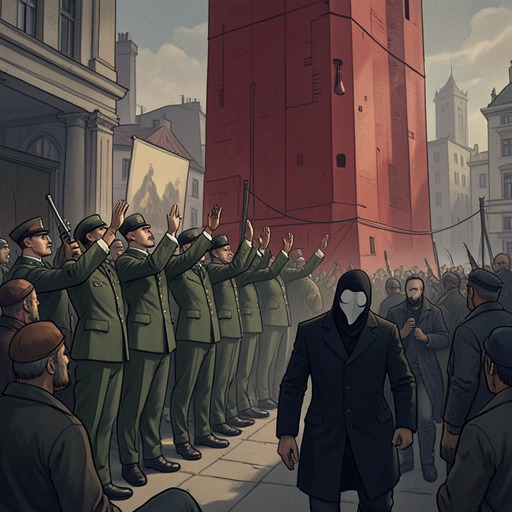
The annual gathering is compulsory and takes place at the municipal dump. The island’s president must crawl across the garbage carrying the Permit of Residence and Renewal of the Lease, signed by every citizen, and deliver it to the Resident Governor, who waits in dress uniform. This deliberately degrading transfer makes the hierarchy legible before anyone speaks: the islanders’ collective signatures are represented by a president required to abase himself before the colonial authority.
The governor takes the papers and asks whether the islanders have decided to let the British stay another year, adding that it is very good of them and asking whether everyone is happy. The question imitates a request for consent while the ceremony’s compulsory attendance and visible force undermine the possibility of an honest answer. Jeep-mounted machine guns sweep across the crowd as the governor speaks. When he declares that everyone is happy, the crowd laughs along with him beneath the guns. Public agreement is thus staged as both a performance and a response shaped by surveillance.
Local Government and Restricted Authority
The Island maintains a Senate and a Congress, and their sessions continue at length, but their jurisdiction is restricted to garbage disposal and outhouse inspection. Their existence preserves the appearance of representative government while denying the elected institutions meaningful authority over the arrangements that determine island life. The contrast between elaborate debate and narrow jurisdiction turns local democracy into a procedure for administering limits rather than setting policy.
For a brief period in the mid-nineteenth century, the island’s representatives were allowed to control the Department of Baboon Maintenance. That authority was later withdrawn because of absenteeism in the Senate. The episode adds an absurdly specific history to the island’s political restrictions: even the limited additional responsibility was temporary, and its loss is explained through a bureaucratic justification rather than through any broader account of who holds power.
The presidency itself is less an honor than a punishment. The office is forced on a citizen considered especially noxious and unpopular, and election is described as the greatest misfortune and disgrace that can befall an islander. The humiliation is so severe that few presidents complete their term; many die after a year or two, having lost their will. Political office on the island therefore carries not prestige but a prescribed public abasement, imposed by a system in which the officeholder embodies the community’s submission.
Baboons and the Island’s Contradictions
The purple-assed Tripoli baboons were brought to The Island by pirates in the seventeenth century. A legend holds that the island will fall when the baboons leave, although the account specifies neither who would take it nor what such a fall would mean. Killing one is a capital offense. The prohibition protects the animals even as their behavior makes life increasingly difficult for the residents.
The baboons’ protection connects superstition, law, and political incapacity. A story about the island’s future is backed by an extreme penalty, while the local legislature’s brief authority over baboon maintenance has long since been withdrawn. The residents remain subject to an official order that is costly and oppressive in daily life but difficult to alter through their own institutions. Occasionally, an islander goes berserk, kills several baboons, and then kills himself, an outcome that registers the pressure produced by the prohibition without suggesting that the law itself has changed.
The Expeditor and the Cost of Office
The Expeditor was once president and completed the full five-year term, an unusual survival of the office’s customary humiliation. Afterward, he changed his name and underwent plastic surgery to erase, as far as possible, the memory of his disgrace. His history shows the presidency’s degrading consequences extending beyond the term itself: completing it does not restore the former president’s standing, but leaves him seeking to make even his identity less recognizable.
The Expeditor’s present occupation is arranging the delivery of merchandise, though no one knows whether his services are useful. Stories circulate both to prove his miraculous efficiency and to establish his utter worthlessness; mentioning him reliably starts an argument. In the commercial scene involving Marvie, the Expeditor has not yet been paid, and Marvie faces the prospect of keeping him waiting eleven months until a check clears. Marvie promises that payment will come but asks him to be patient. The uncertain value of the Expeditor’s work echoes the island’s broader uncertainty about the worth of its official procedures: both depend on claims whose practical force is disputed.
Narrative Significance
The Island’s political order makes consent visible as a ritual while surrounding it with conditions that make refusal implausible. The governor’s genial questions, the president’s required submission, the compulsory gathering, and the guns trained across the crowd form a single scene in which democratic language and coercive power operate together. The crowd’s laughter does not resolve that contradiction; under surveillance, it becomes part of the ceremony that sustains it.
The island’s civic absurdities are not separate from its colonial administration. Narrowly empowered legislatures, an annual lease renewal performed at the dump, a punished presidency, and a capital ban on killing the troublesome baboons all give authority a procedural or legal form. Together, these details present The Island as a miniature political system where control is maintained not only by soldiers but also by ceremonies, rules, offices, and public performances of agreement.