The Man
Naked LunchThe Man is the elusive pusher and connective presence through whom William Lee’s account renders the drug trade as a dispersed but intimate network. Barely noticed by those around him, he is at once a dealer, a signal traveling through shared need, and a figure associated with “The Connection”: the system that draws users together across rooms, streets, and cities. His appearances turn the language of supply into something almost supernatural, while Lee’s concrete encounters with dealers and police keep that network anchored in ordinary transactions.
Identity and Appearance
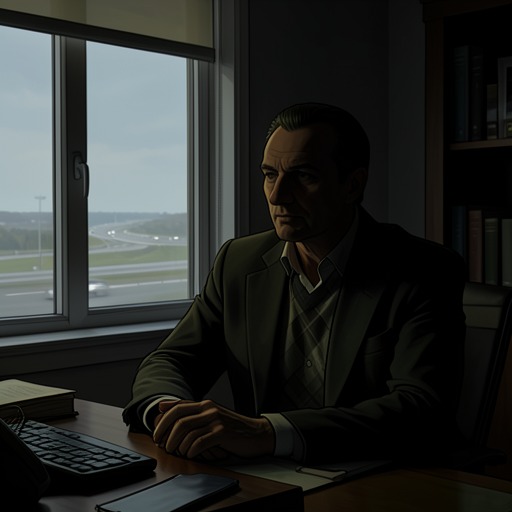
The Man’s defining feature is how little he seems to register as a person. Lee describes a pusher who walks through the world humming a tune, which passersby unconsciously take up as their own. The customers arrive “on Smiles,” “in the 1Mood for Love,” or on another song; the tune changes, but the pusher remains the unobtrusive source that coordinates their arrival. The image makes commerce look like contagious thought: the dealer does not need to call his customers when their shared condition is already drawing them toward him.
The Man is also placed among an assortment of city inhabitants who do not appear to belong to one another: a fat queen walking an Afghan hound in the East Fifties, a wino beside an elevated railway post, a radical Jewish student handing out leaflets in Washington Square, a tree surgeon, an exterminator, and an advertising man who knows a counterman by his first name. These passing figures give the drug network its breadth. The Man is not set apart in a lair; he moves through the same crowded urban fabric as people whose daily occupations and public identities seem unrelated to narcotics.
The Connection Across Cities
Lee describes a worldwide network of users joined by a “cord of rancid jissom,” gathering in furnished rooms and shivering through the sick morning. The language of connection turns scattered scenes of addiction into one repeated condition: people may be separated by geography, but their bodies and needs make them part of the same system. Lee evokes users in Yemen, Paris, New Orleans, Mexico City, and Istanbul, while the surrounding passage shifts between the living and the dead, being high and being sick, getting hooked and being forced off drugs. The network persists through these opposite states rather than resolving them.
The Man’s presence also crosses between street-level dealing and the reader’s sense of an almost shared signal. Lee imagines the connection eating chop suey on Dolores Street in Mexico City, dipping pound cake in an automat, or being chased up Exchange Place by a baying pack of people. The detail keeps the network mobile and bodily: its participants eat, move through streets, and encounter pursuit, even as the image of a single Connection makes their separate transactions seem joined. A note identifies “People” as New Orleans slang for narcotics police, placing enforcement inside the same geography of pursuit and supply.
Dealers, Users, and Police
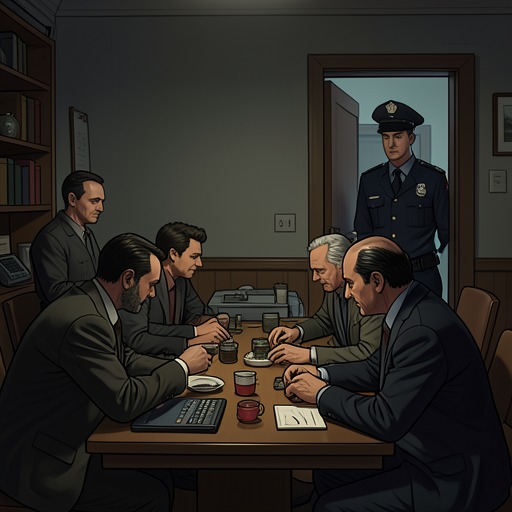
The Man’s relationship to Lee’s account of law enforcement is not simply that of a named suspect being tracked. Lee says the police have his spoon and dropper and are coming in on his frequency, led by Willy the Disk, a blind tracker whose body has been ravaged by drug use. Willy follows Lee’s trail into rooms Lee has already left, and the officers’ arrival may catch unsuspecting occupants instead. The pursuit therefore runs alongside the network: police try to follow the same invisible routes that connect users and suppliers, but the trail can lead into the wrong room or arrive too late.
Lee also treats the connection as something that operates beyond a dealer’s physical presence. The addict’s world, he says, can function without verbal exchange except where the amount of money or drugs must be stated. In his account of Nick and the time spent waiting for a delivery, the trade has no dependable schedule: the user waits because supply arrives when it arrives, and the body becomes the clock. The Man’s importance lies partly in that imbalance. The connection draws customers toward supply, but the people who depend on it cannot command its time.
Encounters and Supply
Lee’s journey through Texas and Louisiana gives this wider network a practical route. In Houston, he returns to a druggist he has not visited in five years. The druggist recognizes him at a glance, tells him to wait at the counter, and later asks what he wants. Lee requests a quart of PG and a hundred nembies; the druggist returns with a package, names a price of fifteen dollars, and cautions him to be careful. The scene is a compact transaction, but its familiarity shows how supply can depend on remembered faces and quiet recognition as much as on the imagined all-reaching signal of The Man.
The road onward involves further labor and risk. Lee describes shooting PG as a troublesome preparation: the alcohol must be burned off, the camphor frozen out, and the brown liquid drawn off with a dropper. Injecting it outside a vein can produce an abscess, and even a proper injection may do so. He and his companion put it in a Pernod bottle and head toward New Orleans through a landscape of lakes, gas flares, swamps, garbage heaps, alligators, motels, and stranded men shouting at passing cars. Drug supply here is inseparable from handling, transport, and the damaged places along the route.
In New Orleans, Lee and his companion walk around Exchange Place breathing PG and find The Man quickly. The city is described as small, and the police already know who is pushing; the dealer’s apparent conclusion is that it hardly matters whom he sells to. Lee and his companion stock up on heroin and backtrack toward Mexico. The sequence makes The Man’s reach concrete without making him omnipotent: he is accessible at a particular place, under conditions shaped by a local police presence, and the encounter enables one leg of a longer journey.
Need, Time, and the Network’s Limits
The surrounding episodes distinguish between the connection as a supply network and addiction as a bodily demand that can outlast any particular transaction. In another scene, the Buyer is overcome by a yen and seeks out a young user, asking to rub against him in order to get fixed. That scene is not an encounter with The Man, but it sharpens the account’s recurring distinction between access to supply and the need that drives people to seek it. Dealers, users, and intermediaries occupy different positions, yet the demand can become its own force.
Lee’s formulation that “Junk is a one-way street. No U-turn” gives this force a stark direction. In the account of junk time, the user’s body measures the interval until the next need; ordinary schedules matter only when they intersect with that bodily clock. The connection thus signifies more than a route from dealer to customer. It is a social relation organized by dependence and waiting, one that can link distant cities while denying its participants control over when relief will come. The Man remains difficult to pin down as an individual, but the network named through him is unmistakable: anonymous, mobile, and sustained by the recurring passage from need to supply and back again.