The Mark Inside
Naked LunchThe Mark Inside is the name given to an inward ruin that defeats the Rube from within, undoing his standing as a con man before the narrator leaves him behind in Philadelphia. The phrase reaches beyond that abandonment: it links the collapse of a hustler’s identity to a world where private desire is made an object of state diagnosis, supervision, and control.
The Mark and the Rube’s Decline
The narrator describes the Rube’s attacks as a social liability. As the condition becomes habitual, its consequences spread into ordinary encounters: cops, doormen, dogs, and secretaries react to his approach with hostility. The Rube, formerly associated with the image of a blond god, falls into a state of social untouchability. The Mark Inside is not presented as a trick another hustler can outplay, but as a crisis that makes the Rube himself the mark.
The narrator gives the decline a broader, harsher formulation: con men do not change so much as break and shatter, leaving an empty body behind. The cosmic image of matter dispersing into dust turns personal failure into a general fate of the hustler. The Rube’s deterioration is therefore both particular and exemplary: his attacks isolate him, while the phrase names the inward force that no confidence game can defeat.
Philadelphia and the Abandonment
The Rube’s condition becomes an immediate danger to the narrator’s trade. Outside Philadelphia, the Rube jumps out to con a police car; the officers recognize him, and the narrator says the encounter exposes the whole group. Later, after describing how cold the Rube’s body feels, the narrator considers leaving him behind rather than continuing to bear the burden of his condition.
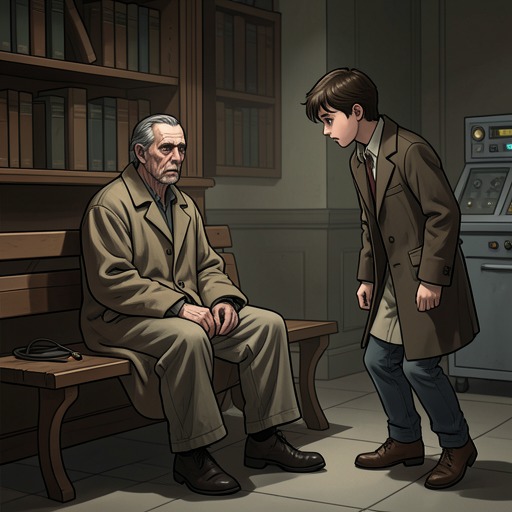
That decision becomes the phrase’s most concrete enactment. In a Philadelphia neighborhood of red-brick slums, under steady soot, the narrator tells the Rube to wait on a corner while he goes to meet a drug contact. He says he will return, warns the Rube not to follow because he might expose him, and then leaves. The farewell turns the Mark Inside from an abstract account of collapse into a separation: the narrator’s final action is to walk away and ask where people go when they leave the body behind.
Desire, Diagnosis, and Control
The phrase’s reach is not limited to the Rube’s downfall. In another passage, Dr. Benway describes a method of exploiting an agent’s cover identity: reinforce the cover story until the agent’s other identity becomes unconscious and controllable, then use drugs and hypnosis. He extends the method to sexual identity, describing how a person’s rejection of latent same-sex desire could be reinforced while the person is subjected to coercive treatment. The scene presents identity not as a protected interior truth but as something an authority can manipulate.
A parallel logic appears in Carl Peterson’s examination. The doctor calls sexual deviation a sickness rather than a matter for censorship, then uses public-health language to justify compulsory treatment and protection of others. He frames the examination as routine and compares it to a fluoroscopic examination for suspected tuberculosis; after Carl says he is interested in women and plans to marry his steady girlfriend, the doctor says that this is precisely why Carl has been summoned for a blood test before marriage. The gap between the doctor’s reassuring manner and the coercive purpose of the examination makes institutional control appear as care.
Meaning and Narrative Function
Across these episodes, the Mark Inside is not a single diagnosis or a fully defined mechanism. It is an expression for a destructive inward vulnerability, first made legible through the Rube’s social and personal collapse, then resonant with the book’s depictions of identity subjected to manipulation and administrative scrutiny. The hustler cannot outwit the mark that has become internal; the examined citizen cannot easily escape a state that turns intimate life into evidence of risk.
The phrase’s force depends on its contrast between the language of control and the experience of being broken. The Rube’s failure is described in images of shattering and dispersal, while the authorities speak in the measured vocabulary of treatment, routine, and public protection. In both registers, the individual’s autonomy is precarious. The narrator’s abandonment of the Rube gives the expression its bleakest human consequence: recognizing the inward collapse does not prevent the narrator from leaving its victim behind.