The Party Leader
Naked LunchThe Party Leader is a Nationalist Party politician whose authority is expressed through staged encounters and managed public disorder. His public language celebrates ordinary life and popular feeling, yet his methods depend on directing people, shaping political messages, and treating a crowd as an instrument. Across the episodes associated with him, performance does not merely decorate politics: it reveals how power manufactures the appearances by which it claims to speak for the public.
Identity and Public Persona
At a Nationalist Party luncheon on a balcony overlooking the Market, the Party Leader appears in a jellaba, smoking a cigar and drinking scotch. The description emphasizes the incongruity of his presentation: expensive English shoes and conspicuous socks accompany a figure presented as a successful gangster in drag. He makes the balcony a stage from which to instruct a lieutenant in what should count as political reality.
Pointing toward the Market, he asks the lieutenant what he sees. When the lieutenant answers that he sees the Market, the Party Leader corrects him: the intended object of attention is the men and women going about ordinary tasks and leading ordinary lives. His formulation makes everyday activity into a political image. The Market matters not simply as a place but as a scene he wants his audience to interpret in a particular way.
The Street Boy and Political Messaging
That staged lesson is interrupted when a street boy climbs over the balcony rail. The lieutenant initially treats him as an unwanted seller, but the Party Leader stops the dismissal and invites the boy to sit, offering him a cigar and a drink. He then draws him into a conversation about the French and colonial rule.
The boy’s account is not a neat repetition of the politician’s framing. He describes exploitation in terms of his own circumstances, including the cost of sexual services and a story about a family harmed by a financial company’s repossession practices. The Party Leader recasts the exchange for his political purpose, describing the boy as an unfiltered voice from the street and then proposing that the French have taken his birthright. The boy’s response remains sardonic and grounded in the more immediate experience of economic hardship. The scene thus gives the Party Leader a useful political witness without making the witness’s perspective fully controllable.
When the Party Leader asks whether the boy hates the French, the boy answers that he hates everyone and attributes his condition to his blood, adding that Dr. Benway is preparing a serum. The Party Leader responds that Dr. Benway is a Western agent and later warns the boy not to approach him, privately calling him a black magician and referring to a resident djinn. These comments present the Party Leader as suspicious of Dr. Benway, but they also show how readily he mixes political accusation with occult explanation. The boy exits after a brief exchange about his work and the Party Leader’s condemnation of it; the Party Leader then calls the boy and people like him hopeless. The encounter ends not in persuasion but in the politician’s frustrated judgment of the very street voice he had just tried to enlist.
Crowd Management and Political Spectacle
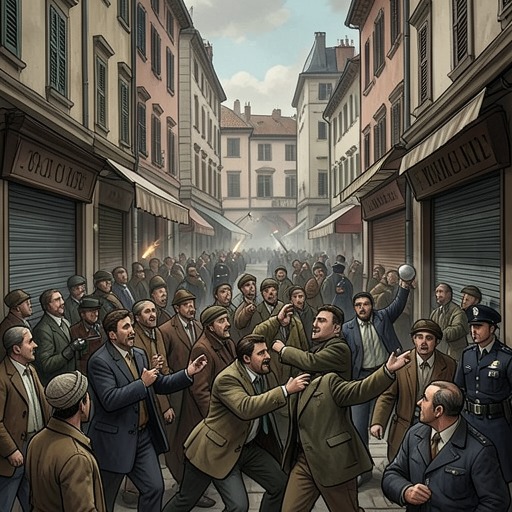
The Party Leader’s political imagination extends from a single interview to the management of mass behavior. In a discussion of a coming riot, he says the next one will proceed like a football play and describes importing a thousand Latahs from Indochina. When a lieutenant suggests that they might imitate one another in a chain reaction, the Party Leader recognizes a technical problem and says they will need to consult Dr. Benway. He also thinks that someone should supervise the operation through to its end.
The passage makes political disorder resemble a planned performance, with the crowd treated as a unit whose actions can be initiated and coordinated. Later, as the Market empties and the rioters surge back in, the Party Leader raises his hand and calls the crowd’s action the voice of the People. The label gives a violent collective event the appearance of popular expression. In conjunction with his earlier interest in planning a riot, the gesture makes the claim of spontaneity deeply unstable: the Party Leader can present unrest as the public speaking even while considering how it might be set in motion.
Power, Classification, and the State
The Party Leader’s political world is one in which institutions assign identities and produce consequences. In the account of Annexia, police and mentalists search private rooms for prohibited objects, and an object such as vaseline can be used to classify a suspect as deviant. After months of such practices, citizens are described as cowering in fear. The same wider account distinguishes criminality from deviation according to whether a person denies or merely circumvents the state’s rules. The Party Leader’s scenes belong to a political landscape where official categories are not neutral descriptions: they help justify surveillance and control.
A related institutional voice appears in a medical examination in which an official describes sexual deviation as a sickness, then uses public-health language to argue for compulsory treatment and protection of others. The stated promise is minimum hardship, but the logic still authorizes the state to impose measures on individuals. Read alongside the Party Leader’s efforts to shape public attitudes, this scene shows how political control can operate through seemingly benevolent vocabularies as well as through crowd spectacle. The Party Leader is not identified as the speaker in that examination; its relevance lies in the surrounding political order, where classification and managed consent reinforce authority.
Political Ritual and Narrative Function
The Party Leader’s scenes sit beside other public performances of authority. At the annual renewal of the Island’s lease and residence permit, the Island’s president crawls across a municipal dump to deliver the documents to the Resident Governor, while soldiers sweep the crowd with machine guns. The Governor asks whether everyone is happy, and the crowd laughs with him under the weapons. The ceremony’s democratic forms persist, but the ritual exposes the coercion that makes consent compulsory. This parallel clarifies the Party Leader’s own appeal to ordinary life and the People: in this world, political legitimacy is often staged rather than freely demonstrated.
His role is therefore less that of a continuously developed private individual than that of a recurring political operator. He directs attention, recruits a witness, interprets a street encounter, considers the mechanics of collective action, and names a riot as popular will. The episodes’ abrupt, theatrical shifts leave his claims exposed to contradiction: the politician who invokes ordinary lives also treats people as material for a political plan. That tension makes him a vehicle for the book’s satire of authority, especially the conversion of managed behavior into a public image of consent.