The Sailor
Naked LunchThe Sailor is a drug dealer whose defining bargain is not simply for money or goods but for time: he offers heroin in exchange for years of another person’s life. A recurring figure in the book’s shifting drug world, he is at once a supplier, a user subject to waiting and need, and a predatory agent who treats other people as sources of a resource he has lost. His encounters with Fats Terminal, a Reptile, and an unnamed street boy turn the abstract idea of “junk time” into a series of transactions—and show the imbalance of power built into each one.
Identity and Introduction
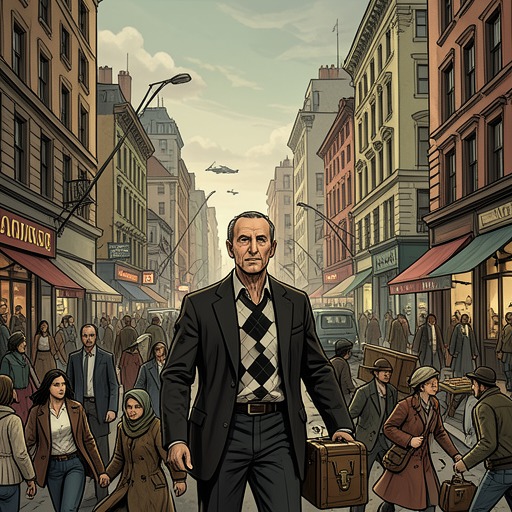
The Sailor first appears as a figure of unnerving stillness and appetite. In a cafe, he studies a shoeshine boy’s arm and remarks on the boy’s veins, then laughs in a way likened to an insect’s orienting call. His eyes are described as cold and predatory; even as he waits, his hunger remains visible. The boy’s question about friendship receives no reassuring answer. Instead, the Sailor’s attention moves to the prospect of a drug connection, and his quiet exchange with Fats Terminal takes precedence over the human encounter around it.
His appearance and movement repeatedly blur the distinction between a man and something parasitic. A grey felt hat and black overcoat frame him in a scene organized by waiting; elsewhere, his clothes give off the smell of mold, and his face shifts in and out of focus. These details do not establish a conventional biography. The text gives him no stable history, instead defining him through the recurring roles of addict, intermediary, and seeker of other people’s time.
Trade, Dependence, and Junk Time
The Sailor approaches Fats Terminal with a proposed delivery of twenty units and asks for an advance. Fats challenges him on whether the deal is “On spec?” The Sailor insists that he always delivers, describing the product as jellied consomme and minimizing the risk with the language of a small, manageable mishap. The negotiation makes clear that he operates inside a trade built on credit, confidence, and the promise of a future supply; the assurance is part of his business method, not proof that the risks have disappeared.
That commercial competence coexists with dependence. When he asks Fats for a tube, Fats tells him to take a walk and get one. The Sailor does so, using a pen and a lead tube in a surreal episode in which a black substance is released and consumed. He decides that the supply will last a month. The scene joins the dealer’s control of distribution to his own need for the drug: he can arrange a sale, but he is also governed by consumption and its demands.
The book describes an addict as living on “junk time,” with the body acting as a clock and drug need determining when time matters. The Sailor embodies this condition in his long waits as well as his abrupt intrusions into other people’s time. In a cafe he waits for a Reptile to acknowledge him; later, the narrative places him at a coffee cup, subject to the same uncertain schedules as other petitioners in the drug economy. His eventual attempt to obtain time from someone else thus grows out of a world in which waiting and need already rule his own existence.
Contacts and Conflicts
In a scene at the Plaza, the Sailor seeks a supply for Fats through a Reptile. He orders green syrup and waits an hour before the creature registers his presence. When he asks whether it has anything for Fats, another two hours pass before it raises three fingers. The exchange is nearly motionless, yet it shows the Sailor continuing to work his contacts through a slow, opaque chain of supply. His importance in that chain does not give him command over every link.
A separate drug encounter occurs when NG wakes after an episode involving a medical electrode and reaches for a loaded syringe. Lee is present. A slug emerges from Lee’s eye and writes on the wall that the Sailor is in the City buying up time. The warning connects the Sailor’s movements to the wider cast of agents and drug users, and gives his search a larger scope than an isolated deal. It also anticipates the explicit bargain he later makes with the boy.
The Time-for-Heroin Bargain
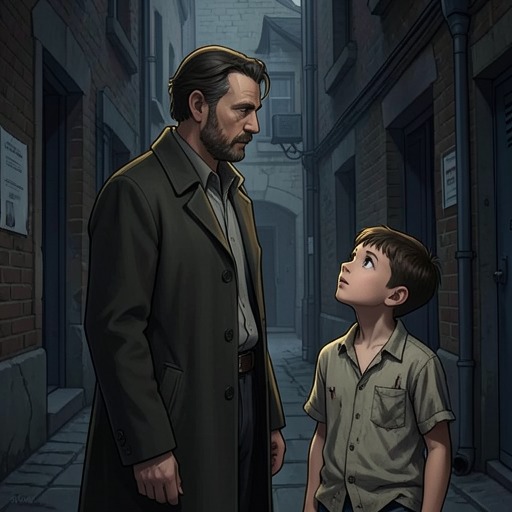
The Sailor’s clearest confrontation with a potential customer begins in a cafe. He tells a boy that his connection is broken, then identifies himself not as an agent but as a “vector.” When the boy asks whether he has drugs, the Sailor refuses the offer of money: he wants the boy’s time. The distinction establishes the terms on which he is operating. Heroin is the inducement; the intended payment is a portion of another person’s life.
He takes the boy to an empty room and presents a package of heroin, calling it pure and saying it is all the boy will have. When the boy asks what he wants in return, the Sailor answers, “Time.” He describes the exchange as five years apiece, “Right down the middle,” and frames it as a better deal than anything available on the street. The boy does not understand what the Sailor means, but the difference in their knowledge and power is evident: the Sailor sets the terms and controls access to the drug, while the boy is being asked to accept a cost he cannot comprehend.
The Sailor then gives the boy heroin by injection. The boy experiences the drug as an immediate, overwhelming rush and asks whether the Sailor is leaving. The Sailor rejects the possibility of simply returning to life as before: “Junk is a one-way street. No U-turn. You can't go back no more.” The line functions both as a warning about dependence and as pressure in the transaction. The bargain has moved beyond talk, but the text does not confirm that the boy understands, freely accepts, or completes the proposed five-year exchange.
Narrative Role and Significance
The Sailor’s episodes connect everyday mechanisms of the drug economy—advances, unreliable supply, waiting, and bodily need—to the book’s more fantastic transformations. His offer makes time a commodity in its most literal form, while the narration’s account of junk time supplies the larger pattern: the user’s present is measured by need, and other people become petitioners or resources within that schedule. The Sailor both suffers this ordering and reproduces it against someone more vulnerable.
The text ultimately groups him with The Vigilante, The Rube, Lee, A. J., Clem and Jody, Hassan O'Leary, The Exterminator, Andrew Keif, Fats Terminal, Doc Benway, and “Fingers” Schafer in a vision of figures occupying the same position in space-time and speaking the same words. The formulation unsettles the idea of a sealed, independent self; in its final image, recognition is associated with “The junky naked in sunlight.” The Sailor is therefore more than a recurring dealer: his time bargain makes dependence into an exchange between bodies, while his inclusion in the shared identity vision folds him into the book’s broader challenge to individual separation.