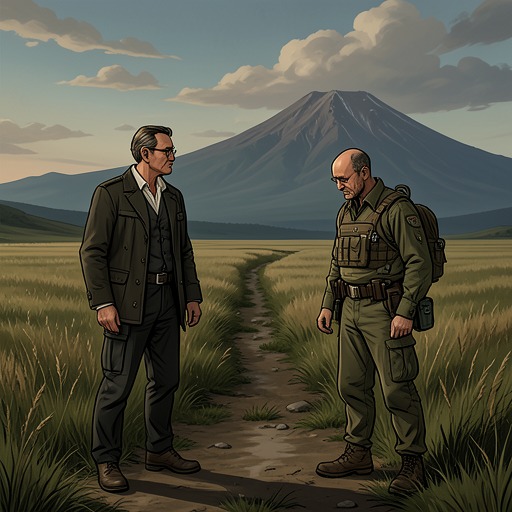
“To create, without sacrificing one’s senses for it”
Narcissus and Goldmund“To create, without sacrificing one’s senses for it” is Goldmund’s formulation of a life he longs to make possible: artistic creation joined to full sensual experience, rather than purchased at its expense. The expression stands at the center of his struggle with mortality, freedom, and the apparent opposition between living and making art.
The dilemma behind the expression
Goldmund sees two unsatisfactory alternatives. One is to live through the senses, drinking at what he calls the primitive mother’s breast: this offers great bliss, but no protection from death. Such a life resembles a forest mushroom, colorful one day and rotten the next. The other is to defend against transience by shutting oneself away for work and building a monument to passing life. That choice serves what endures, but makes the person a tool, drying up freedom, scope, and lust for life.
Master Niklaus embodies the cost of the second course in Goldmund’s reflection. The thought is not simply that art and pleasure occupy different spheres; it is that devotion to permanence can impoverish the very life from which art draws its substance. Conversely, unrestrained experience cannot by itself preserve what has been lived.
A hoped-for reconciliation
Goldmund insists that existence makes sense only if it can hold both possibilities together: to create without sacrificing the senses, and to live without renouncing the nobility of creation. He frames this as a question of whether such a union is impossible, then allows that some people may achieve it. He imagines faithful husbands and fathers who retain sensuality, and settled people whose hearts have not been dried by the loss of freedom and risk. Yet he has never met anyone who reconciles these conditions.
That admission leaves the expression as an aspiration rather than a settled doctrine. Its paired clauses give equal weight to making and living: neither art nor experience should be accepted as the price of destroying the other. The ideal matters precisely because Goldmund has not seen it realized.
Duality and the cost of choice
Goldmund places this conflict within a wider pattern of existence organized by contrast. He lists man and woman, wanderer and settled burgher, thinking and feeling, freedom and order, instinct and mind. In each pair, he believes, a person must pay for one condition through the loss of another; neither side is less desirable or important. The expression therefore answers a perceived structure of forced alternatives, not merely a practical problem of balancing work and pleasure.
His reflection on women sharpens the contrast. Nature, he suggests, makes desire bear fruit automatically in a child, so that the bliss of love becomes a form of fertility. For a man, eternal longing takes the place of that simple fruitfulness. Within this meditation, the wish to create without renouncing the senses seeks another kind of reconciliation: an artistic act that might give lasting form to experience without extinguishing the longing and vitality that produced it.