Art Against Death and Transience
Narcissus and GoldmundArt Against Death and Transience is the idea that artistic creation can preserve what ordinary life cannot: people change and disappear, but an image may endure. For Goldmund, art is not simply a record of beauty or a display of skill. It gives lasting form to transient experience and offers a way to reconcile the bodily, instinctive world with spiritual thought. Its promise is powerful but costly: creation requires materials, work, and a surrender of the freedom he once found in wandering.
The Image That Endures
Goldmund first grasps art’s resistance to transience while waiting for Master Niklaus to respond to his drawing. In the courtyard, he watches water fall into a stone basin, where its surface briefly holds the reflection of his changing face. The image leads him to consider how people, like the water, alter and pass away, while artist-created images remain. He imagines that the woman who inspired Niklaus’s Madonna may already have aged or died, and that Niklaus himself will also die, yet the statue will continue to stand in the quiet church, its expression unchanged.
This reflection makes fear of death a possible source not only of art but of intellectual work. People grieve over flowers wilting and leaves falling because they recognize their own transience in those losses. Artists and thinkers, Goldmund reasons, try to salvage something from that continual passing: one makes images, the other searches for laws and formulates thoughts. Art cannot stop the change that gives rise to it, but it can preserve a form beyond the life that first produced it.
The Madonna and the Vocation to Create
The idea becomes personal when Goldmund sees a wooden Madonna in a side chapel. A shaft of sunlight draws his attention to the figure: she inclines gently forward beneath a blue cloak, extending a delicate hand, her living expression combining a grieving mouth with a graceful forehead. Goldmund is moved by the statue’s beauty and by the sense that it embodies something he has long sought. He turns away several times, yet repeatedly finds himself drawn back to it.
The priest explains that the Madonna, donated to the cloister only a year earlier, was made by Master Niklaus and has provoked controversy. Some viewers consider it too worldly and modern to represent the Mother of God; Goldmund instead sees its beauty and spiritual life as evidence of exceptional artistic power. Learning that its maker lives in the bishop’s city, a day’s journey away, he asks eagerly about him. The encounter redirects Goldmund toward the craft: the statue is not merely an object to admire but a sign that he, too, may have a vocation as an artist.
At first, that vocation is uncertain and materially constrained. Niklaus tells Goldmund that guild apprentices ordinarily begin at thirteen or fourteen, serve for years, and have their apprenticeship paid for by their fathers. Goldmund is already a grown man, and neither the customary route nor a formal contract suits him. Yet Niklaus judges his drawing beautiful despite its faults and offers to let him learn in the workshop without obligation, free to leave whenever he chooses. The arrangement makes room for an unconventional artist while keeping the practical conditions of craft in view: tools and instruction matter, but so do guild rules and the artist’s freedom to refuse them.
Images Made from Memory and Relationship
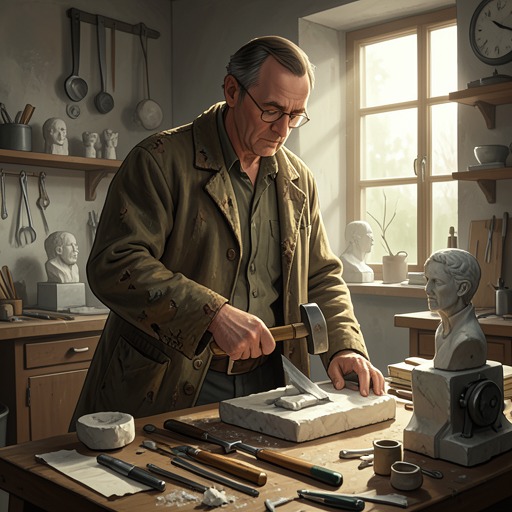
Goldmund’s understanding of art develops through practice, and his works gather meaning from particular relationships. During a year with Niklaus, he becomes a capable draftsman and is allowed to try modeling clay. His first successful piece is a figure of Julie, Lydia’s younger sister, which the master praises but considers too worldly to have cast in metal. Goldmund then begins a wooden statue portraying Narcissus as the Apostle John. The work turns a friend’s remembered character into a religious image, intended for a crucifixion group that Niklaus has been commissioned to make.
Goldmund approaches the Saint John differently from the distractions that repeatedly interrupt his work. Love affairs, dances, drinking, dice, and quarrels may keep him away from the workshop or leave him unable to work attentively. He returns to the statue in hours of readiness, with devotion and humility, and feels that its features emerge from the wood with increasing clarity. In that process he does not experience himself as imposing an image by force of will. He feels, rather, that Narcissus is using the artist’s hands to step beyond life’s continual changes and become visible in a lasting form.
That experience helps Goldmund distinguish genuine art from accomplished ornament. He believes that a true work comes about through a mysterious, sacred process, rather than through technical dexterity or an artist’s vanity. Niklaus’s Madonna exemplifies this achievement for him, while other finely made works can seem merely decorative if they lack an essential relation to the soul. The distinction does not mean that craftsmanship is irrelevant: Goldmund’s work depends on sustained learning, tools, and material effort. Rather, technique alone cannot guarantee that an image will feel alive or carry meaning beyond its finish.
The Mother Image and Art’s Double Nature
Goldmund’s most cherished artistic ambition is to give form to the mother image he carries within him. This image began in the memory of his own mother, but it has changed through encounters with women, including Lise, a gypsy woman, and Lydia. Each new experience contributes to its evolving features. The figure he hopes to create would not represent one specific woman; it would embody the source of life itself, the original mother, and express the intimate relation of ecstasy to pain and death.
For Goldmund, that vision reveals why art joins opposites. A work that is truly sublime has a double nature: it may begin in sensual experience and lead toward abstraction, or begin in an idea and end in the particularity of living flesh. He understands art as a union of the father and mother worlds, of mind and blood, instinct and spirituality. The imagined Eve-mother would embody this reconciliation more fully than any other statue he might make. Art does not erase the division in Goldmund’s nature; it makes that division newly visible and potentially fruitful.
The image also brings beauty and death into the same conception of life. Goldmund comes to understand the mother as the source of both bliss and mortality, giving birth and taking life in an unending cycle. Desire and grief, ecstasy and death, therefore belong to a shared pattern rather than separate realms. His artistic ideal is not a consoling image detached from loss, but one that can hold life’s beauty and its ending together.
The Cost and Social Conditions of Making Art
Goldmund’s devotion to art costs him something he deeply values: freedom. For more than three years he gives up the open-ended life of the wanderer for a roof, a workshop, tools, and the patience required by sustained work. At times he experiences this settled existence as a kind of slavery. His obedience is not primarily demanded by Niklaus or by material need; he submits because he believes the work itself requires the sacrifice. Art’s spiritual promise depends on ordinary necessities, including wood, clay, tools, time, and shelter.
The conflict also exposes the different expectations Goldmund and Niklaus bring to the workshop. Niklaus worries over Goldmund’s irregular attendance, indifference to money and ownership, love affairs, and quarrels. He nevertheless remains patient because he sees the Saint John taking shape and believes it will become a work beyond the abilities of his assistants. Their relationship thus joins artistic judgment to the compromises of professional life: Goldmund resists settled routines, while Niklaus must sustain a workshop and its livelihood even as he recognizes the exceptional quality of his pupil’s work.
After the Saint John is finished, Niklaus tries to secure Goldmund’s future in the guild. He persuades the guild to issue him a master’s diploma and proposes that he become an associate, sharing important commissions and their earnings rather than remaining a subordinate. He imagines enlarging the back workroom and giving Goldmund an attic room; Lisbeth is not opposed to the prospect of his settling down. Goldmund, however, leaves rather than accept a future organized around the workshop. The offer shows that his refusal is not simply a lack of opportunity: even a position that recognizes his talent and grants professional standing cannot overcome his attachment to wandering.
Art in Religious Space and the Dance of Death
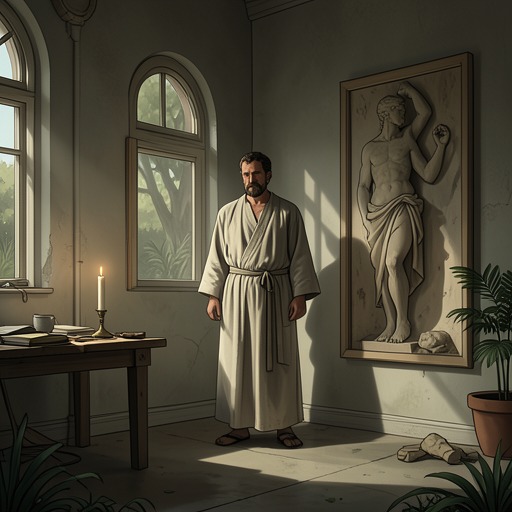
Later, after returning to the cloister, Goldmund begins preparing a work intended for a specific place and communal use. He chooses the unornamented raised niche in the refectory, where a young brother reads from the lives of the saints during meals. He proposes carved panels for the lectern steps and the lectern itself, with figures in half-relief and others nearly free-standing. Rather than make an isolated object, he wants the carving to belong to the architecture and daily religious life of the house.
His design gives the work a structure that joins the natural world to religious teaching. The oak-trunk stairs represent creation, with images of nature and the simple lives of the patriarchs and prophets; the upper parapet bears the four apostles. Goldmund plans for the evangelists to carry the features of Abbot Daniel, his successor Father Martin, and Master Niklaus. The lectern therefore makes artistic preservation communal as well as personal: the material object connects creation, sacred history, the cloister’s present leaders, and the artist’s own past.
The contrast with a dance-of-death fresco clarifies Goldmund’s distinctive response to mortality. The fresco shows Death leading people of every rank out of life, accompanied by skeleton musicians. Goldmund recognizes it as a forceful lesson in the inevitability of death, but feels it misses the experience he has known. To him, death is not only a stern judge or warrior; it also has a maternal, seductive aspect, a call that makes the remaining light of life seem more intense. The contrast is not between art and death, but between different ways of representing their relation. One image insists on the universal end; Goldmund seeks a form that also contains desire, tenderness, and the continuing force of life.
Across the Madonna, Saint John, and refectory project, art becomes Goldmund’s means of carrying change into durable form without denying that change. Its images preserve traces of loved and remembered people, enter the spaces where communities worship and learn, and transform an encounter with mortality into a visible composition. Yet the preservation is never effortless or complete: it depends on the artist’s labor and sacrifice, and the life it holds remains inseparable from its eventual passing.